Indonesia’s AI gap widens between casual use and business adoption
Indonesia is seeing widespread individual use of artificial intelligence, but far fewer companies have integrated AI into their business operations. Consumer adoption stands at 54 percent of the working population, compared with organizational adoption of about 14 percent, according to figures cited in an ACN Newswire report.
- 54 percent of Indonesia’s working population uses standalone generative AI.
- Microsoft’s organizational adoption figures are 14.1 percent and 14.8 percent.
- Indonesia’s active video commerce sellers grew 75 percent to 800,000.
- Language, dollar-based pricing and data rules limit workplace deployment.
- Sahabat-AI runs on infrastructure inside Indonesia.
A sharp divide between personal and workplace use
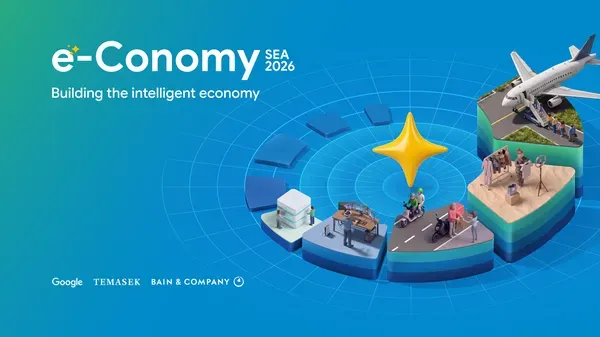
The e-Conomy SEA 2025 report from Google, Temasek and Bain & Company puts standalone generative AI use among Indonesia’s working population at 54 percent, below the six-country regional average of 58 percent. Thailand reached 63 percent, Vietnam 65 percent, Malaysia 68 percent and Singapore 70 percent.
Indonesia’s internet penetration is 81 percent, while 79 percent of Indonesian users have taught themselves to use AI tools. Veronica Utami, Google’s country director in Indonesia, said at the report launch that 80 percent of users interact with AI daily. She also said Indonesians generate 18 million images per day on the Nano Banana image feature alone.
Enterprise adoption is considerably lower. Microsoft’s tracking places AI use inside Indonesian organizations at 14.1 percent in one measurement period and 14.8 percent in the next. The source cautions that the surveys measure different populations, so the exact difference between 54 percent and 14 percent is an estimate. The direction is consistent: people use AI at home much more readily than companies rebuild their workflows around it.
Commerce is adopting AI-adjacent tools first
The strongest business activity has appeared on the selling floor rather than in traditional office operations. Video commerce in Indonesia increased its active seller count by 75 percent year on year to 800,000 sellers, while transaction volume rose 90 percent to 2.6 billion transactions.
These businesses increasingly use recommendation feeds, AI-dubbed product videos and automated customer replies. Claude’s usage tracking shows penetration of 23 percent in Indonesian computer and math occupations and 25 percent in education. Lazada reports that 31 percent of its Indonesian sellers use its AI sales assistant. Those figures sit above the organizational adoption rate but well below consumer usage.
The report describes a food business in Jakarta that manages orders, supplier invoices, staff receipts and other work through WhatsApp. A chatbot can answer customers faster, but the more difficult tasks involve matching invoices to orders, chasing payments and filing records. That gap between conversational AI and operational AI is where many companies remain stuck.
Language, cost and regulation shape the next step
The source identifies three barriers to wider business deployment. Global models may handle English well but struggle with the Javanese and Sundanese used in everyday commerce. Subscription costs are also billed in US dollars, typically 20 to 30 dollars per user per month, creating a significant expense for Indonesian small and medium-sized businesses.
Data protection adds another layer of work. Indonesia’s Personal Data Protection Law, UU PDP 27/2022, took full effect in October 2024. Its implementing regulation, GR 33/2026, requires processing registers, impact assessments for higher-risk processing and respect for objections to automated decisions. Cross-border transfers of personal data require a legal basis, and remote access from outside Indonesia counts as a transfer.
One option is to restrict global tools to internal English-language tasks, drafting, summarizing, coding and analysis of non-personal data. The source also describes a sovereign-hosted route involving Sahabat-AI, the model family built by GoTo and Indosat Ooredoo Hutchison, running on Lintasarta’s GPU Merdeka infrastructure inside Indonesia. For users and companies, the choice is therefore less about whether AI is popular and more about whether it can fit local languages, budgets and compliance requirements.
ACN Newswire: Artificial Intelligence: Indonesia's AI gap: 54 percent use it, 14 percent work with it