insitro and Lilly Bring In Vivo Drug Property Prediction Models to TuneLab
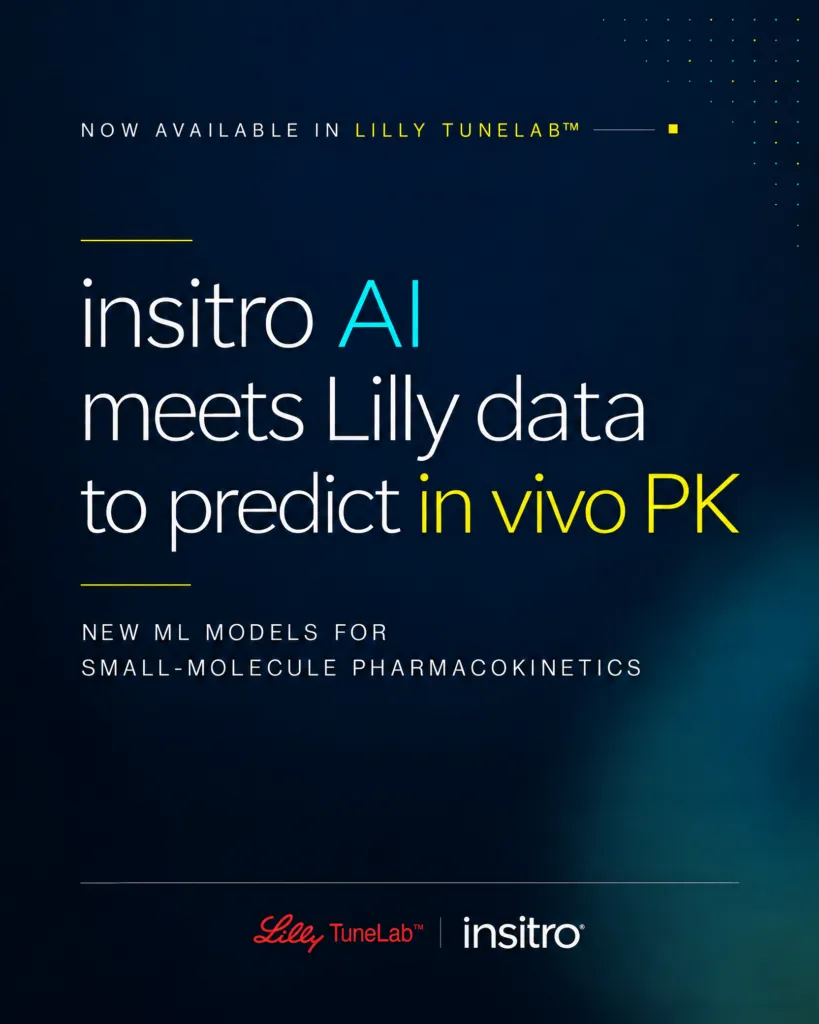
Machine learning models that insitro built with Eli Lilly to predict in vitro and in vivo properties of small molecules are now available to certain biotech companies through Lilly TuneLab. According to insitro, the models were trained on decades of Lilly preclinical data from hundreds of thousands of unique molecules.
- insitro and Lilly's ML models for predicting in vitro and in vivo small molecule properties are now available to certain biotechs in Lilly TuneLab.
- The models were trained on multi-species preclinical data from hundreds of thousands of unique molecules generated by Lilly over decades.
- insitro says they offer an alternative to extrapolating from in vitro assays, and they will be updated as the dataset grows.
- The models are a component of insitro's TherML platform and will also be used in its own and partners' discovery work.
- TuneLab runs on a federated learning infrastructure hosted by a third-party provider.
What the models do and how they were built
insitro, which describes itself as an AI company focused on causal human biology, said the models predict both in vitro and, as it put it, "critically, in vivo" properties of small molecules. They were trained on multi-species preclinical data that Lilly generated over decades of research, covering hundreds of thousands of unique molecules.
According to insitro, the models offer an alternative to the current industry standard, which relies on extrapolating from in vitro assays. The company says this gives smaller organizations an enterprise-grade capability that has traditionally been available only to those with the scale to generate such data themselves. The models will be updated as the dataset continues to expand.
The work stems from a collaboration announced in September 2025. It paired insitro's computational and AI/ML expertise with Lilly's proprietary dataset of in vitro and in vivo measurements. The compounds in that dataset have established ADMET (Absorption, Distribution, Metabolism, Excretion, and Toxicity) properties. insitro calls it a world-class dataset in quality, consistency and scale.
Why pharmacokinetic prediction matters
Daphne Koller, founder and CEO of insitro, pointed to the high failure rate in drug development. "Nine in 10 programs that enter the clinic fail, most often when we first test for efficacy," she said. Failures happen when the mechanism did not drive the disease, but also when the molecule never reaches the tissue at the right concentration for the right duration.
In her words, a molecule's in vivo behavior has been "an empirical question, answered experimentally, slowly, one compound at a time." The new models, she said, "make it a computational question first."
insitro argues that better prediction at the design stage may mean fewer candidates advance on flawed structures and promising molecules reach the clinic on shorter timelines. The company also says improved in silico prediction supports reduced reliance on animal studies, which it links to the goals of the FDA's April 2025 Roadmap to Reducing Animal Testing in Preclinical Safety Studies and its March 2026 draft guidance on new approach methodologies.
Role of Lilly TuneLab and the TherML platform
Aliza Apple, Vice President of Catalyze 360 AI/ML and Global Head of Lilly TuneLab, said the models let teams apply signals that have historically only been available later in development, from in vivo studies, at the virtual screening stage, "before a molecule is even synthesized." She said TuneLab was built on the premise that learnings from drug discovery data could be used as a collective rather than being under-utilized behind a single company's walls. For member companies, she said, the practical effect is a shift toward insights that can inform early decision making and where scarce resources should go.
Lilly TuneLab is part of Lilly Catalyze360, alongside Lilly Ventures, Lilly Gateway Labs and Lilly ExploR&D. These programs support biotech innovation through strategic capital, lab space and technology, and research and development capabilities. The platform is built on a federated learning infrastructure and hosted by a third-party provider.
For insitro, the in vivo PK models are a component of its TherML platform for small molecule discovery. That platform also includes machine learning and physics-based in silico screening, affinity models powered by proprietary adaptive DNA-encoded libraries (generating data up to 1B compound scale), and an active-learning medicinal chemistry design engine. insitro and its partners will also use the models to advance discovery of first-in-class medicines.
What it means for biotech teams
The release gives certain biotech companies in TuneLab access to models drawn from a dataset that few organizations could assemble alone. If the approach works as described, early-stage teams could screen candidates for in vivo behavior before synthesis and direct limited resources accordingly. The source does not give performance figures for the models, and access is limited to certain biotech companies rather than the industry at large.