Intel Details Crescent Island GPU With 480 GB Memory and New Xeon Racks at OCP

Intel has released new technical details on its Intel GPU D-series, formerly code-named Crescent Island, and showed new Xeon-based rack designs at the Open Compute Project (OCP) Global Summit. The company says the hardware is meant to support open, heterogeneous infrastructure for agentic AI and inference at scale.
- Intel GPU D-series (Crescent Island) offers up to 480 GB LPDDR5X, 1.5 TB/s bandwidth and 1.3 petaflops FP8 in a 350-watt envelope.
- It supports models up to 300 billion parameters on one card and over one trillion in an eight-GPU system, according to Intel.
- Select Xeon 6+ rack configurations scale beyond 46,000 cores at 133.45 kW total rack power.
- The GPU uses a PCIe, air-cooled design, and customer sampling is underway.
- Intel cites 116 OCP contributions since 2011 and a new Open Adapter Card form factor effort.
Intel GPU D-series: memory-heavy inference in a standard card
According to Intel, the Intel GPU D-series is designed to improve the economics of sustained, memory-intensive AI inference. It is built on the company's Xe3P architecture and combines up to 480 GB of LPDDR5X memory, 1.5 TB/s of memory bandwidth and 1.3 petaflops of FP8 compute within a 350-watt power envelope.
Intel says the GPU targets large language models, long-context workloads and concurrent inference services. It supports models with up to 300 billion parameters on a single card and more than one trillion parameters in an eight-GPU system. Target applications range from multi-tenant AI services to robotics and other latency-sensitive workloads.
The card uses a standard PCIe form factor and an air-cooled design, with a common Xe software foundation. Intel says this is meant to simplify deployment in existing data centers, so customers can scale inference without specialized rack or cooling infrastructure. Customer sampling is underway.
Anil Nanduri, vice president, AI Products & GTM at Intel Data Center Group, said: "With Intel GPU D-series, we're focused on making high-capacity inference practical to deploy and economical to scale."
Xeon-based racks for agentic workloads
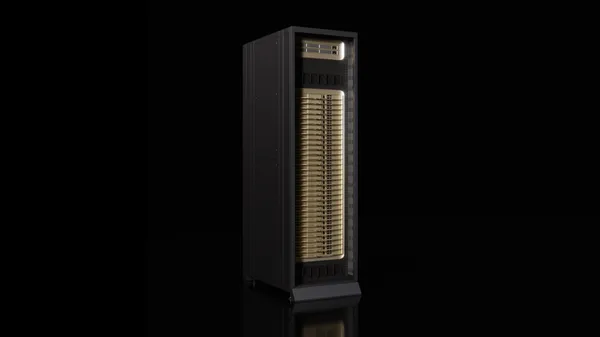
Intel also showcased new Xeon-based rack designs developed with ecosystem partners. Many use the Open Compute Project's Open Rack v3 (ORv3) standard to ease deployment and integration in open data center infrastructure.
The company argues that agentic AI turns inference into a multi-step workflow spanning retrieval, reasoning, orchestration, tool use and execution, with x86 CPUs playing a central role. These workflows place greater demands on general-purpose compute, which orchestrates workloads, processes data, manages I/O and executes tasks that keep accelerators productive.
According to Intel, select Xeon 6+ configurations scale beyond 46,000 cores per rack at 133.45 kW total rack power. Intel also says performance is increasingly measured by the number of concurrent agents a rack can sustain at target latency.
Open software and the Open Adapter Card effort
Intel's software strategy centers on native upstream integration with industry-standard AI frameworks, inference runtimes and deployment environments across CPUs and GPUs. The company lists several capabilities:
- Portability: the common Xe foundation lets developers reuse existing applications across Intel GPU platforms.
- Open frameworks: Intel supports widely used AI frameworks, serving engines and development tools, plus performance libraries to optimize inference throughput.
- Day 0 model support: Intel says it is working to support new open models on Intel GPU D-series and Xeon as they appear, including Day 0 support for Meta's Muse Glimmer.
- Agent tooling: the Intel AI for Enterprise Agent Toolkit is optimized and deployable on Xeon today, and its provider-based architecture is designed to extend to Intel GPUs.
On the hardware standards side, Intel says it has made 116 contributions to the Open Compute Project since 2011. This year it is showing its contribution to the Open Adapter Card workgroup, which defines a standardized sub-rack accelerator card form factor. The goal is better mechanical, electrical and management interoperability, giving system builders and cloud providers a more consistent way to integrate accelerators.
What it means for enterprises
Intel frames the announcements around cost and flexibility. Nicolas Dubé, corporate vice president, Data Center Systems and Solutions Group, said organizations need infrastructure that matches workloads with "the right intelligence, right compute resources and right economics," which he summarized as "put every prompt in its place."
Intel says it is working with OEMs, ODMs, neoclouds, independent software vendors, appliance providers and AI-native companies on validated platforms and deployment-ready solutions. The stated aim is to help customers move faster from model evaluation to production.
For buyers, the company's pitch is the freedom to evolve AI systems without starting over: building on existing investments, adding new compute as workloads change, and keeping choice over how infrastructure develops. The source does not give pricing or availability dates beyond the note that customer sampling of the GPU is underway.