Intento Benchmark Tests 229 AI Translation Solutions Across 100 Languages
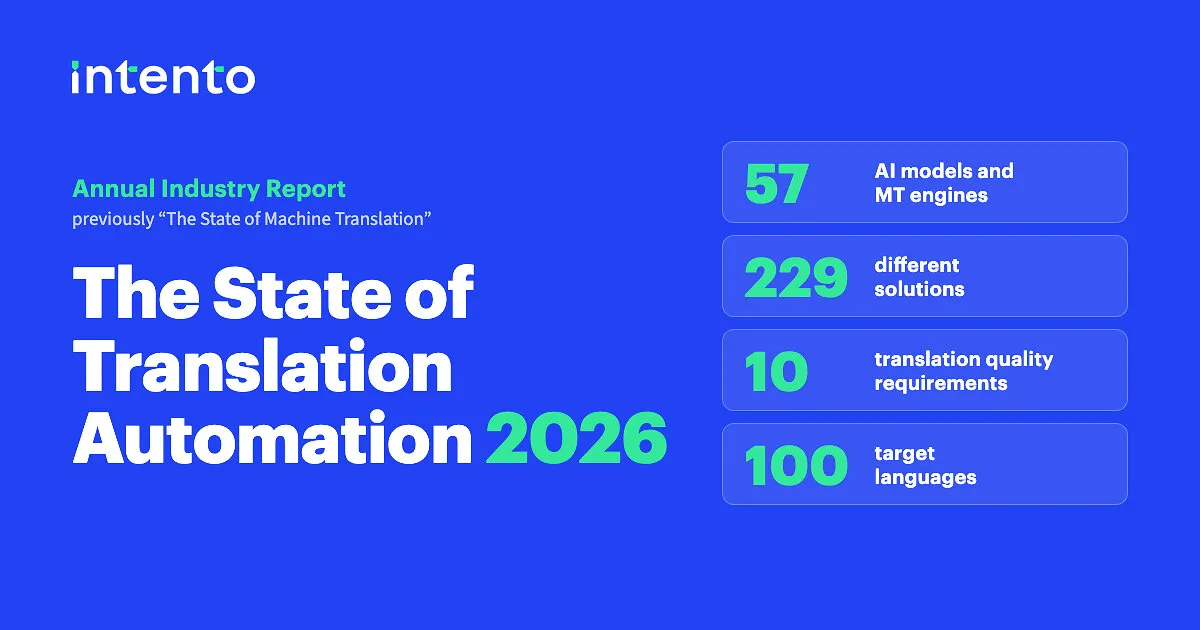
Intento has published The State of Translation Automation 2026, an interactive report that compares 229 AI translation solutions across 100 languages on quality, cost and translation time. According to the company, the findings show that quality depends heavily on the language, the requirements and the workflow built around the model.
- Intento evaluated 229 solutions built from 57 AI models and MT engines, translating from English into 100 languages.
- 54 languages have a one-step solution plus qualifying backup for Basic quality, falling to 38 for Standard and 12 for Advanced.
- Among LLM solutions that initially fall short, 24% meet the general quality requirement after post-editing and 60% after quality assessment and repair.
- None of the real-time one-step solutions assessed in 84 languages meets every Standard requirement.
- The report is free to read without registration, with costs based on August 2026 list prices.
What the report covers
The report lets readers pick their translation requirements, a target language and what to optimize for: quality, cost or translation time. It then shows which solutions meet those requirements in that language and how they compare. It is open to read without registration.
Language engineers at Intento evaluated 229 solutions built from 57 AI models and machine translation (MT) engines, translating from English into 100 languages. The 57 models come from 37 vendors, including Alibaba, Amazon, Anthropic, Cohere, DeepL, DeepSeek, Google, Microsoft, Mistral, OpenAI, Tencent and xAI. They include neural machine translation models, MT systems based on large language models (LLMs), and commercial and open-weight LLMs.
Each solution combines a model with a harness: prompts, glossaries and other context, and pre- and post-processing. The team tested off-the-shelf models and models adjusted with glossaries, tone of voice instructions and tag handling. It also tested two-step solutions that translate and then post-edit with an LLM, three-step solutions that translate, assess quality and repair errors, and multi-agent systems for advanced requirements.
Three quality levels and how the tests worked
The team assessed 10 requirements across three levels of translation quality:
- Basic: general translation quality.
- Standard: Basic plus terminology, tone of voice and six formatting requirements, such as tag handling, valid JSON and Unicode support.
- Advanced: Standard plus gender neutrality.
For each language, the team started with an off-the-shelf model and added steps only when a simpler solution could not meet the requirements. Intento says this is the same approach it uses for clients.
Between June and September 2026, the engineers translated four English business texts totaling 2,978 words: an editorial article, a legal privacy notice, an institutional mission statement and planning guide, and a travel-safety alert. Two automated quality-estimation metrics shortlisted 10 to 13 solutions per language. Intento LQA then assessed those translations. Three LLM judges from three vendors identified errors by type and severity, and a fourth LLM combined their anonymized findings. A result was accepted only where the three judges agreed on at least 90% of sentences. The six formatting requirements were checked in code. Costs use August 2026 list prices in US dollars per million characters of the English source.
Key findings: stricter requirements cut the options
More demanding requirements leave fewer languages with a one-step solution plus a qualifying backup. For Basic quality, 54 of the 100 languages have this combination. The number falls to 38 languages for Standard quality and 12 for Advanced quality. The backup may require additional steps. In 18 languages, automated checks are not reliable enough to assess every requirement.
Extra steps help LLM solutions meet the general translation quality requirement. Among evaluated LLM solutions that initially fall short, 24% meet it after translation and post-editing, and 60% after translation, quality assessment and repair.
Speed carries a cost in quality. None of the real-time one-step solutions assessed in 84 languages meets every Standard requirement. Across the 38 languages where a one-step solution does meet those requirements, the fastest qualifying solution takes a median of about 65 seconds per 1,000 source words.
What it means for translation buyers
Konstantin Savenkov, CEO and co-founder of Intento, said automating translation "used to mean choosing the 'less wrong' machine translation model for your content and language pair." He added that it now means building a harness around the models that meets your requirements, and that this is not possible "without evaluations that check each requirement."
For companies, the report suggests that picking a single best model is not enough. The right setup varies by language and by how strict the requirements are, and the results show where extra steps or fallbacks are needed. Intento notes that the same language engineers configure AI workflows for more than 60 enterprise customers across hundreds of language pairs. The company sells translation automation, so readers should keep in mind that the benchmark comes from a vendor in this market.