ITU's AI for Good programme at India Mobile Congress draws 200 hackathon teams
The International Telecommunication Union ran a five-event AI for Good programme at India Mobile Congress 2026 in New Delhi from 8 to 10 October, covering national AI capacity, agri-food innovation, youth robotics and AI agents for 5G networks. According to ITU, the events brought together young innovators, researchers, policymakers and international organisations.
- ITU held five AI for Good events at India Mobile Congress 2026 in New Delhi from 8 to 10 October.
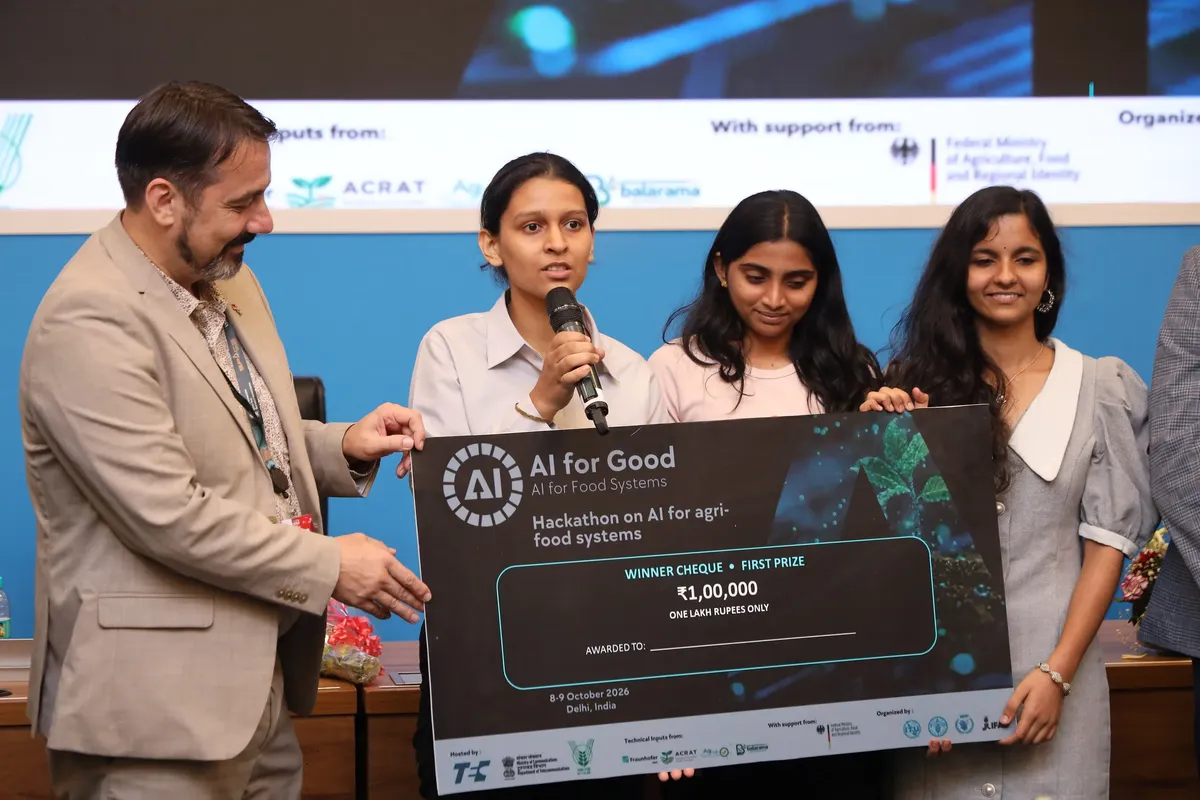
- The agri-food hackathon drew 200 teams and over 500 participants; KrishiNex of India won first place.
- India is one of ten pilot countries of the AI for Good Lab, which has three pillars: readiness and policy, skills, and public AI infrastructure.
- The Robotics for Good Youth Challenge India had 57 teams; the two winning teams go to the Geneva Grand Finale in June 2027.
- Build-a-thon 5.0 was won by netaxis from RVCE Bangalore, with winners possibly featuring at the 2027 Summit.
Building national AI capacity through the AI for Good Lab
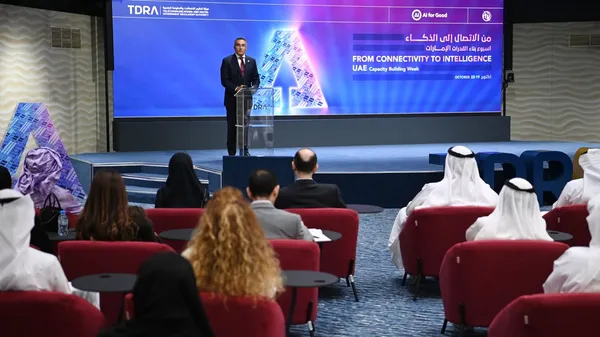
On 9 October, the workshop "From strategy to impact: Accelerating national AI capacity through the AI for Good Lab" looked at how countries can move from readiness assessments and strategies towards locally relevant applications. It was organised jointly by ITU and India's Department of Telecommunications (DOT) and inaugurated by Communications Minister Jyotiraditya M. Scindia.
India is one of the Lab's ten pilot countries. The Lab rests on three pillars: AI Readiness and Policy, AI Skills Development, and Public AI Infrastructure. According to ITU, these support policy assessment, national talent development and environments for testing, validating and reusing AI solutions.
Discussions covered institutional engagement, priority sectors and knowledge-sharing across the Global South. Participants also explored AI Sandbox requirements, including how to assess fairness, robustness and safety before expanding deployment.
Agri-food hackathon and international meeting
The Hackathon on AI for Agri-Food Systems took place on 8 and 9 October at the ICAR campus. It drew 200 teams and over 500 participants, who worked on solutions across agriculture, food production and value chains. Held under the Global Initiative on AI for Agri-Food Systems, it encouraged interoperable, scalable approaches using the Initiative's Open Reference Architecture.
- First place: Team KrishiNex from India, for work on Maximum Residue Limits in farm production.
- Second place: Team NutriEdge from India, focused on crop health and nutrition.
- Third place: Team UniferX from Germany, for abiotic stress and biostimulants.
- Jury Prize: Two Skys from Ethiopia.
ITU noted that further development is needed to turn the competition solutions into use in the field.
On 10 October, the Initiative held its second meeting at the Congress, with around 70 delegates in person and 25 online. It was jointly hosted by the Telecommunication Engineering Centre (TEC), DoT and ICAR. The Initiative is coordinated by ITU in close collaboration with FAO, IFAD and WFP. Discussions explored how connected sensors, weather information, drones, satellite systems and AI analytics could support agricultural decision-making and resource management.
Youth robotics and AI agents for 5G
The Robotics for Good Youth Challenge India, held on 10 October, brought together 57 teams and around 300 students and mentors from 14 states. Organised by ITU and DoT with support from IIT Delhi's I-Hub Foundation for Cobotics, it challenged students aged 10 to 18 to design, build and programme autonomous robots for public health emergency response. Tasks included sample delivery, medical-kit distribution, quarantine-zone construction and triage.
Team Singularity from Gopalan International School, Karnataka, won the junior category. Team Ferrum Incubators from Cambridge School, Noida, Uttar Pradesh, won the senior category. Both will represent India at the Grand Finale during the AI for Good Global Summit in Geneva in June 2027.
Also on 10 October, Build-a-thon 5.0, "Creating innovative agents in 5G", asked students, researchers and professionals to build solutions for network troubleshooting and resource optimisation using the ITU AI for Good Sandbox. Participants developed country-specific knowledge bases and AI agents grounded in relevant policies, standards and regulations.
netaxis from RVCE Bangalore won first place, followed by teamSNR, also from RVCE Bangalore, and agentnet from GITAM. The Women's Prize was shared by orbitflow from SNU Chennai and handshake protocol, while nethealers and Callmatic received Judges' Prizes. Winning solutions have an opportunity to feature in the 2027 Summit's live multi-country error exercise.
What comes next
ITU says the programme linked learning, experimentation and cooperation across sectors, giving participants chances to develop ideas and build relationships for further work. The robotics winners will take their next step at the AI for Good Global Summit, scheduled for 21 to 24 June 2027 in Geneva. For the agri-food entries, the stated aim is to identify ideas with potential for further development, piloting and replication.
ITU AI for Good: India Mobile Congress 2026: Connecting AI innovation, skills and real-world impact