Kilo Code: Security Is Now the Multiplier in the LLM Buying Equation
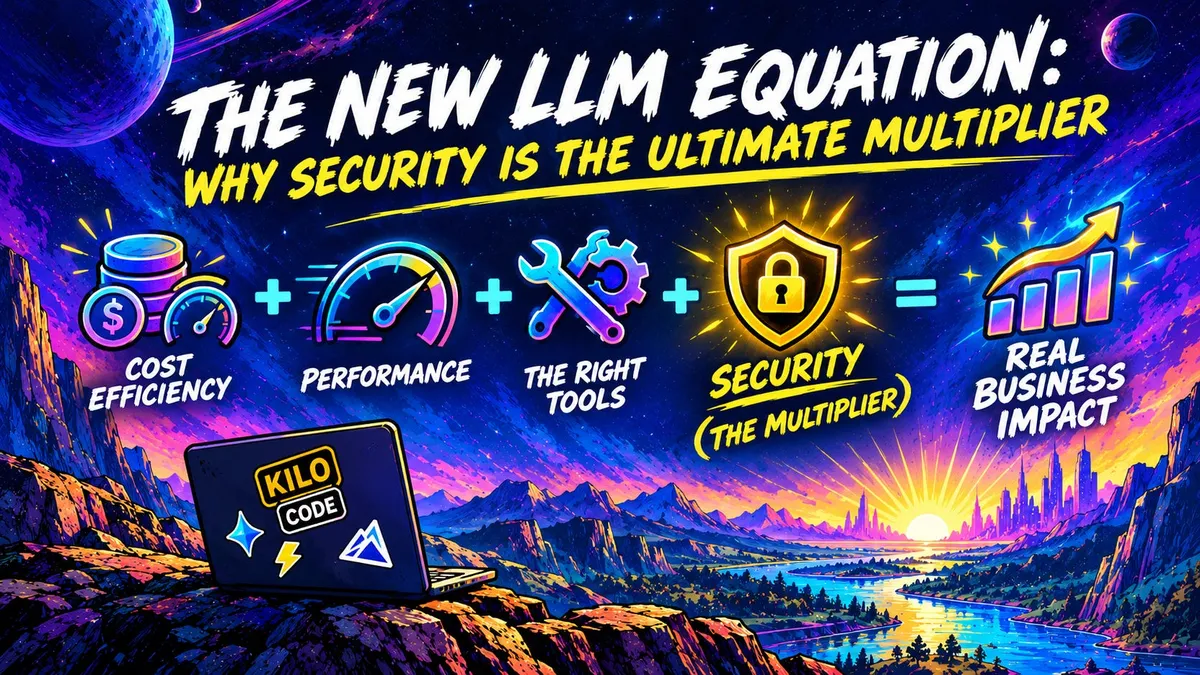
Kilo Code argues that enterprise model selection should no longer be judged on cost, performance and efficiency alone, because security now multiplies all three. In a blog post by Ari Messer, the company points to this week's releases from Google, OpenAI and Anthropic as evidence that the frontier labs are putting safety ahead of speed.
- Kilo Code says model selection should now be (Cost + Performance + Efficiency) × Security.
- Google is rolling out Gemini 4 Argon in phases while it improves safeguards, according to Kilo.
- OpenAI skipped GPT-6.1 Astra and shipped GPT-6.1 Sol at DevDay in San Francisco.
- Claude Sonnet 5.5 is priced at $2 / $10 per million tokens and is over 30% faster than Sonnet 5, per Kilo.
- Enkrypt AI risk scores are now shown in the Kilo Leaderboard.
A new equation for choosing models
According to Kilo Code, the enterprise AI conversation for most of this year ran on a three-part equation: Cost + Performance + Efficiency. Teams tracked tokens per second, context window sizes and the dollar cost per million tokens. The company says that equation is now obsolete and should read (Cost + Performance + Efficiency) × Security.
The reasoning is that a fast, cheap model is worth little to an enterprise if it leaks data, writes vulnerable code or behaves unpredictably when it runs unsupervised. Kilo says the scale makes the issue urgent: Kilo by Anaconda orchestrates trillions of tokens a month for more than 5 million developers, and each token passes through a model someone had to choose and trust.
Google and OpenAI hold back
Kilo says Google chose a gradual, phased rollout of Gemini 4 Argon instead of a global general availability launch, because of safety and security concerns. Google has used the model extensively internally and noted it is especially strong at memory efficiency and large-scale codebase migrations and optimizations. It is still working to improve a number of "critical frontier safeguards" before a general release. Kilo cites a WSJ report on the gradual rollout and reads it as a sign that managing deployment risk now outranks winning the news cycle.
The post also says Gemini 3.8 Flash outranks GPT-5.5 and Kimi K3 on KiloBench and has become a daily driver for many Kilo Coders.
OpenAI went further, according to the post. The industry expected GPT-6.1 Astra at DevDay in San Francisco, but OpenAI chose not to release it, citing a range of safety concerns. It then shipped GPT-6.1 Sol at the same event. Kilo says the new model has already proven to be aligned and guardrailed, balancing performance with stricter safety guarantees. The author reads the message as "raw capability that can't be secured won't ship", but adds that the coming months will show whether this is consistent or a one-time blip.
Anthropic's Claude Sonnet 5.5
Anthropic launched Claude Sonnet 5.5 this week, shortly after Opus 5.5. Kilo describes it as Anthropic's most efficient model yet. It is priced at $2 / $10 per million tokens and, compared with Sonnet 5, runs over 30% faster and cuts per-task costs by up to 30% for most work.
On safety, the post quotes Anthropic as saying Sonnet 5.5 "scores better than Sonnet 5 across our alignment evaluations" and has "new, stronger safeguards to match its jump in capability". Higher-risk cybersecurity requests now return an immediate refusal. Kilo adds that GPT-6 Astra and Opus 5.5, rather than the new Sonnet, have recently ranked high on its Code Review leaderboard, along with GLM 5.3 Flash.
The open-weight dilemma and Kilo's answer
Kilo says open-weight models are accelerating while posing a different security question. In its internal benchmarks, MiMo v2.6 Pro and GLM 5.3 show state-of-the-art results in autonomous code review, vulnerability detection and secure code generation. Enterprise teams still ask how the models were trained, what is in the weights and where requests are served.
The post notes that Anthropic has compared GLM-5.3 to Fable on cybersecurity capabilities, finding that "GLM-5.3's lax safeguards significantly increase the cyber capabilities available to malicious actors."
Kilo positions its enterprise offering as a response. It lists several levels of security controls, no data retention on paid plans, subprocessors, encryption and access controls, incident response, DPA support and a live Trust Center. It also recommends Enkrypt AI, a security and governance platform that provides inline Sentry guardrails, automated red-teaming and workspace compliance monitoring. Enkrypt's risk scores are now available in the Kilo Leaderboard.
What it means for builders
For teams choosing models, the post's takeaway is that benchmark speed and price are no longer enough on their own. Release decisions from the major labs this week, as Kilo describes them, show safeguards shaping what ships and when. Teams using open-weight models are advised to weigh provenance and serving location alongside capability. As a vendor of tools in this space, Kilo has its own interest in this framing, and the benchmark claims in the post come from its own internal testing.
Kilo Code: The New LLM Equation: Why Security Is the Ultimate Multiplier