LangChain brings asynchronous background workers to Deep Agents
LangChain has introduced async subagents for Deep Agents, separating user-facing coordination from background work on long-running tasks. The company says the architecture is designed to help agents stay responsive while progressing on multiple tasks in parallel.
- LangChain introduced async subagents for Deep Agents.
- An orchestrator remains available while background workers handle long tasks.
- Five tools start, monitor, update, cancel and list async tasks.
- The feature is available in Deep Agents for Python and JavaScript.
- Task notifications are in beta and the API may change.
An orchestrator stays available while tasks run
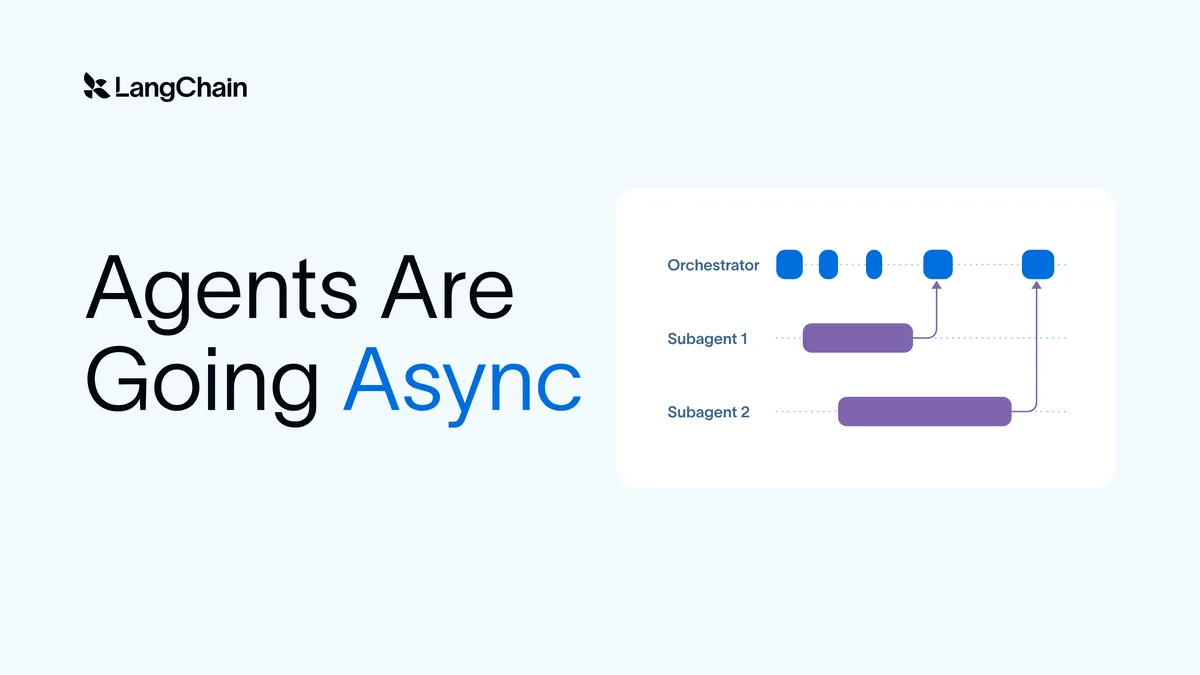
In LangChain's design, an orchestrator remains available to the user and keeps the conversation's context organized. Async subagents act as background workers, taking on delegated tasks and reporting their results to the orchestrator when they finish.
The approach addresses a limitation in the standard ReAct loop, where a long tool call blocks the loop and other tasks wait behind it. With async subagents, the call returns immediately while the work continues independently. LangChain compares this behavior with starting a task using asyncio.create_task or a Promise that is not awaited immediately.
The company says an agent's capacity can grow with the number of background workers rather than the length of a single loop. The orchestrator can start work as tasks arrive instead of waiting for a complete batch to return.
Five tools manage background work
Deep Agents uses five tools to manage async subagents. start_async_task starts a subagent on its own thread and returns immediately, while check_async_task retrieves a task's status and result after completion. update_async_task sends new instructions to a running task, cancel_async_task stops one, and list_async_tasks shows every task and its status.
Follow-up instructions can either interrupt a running task or wait until it finishes. The default interrupt strategy stops the current run and restarts it with the new instruction. The enqueue strategy holds the follow-up until the current run is complete.
Tasks can report back automatically, or the orchestrator can poll for updates. If the orchestrator is busy, it checks unfinished tasks before each model call. If it is idle, a subagent can wake it with a new run. When approval is required, the approval remains in place while the result arrives after the user responds. In Managed Deep Agents on Slack, the request posts back to the original thread.
Available in Python, JavaScript and Managed Deep Agents
LangChain says async subagents are available in Deep Agents for Python and JavaScript, as well as in Managed Deep Agents. In the provided example, developers add an async field to a subagent definition to run a research assistant in the background using openai:gpt-5.5.
In Managed Deep Agents, every served agent also receives an async copy of the general-purpose subagent. This allows it to decide at runtime whether delegated work should run in the foreground or background. Task notifications are currently in beta, so LangChain says the API may still change.
LangChain expects the same pattern to extend beyond subagents to tools more broadly. The company points to OpenAI's support for async tool calling, where a model continues working after calling a tool and the application sends the result in a later request. For developers building agents around long tasks, the release provides a way to keep the user-facing conversation active while delegated work continues.
LangChain: Agents Are Going Async