LangChain Open-Sources Content Studio, Its Slack-Based Design Agent
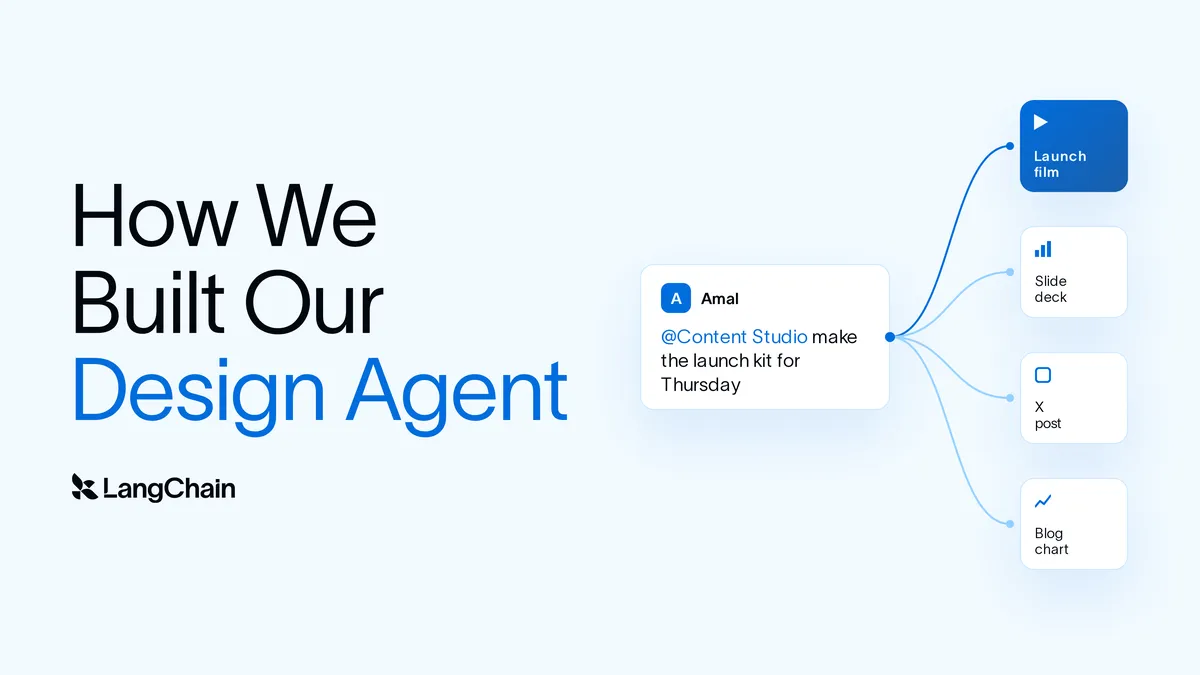
LangChain has open-sourced Content Studio, the design agent it built in-house to create videos, social graphics, slide decks and other assets from a single prompt in Slack. The company says the agent has delivered over 3,000 assets and that three in four requests now come from outside marketing.
- LangChain open-sourced Content Studio, a Slack design agent that makes videos, graphics and decks from one prompt.
- According to LangChain, it has delivered over 3,000 assets, and three in four requests come from outside marketing.
- Median request cost fell to about 50 cents from about $8 in mid-September.
- The team taught the agent design principles, guardrails against AI slop and the reasoning behind designer feedback.
- Teams can fork the repo, add brand tokens, fonts and skills, and deploy via Managed Deep Agents.
Why LangChain built a design agent
According to LangChain, the company runs constant product launch campaigns, webinars, blogs and events, and each one needs assets such as blog headers, diagrams, decks, videos and ad creatives. Its design team was stretched thin, with repetitive requests crowding out more strategic work.
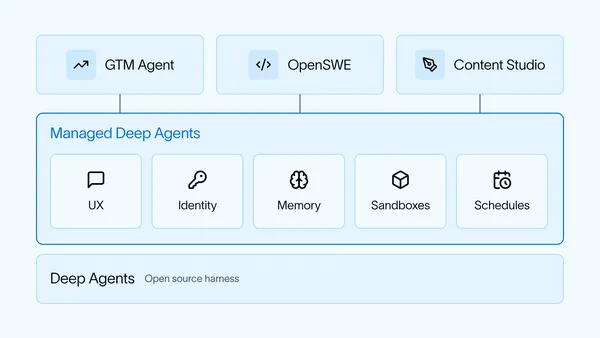
The answer was Content Studio, an agent that lives in Slack. A team member describes what they want and attaches content or briefs, and the agent returns finished, on-brand files. Every asset it produces is written in code. LangChain says it was built entirely in-house on Managed Deep Agents, which supplied a managed LangSmith Sandbox, Slack integration, managed tools, scoped agent memory and scheduled agent runs.
The team says it needed three things: its designers' judgment written into the agent's skills and checks, a custom environment including a video editing computer with tools for every layer of design work, and a user experience that lets a whole team collaborate on a project running for hours from one Slack thread.
Teaching the agent taste
LangChain argues that the underlying model was already good at execution, including HTML and CSS, chart specs and animation timelines. What it lacked was the company's context, so it reached for familiar patterns, which the post links to what Anthropic calls “distributional convergence”. The result could look polished and still resemble a hundred other designs.
The team cites Katie Dill, Head of Design at Stripe, who warns of “zombie UI” and says a point of view is needed because “if you don’t, AI will give it for you.” LangChain's conclusion is that AI is not bad at design, but has no point of view unless one is provided.
The guidelines started with color tokens, font weights, spacing and alignment. The team then added design principles, such as one focal point per frame, guardrails against common AI design patterns, and the reasoning behind each piece of designer feedback. In one comparison, a local coding agent with the company's brand skill missed the correct logo lockup, text alignment and primary versus secondary colors. Content Studio, given the same prompt, produced an on-brand image, according to LangChain.
One early motion graphic showed a bird with a trailing ribbon of light. The first pass to “no sharp edges” came back clunky. In a later iteration the agent built its own frame-by-frame check to confirm the ribbon stayed attached to the bird's tail. Measurable problems, such as default capitalization, are now caught by an automated check. For subjective calls, the reasoning is captured in a skill for future drafts.
Results and how the team works with it
LangChain reports the following figures:
- Over 3,000 assets delivered across the company, including more than 80 slide decks.
- Posts with its work drew about 4.5M views on X.
- On the LangChain account, posts with its visuals earned about 2x the likes and 3.7x the bookmarks of other posts.
- 75% of users are repeat visitors who return every week.
- The median request costs about 50 cents in model spend, down from about $8 in mid-September.
- The company's own code shrank by about 80% after migrating to Managed Deep Agents.
One of the agent's decks was used in the company's most-watched organic YouTube video, according to the post.
What it means for teams
LangChain says Content Studio changed who can do design work: a PM, engineer or founder can brief the agent in Slack and receive something on brand and ready to ship. For designers, the role has moved closer to that of a creative director, setting direction and reviewing work instead of producing every asset.
The company's lessons include deleting rules that only compensate for a model's weaknesses as models improve, while keeping the design principles. It also says long-running agents need multiplayer UX: big jobs run for hours on async subagents, and the Slack thread shows the plan, live progress and an approval step before anything ships, while anyone on the team can steer the agent mid-run.
Other teams can fork the open-source repo, add their brand tokens, fonts and skills, and deploy it to Slack with Managed Deep Agents. LangChain plans a session on the harness and UX at GTM Engineering Live on October 28.
LangChain: How We Built Our Design Agent