Liquid AI launches RIPL, an inference engine for sub-50 ms LLM responses
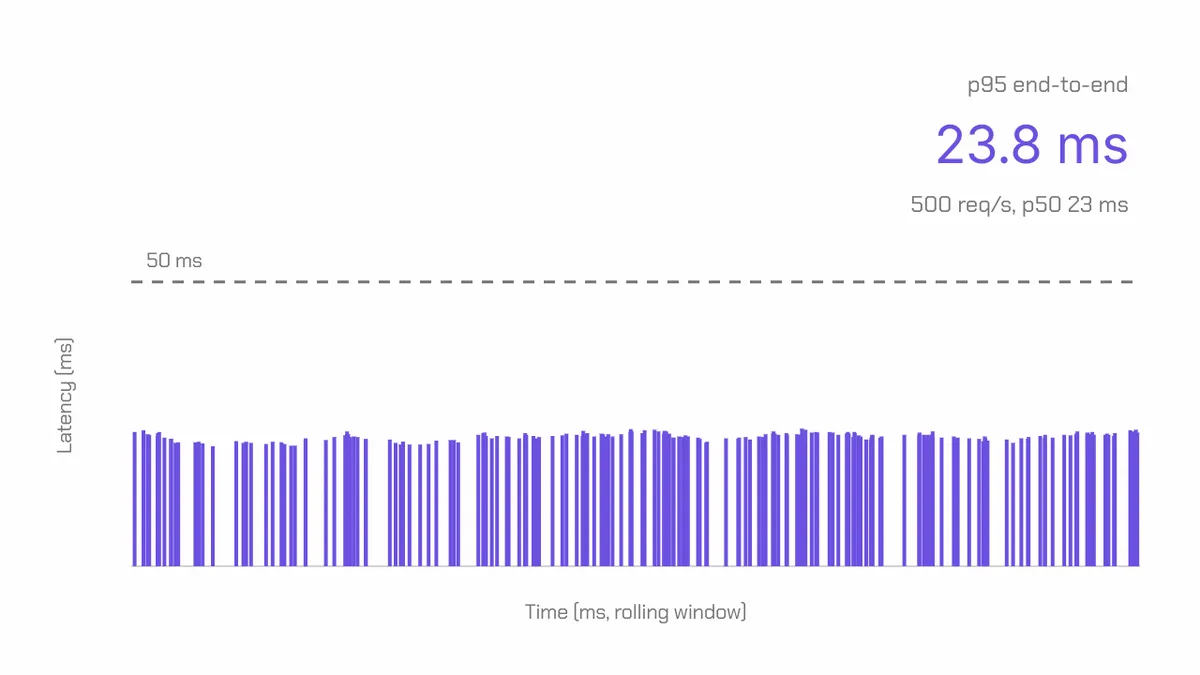
Liquid AI has introduced Liquid RIPL (Real-time Inference Pipeline), a low-latency inference engine that, according to the company, returns complete generated responses from Liquid Foundation Models (LFMs) in under 50 ms end to end. Liquid AI says it holds that speed while traffic arrives continuously at peak load.
- Liquid RIPL returns complete LFM responses in under 50 ms end to end, according to Liquid AI, including at peak load.
- LFM2.5-1.2B on RIPL has 14.4, 28.4× lower p95 latency than Qwen3.5-0.8B on vLLM.
- LFM2.5-2.6B has 5.6, 7.7× lower p95 latency than Qwen3.5-2B.
- Shopify uses LFMs for search enhancement with sub-20ms inference on real production workloads.
- RIPL is available now for enterprise deployments on NVIDIA GPUs including H100, H200, B200 and RTX PRO 6000.
Built for live requests, not long agent runs
Liquid AI argues that most current serving infrastructure targets a different job: general purpose models, large batches and long running agentic workflows, where a few seconds per request is acceptable. Enterprise real-time workloads work with far smaller latency budgets.
The company names search rankings, product recommendations, fraud decisions and payment authorizations as examples that need an answer in milliseconds. Even small delays add friction, it says, such as a slower checkout that hurts conversion. For that reason, these systems have traditionally relied on fast but less accurate methods like gradient-boosted trees or small embedding models.
RIPL is meant to change that trade off. Liquid AI says it puts LFMs directly in the path of a live request, with the aim of making generative AI experiences more responsive in how customers search, discover, transact and interact.
Latency figures against vLLM
Liquid AI published comparisons across two workloads. According to the company, LFM2.5-1.2B on Liquid RIPL has 14.4, 28.4× lower p95 latency than Qwen3.5-0.8B on vLLM. LFM2.5-2.6B has 5.6, 7.7× lower p95 latency than Qwen3.5-2B.
These numbers come from Liquid AI itself. The post also describes an interactive tool where users can pick a GPU and a request shape to estimate end-to-end latency for an LFM2.5 model as the request rate rises.
Shopify as a production example
Liquid AI says Shopify is deploying LFMs in production across latency-sensitive commerce workloads, where fast and reliable inference matters under high request volumes. One example is search enhancement, where LFMs enable sub-20ms inference on real production workloads.
According to the post, LFMs using about 50% fewer parameters outperform alternatives while delivering 2, 10× faster inference, without compromising quality. Liquid AI presents this as a case where efficient, task-specialized models work well, especially when paired with a high-performance engine such as RIPL.
Availability and what it means
RIPL is available today for enterprise deployments of LFMs on NVIDIA GPUs, such as H100, H200, B200 or RTX PRO 6000. The post does not give pricing.
For teams running request paths with a hard latency budget, the pitch is that small language models could replace faster but less accurate techniques in areas like ranking, recommendations and fraud or payment decisions. Liquid AI invites such teams to contact it. As the performance claims are the company's own, buyers will likely want to test them on their own workloads.
Liquid AI: RIPL: Real-time Intelligence When Every Millisecond Counts | Blog