AI Ethics Brief: Consumer Agents Shift Decisions Away From Users

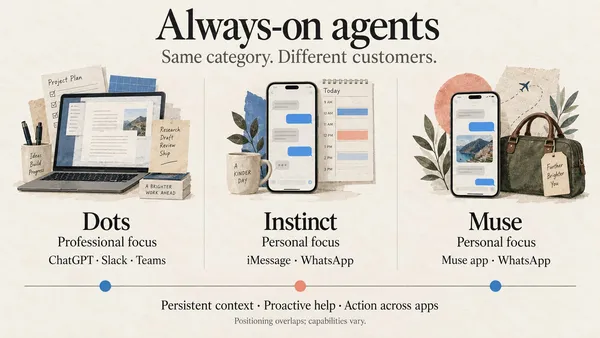
The Montreal AI Ethics Institute argues in its latest brief that consumer AI agents such as Meta's Muse and OpenAI's dots move key decisions away from the people they serve. The same edition asks who is missing from Canada's new National Council on Artificial Intelligence.
- Meta launched Muse in the U.S. on September 8 and in Canada ten days later; OpenAI introduced dots on September 29.
- Amazon blocked Muse on September 20, while Shopify enabled it across all its stores the next day.
- OpenAI's FAQ says users cannot view, delete or directly modify individual dot memories.
- An open letter says Canada's National Council on Artificial Intelligence lacks civil society and community representation.
- SAIER Volume 8 publishes on November 10, according to MAIEI.
Agents that act on a person's behalf
According to the Montreal AI Ethics Institute (MAIEI), Meta launched Muse in the U.S. on September 8. The agent works across connected services to send emails, book travel, negotiate bills and make purchases. It launched in Canada ten days later. On September 29, OpenAI introduced dots, described as "proactive, always-on agents" that each run on their own cloud computer and connect to more than 4,000 apps.
MAIEI notes that both companies describe permission controls. Meta says Muse cannot see passwords or payment methods, and OpenAI requires users to take over for sensitive actions such as changing a password or moving money. The brief also points to the business model: Mark Zuckerberg said Meta expects that "over time we will profit by taking a small fee from transactions." MAIEI observes that an agent earning on every purchase has a commercial interest in the purchases it helps make.
Three cases from the first month
The brief says three developments show where those controls reach their limits.
- Access to stores. On the night of September 20, Amazon began blocking Muse, telling users that "Continued access by an unauthorized AI agent violates Amazon's Conditions of Use." Amazon said Meta had not told it Muse would access the store, that the agent did not identify itself, and that it appeared to capture and store customer credentials. Meta has said credentials go into secure storage Muse cannot see. The next day, Shopify CEO Tobi Lütke announced that Shop Pay checkout would be enabled for Muse across all Shopify stores.
- Humans in the loop. On September 22, 404 Media reported that Meta was testing human contractors to place some Muse calls to businesses. An internal post said Muse could "hand requests to a trained human agent, who places the call and works it through." One employee tester said they were "only told after." Meta said the feature would launch "only when it's ready and with the proper disclosures." The reporting does not say what the receiving businesses were told.
- Memory. OpenAI's privacy FAQ states that users "currently cannot view, delete, or directly modify individual dot memories." Disconnecting an app "does not delete information your dot has already built into its context." The only remedy is deleting the whole dot.
The questions MAIEI raises
MAIEI argues that each case moves a decision away from the person the agent serves. Amazon and Shopify decide where it can shop, Meta decides when a person steps in and who is told, and OpenAI decides what the agent keeps. The user's part, it says, is to approve. Approval prompts carry their own trade-off: too many invite reflexive clicks, too few leave people surprised. The brief quotes a Hacker News commenter, cited by Sébastien Dubois: "my throughput is limited by my approval."
It lists three questions that product settings alone do not settle. What should an agent disclose to the businesses it deals with, and who needs to know when a person steps in? How is responsibility shared among the user, the maker and the service when an agent buys the wrong item or exposes information? And can people see what an agent has inferred about them and correct it without deleting everything?
For Canadian readers, MAIEI says these are practical questions, since Muse is already available in Canada and Bill C-36, the federal privacy bill introduced in June, is where some answers will be written.
Who is missing from Canada's AI council
The brief's second theme is the Prime Minister's National Council on Artificial Intelligence, launched by Mark Carney on October 2 "to provide independent, practical advice on Canada's AI transformation." It will advise on the government's AI for All strategy. A small team in the Privy Council Office supports it. According to MAIEI, the release does not name a chair or say whether the council's advice will be published.
BetaKit and The Logic report 13 members. The Logic noted that domestic members are concentrated in Ontario and Quebec and that some are based in the U.S. A bilingual open letter, AI by All / L'IA Par Tous, finds "substantial representation from government, academia, finance, technology, AI research and consulting but no clearly designated representation from civil society or community-based organizations." It asks for Indigenous participation on a Nation-to-Nation basis, seats for civil society, labour, disability and equity-seeking communities and youth, and published agendas, evidence and conflict-of-interest disclosures. MAIEI says it agrees with the letter's core ask.
What it means
MAIEI's conclusion is that delegation is a relationship of trust. Its brief says makers of agents owe users a clear account of what the agent accessed, what it did, what it learned and where a person stepped in. In its words, "To delegate to an AI agent is to accept the governance decisions already made inside it, and beneath it."
The edition also announces that SAIER Volume 8 publishes on November 10, with Brief #203 arriving on launch day.
Montreal AI Ethics Institute: The AI Ethics Brief #202: Delegated by Default