Meta Says AI Agents Now Handle Most Ads Model Technique Propagation
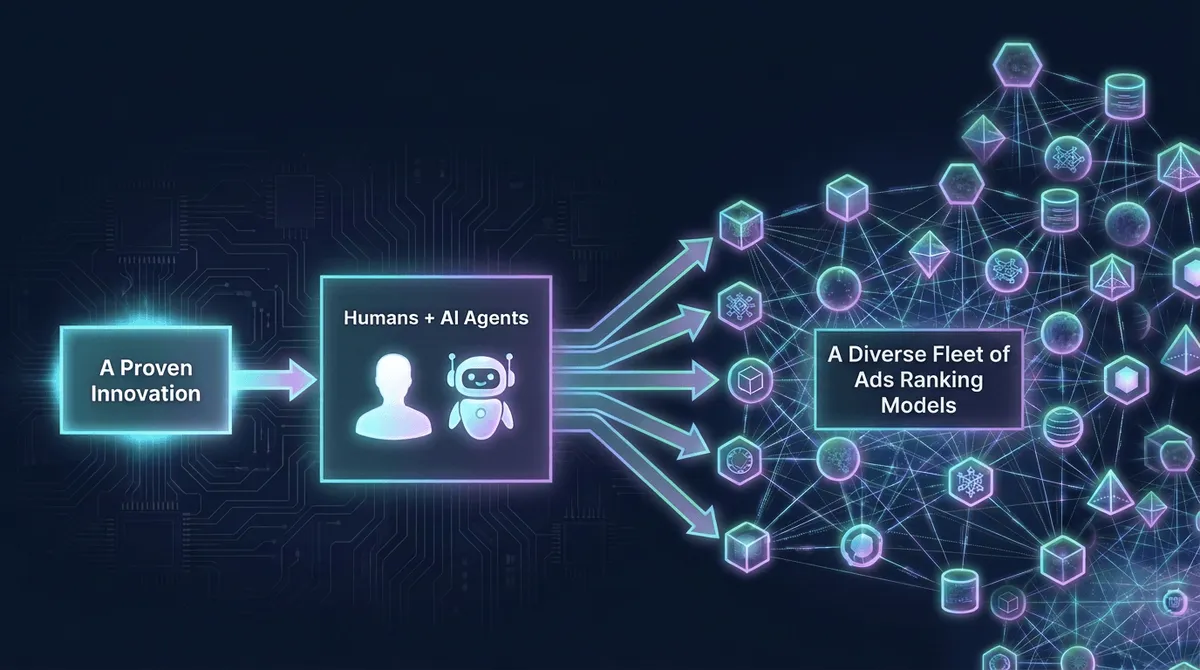
Meta says its AI agents now handle over 60% of technique propagation across its ads ranking models, helping adapt proven machine learning methods to a large and diverse model fleet. The company estimates the system has delivered 3x greater engineering productivity, a median 4x reduction in training compute across select combinations, and more than $45 million in compute savings by the end of the year.
- AI agents handle over 60% of Meta’s technique propagation, according to the company.
- Meta reports 3x greater engineering productivity in early results.
- Training compute fell by a median 4x across select combinations.
- Meta estimates more than $45M in compute savings by the end of the year.
- Standardization and automation have shipped 5,000+ technique-model combinations.
Why Meta needs automated technique propagation
Meta’s ads recommendation system uses many distinct ranking models for different product surfaces and advertiser objectives. Each model has its own architecture, training data, and serving constraints, so a technique that improves one model usually cannot be copied directly to another.
Meta uses the term “technique” for changes that improve a ranking model, including architectural advances such as Wukong factorization layers and Interformer interaction networks, richer data representations, training optimizations, and improvements to training or inference efficiency.
The company says the challenge grows as more techniques and models create a combinatorially expanding set of possible combinations. Manual adaptation requires engineers with deep knowledge of both the technique and the target model. Training runs also consume compute, and many attempts may deliver suboptimal gains.
Agents support discovery, adaptation and deployment
Meta’s technique propagation system is organized around discovery, generalization and adoption. Discovery identifies proven techniques and estimates how well they may transfer to each model. Generalization adapts a technique to different architectures, data, features and serving constraints. Adoption turns validated adaptations into shipped models.
AI agents combine large language model reasoning with specialized machine learning tools, according to Meta. They help decide which adaptations to try, diagnose failures, mitigate problems, navigate hyperparameter searches and manage capacity across hundreds of concurrent jobs.
The agents use a shared knowledge base containing prior training runs, model architectures and technique outcomes. This allows them to assess the model fleet at once and produce prioritized technique lists ranked by expected impact, rather than relying on one expert to evaluate models one at a time.
For models built from standardized templates, agents can help develop and test template-level changes across representative model sets. A technique validated at the template level can then reach every model built from that template. For customized, highest-revenue models, agents work alongside machine learning engineers as techniques are initially adapted to a smaller number of models.
What Meta’s results show
Before introducing agents, Meta had already used standardization and automation to ship more than 5,000 technique-model combinations over two years, while reducing per-model engineering time by 92%. Those systems handled deterministic steps, but human judgment was still needed to choose adaptations, set the scope of hyperparameter searches, diagnose weak results and resolve failures.
Meta says agents began driving execution in March 2026. The company estimates they now handle over 60% of all technique propagation. Compared with the same work before agents, early results include 3x greater engineering productivity, a median 4x reduction in training compute across select combinations, and an estimated $45M+ in compute savings by the end of the year.
For Meta, the reported gains could help proven ads ranking techniques reach more applicable models faster, while reducing the engineering and compute resources required for adaptation. The company says speed matters because techniques can be superseded within a couple of model development cycles, making faster propagation important to the value those techniques deliver across its ads model fleet.
Engineering at Meta: How Meta Uses AI Agents to Scale ML Innovations Across Ads Ranking Models