Meta's GenRecs Tokenization Lifts Ad Conversions 0.35% With Semantic Vocabulary
Meta says its new GenRecs Tokenization, which represents ads, products and pages with tokens from a stable semantic vocabulary instead of dedicated IDs, has delivered a +0.35% lift in conversions across surfaces when paired with its Generative Ads Model (GEM) and Adaptive Ranking Model. The company describes the approach as the foundational data representation for Generative Recommenders, or GenRecs, in its ads systems.
- Meta's GenRecs Tokenization represents ads, products, pages and pixels with tokens from a stable semantic vocabulary instead of dedicated IDs.
- Paired with GEM and Adaptive Ranking Model, it delivered a +0.35% lift in conversions, according to Meta internal data measured in February 2026.
- The tokenizer uses a three-stage pipeline: encode, decompose into subspaces, and quantize with codebooks.
- Meta says tail and new ads benefit most, since they inherit what the model learned about similar items.
- Across eight tokenizer versions, intrinsic quality metrics correlated strongly with CTR prediction accuracy, per Meta.
From item IDs to semantic tokens
GenRecs is short for Generative Recommenders. According to Meta, it shifts the company's approach from scoring every individual ad candidate to using an LLM architecture that reasons about ad content and user preferences at the same time. The goal is to move beyond click-pattern matching and understand underlying user preferences.
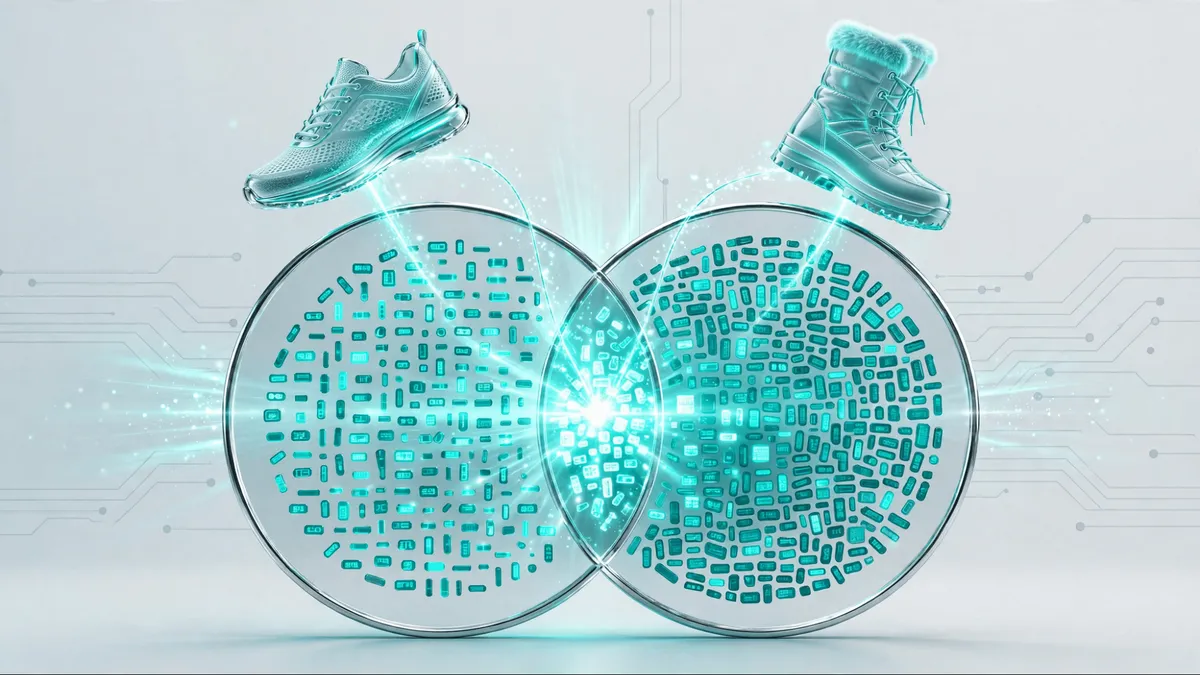
GenRecs Tokenization is the data layer behind this. Rather than keeping a dedicated ID for every item, the system describes each item with a set of tokens from a small semantic vocabulary, much as language models compose concepts from tokens. Because the tokens describe what an item is, the model can relate an item with no engagement history to items it already knows well. Meta gives the example of a newly launched trail shoe, which inherits what the model has learned about that category instead of starting with an empty representation.
Meta says the approach enables GenRecs for both retrieval and ranking across every item type in the system, including ads, products, pages and pixels.
How the tokenizer works
Pre-trained multimodal models read each ad, product and page, including text and images, and encode them into an embedding that carries world knowledge. The tokenizer combines that content signal with representations learned from how people engage with items, then quantizes the result into a short sequence of discrete tokens. Similar items share tokens, as related words share roots.
Meta describes a three-stage pipeline:
- Encode each item into a semantic embedding space.
- Decompose that embedding into independent subspaces.
- Quantize by mapping each subspace to an entry in a codebook.
For many ad representations, GenRecs Tokenization uses prefix n-grams that combine a learned encoder, residual decomposition, learned vector codebooks and token parametrization, according to the company.
Meta also reports that tokenizer quality can be judged by intrinsic measures: cluster purity, distribution balance and codebook utilization. Across the eight tokenizer versions it tested, the company says it saw a strong correlation between these metrics and downstream ranking accuracy, with better-scoring versions also showing better CTR prediction accuracy for ads models.
Cold start and the feedback loop
Meta says the main benefit shows up for tail ads, which accumulate fewer impressions. Tokenization lets recommendation models generalize across them through shared content structure, recovering cold-start performance and enabling transfer across entities. The company lists related benefits: faster learning from new entities such as new ads and niche products, transfer of insights across campaigns for an advertiser, and a direct interface between pre-trained language models and ad content.
The company also describes a flywheel. Better predictions for tail ads produce better training data, which in turn improves predictions for all ads. Meta adds that across production ranking and retrieval, tokens "bend the scaling curve along sequence length, training data, and model architecture." The +0.35% conversion lift is footnoted as Meta internal data measured in February 2026.
On retrieval, Meta says a two-tower architecture built on a shared LLM encoder reaches state-of-the-art retrieval quality while remaining efficiently servable, matching classic two-tower performance on a fraction of the training data. It is now extending reasoning-aware ranking on top of the same vocabulary.
What comes next for advertisers and Meta's ads stack
Meta names three directions: deepening cold-start generalization by scaling tokenization coverage across all items, treating tokenizer quality as a first-class objective, and serving LLM-native architectures efficiently. On the last point, the company says fully verbalized tokenization gives the richest view of an ad but needs context windows that are impractical at ads scale, so it is combining compacted verbalized tokens with semantic IDs to keep reasoning quality at acceptable latency.
Because intrinsic quality measures predict downstream ranking gains, Meta says it can iterate on the tokenizer without waiting for a full model training cycle. Looking further out, it is exploring whether one shared token space across text, image, audio and video ads content could replace separately learned embeddings.
For advertisers, the practical claim is better matching for new and low-volume ads, where Meta says its advertiser impact is largest. The only quantified result in the source is the +0.35% conversion lift, reported by Meta itself.
Engineering at Meta: GenRecs Tokenization: Transforming Ads Recommendation at Meta with Stable Model Vocabulary