Meta unveils liquid-cooled 102.4T switch rack and new GPU fabric at OCP 2026
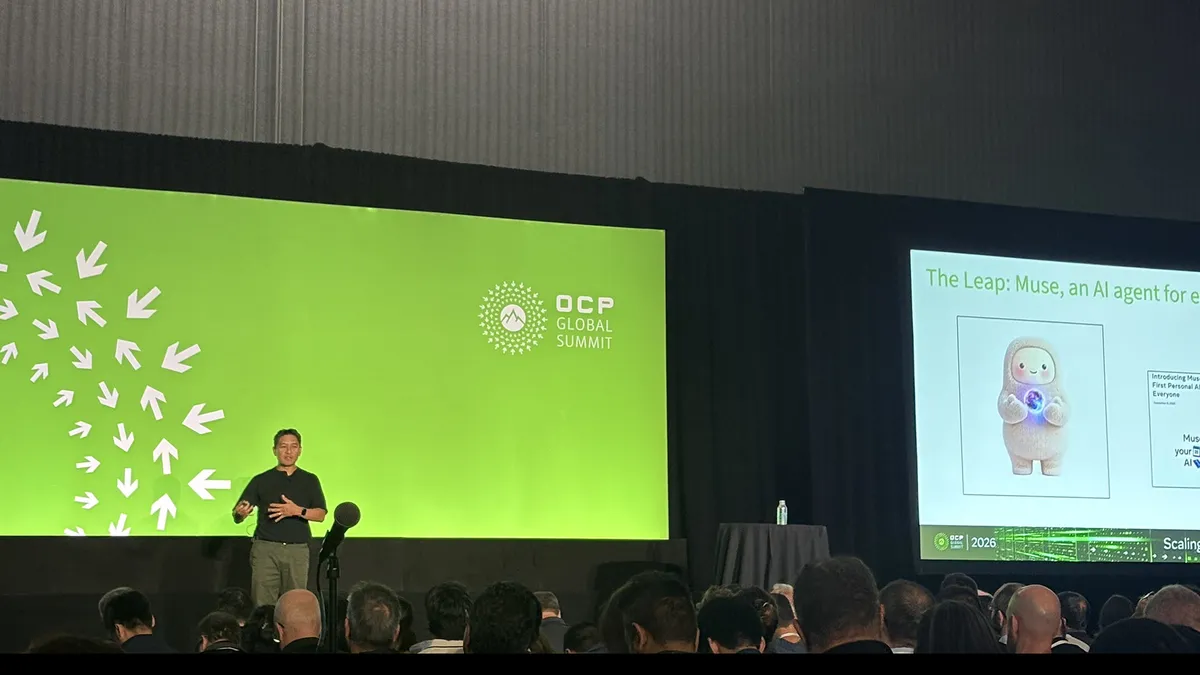
At the 2026 Open Compute Project Global Summit, Meta introduced its first liquid-cooled network rack, called IcePack, along with IceCube 102.4T switch blades and a new multiplane GPU fabric named Flattened Planar Fabric (FPF). The company also launched the Open Switch Platform Architecture (OSPA) initiative within OCP and said its MetaRoCE transport protocol now has open-source implementations.
- Meta introduced IcePack, its first liquid-cooled network rack, with IceCube 102.4T switch blades running FBOSS.
- IceCube comes in Broadcom Tomahawk6C and NVIDIA Spectrum-6 variants and doubles bandwidth versus Meta's 51.2T platforms, according to Meta.
- Flattened Planar Fabric connects each GPU over eight 100G links to eight switches and moves from a 3-tier to a 2-tier Clos fabric.
- OSPA, co-led by Meta, Microsoft and Alibaba, has submitted specification v1.0 to OCP.
- MetaRoCE, Meta's RDMA transport protocol for AI networks, now has open-source implementations.
IcePack and IceCube: liquid cooling for 102.4T switching
Meta says AI clusters are heading toward gigawatt scale, which forces network switches to deliver far more bandwidth inside tighter power and cooling limits. Its answer is IcePack, described as its first-generation liquid-cooled network rack, built on OCP's ORV3-HPRv1 rack standard.
Each rack holds IceCube switch blades. According to Meta, these are 102.4-Tbps fabric switches that deliver 128×800G non-blocking switching capacity. IceCube comes in two variants: one built on Broadcom's Tomahawk6C switch ASIC and one on the NVIDIA Spectrum-6 Switch ASIC. Both run Meta's open-source FBOSS network operating system, which uses OCP SAI (Switch Abstraction Interface).
Meta describes the generation as a 2x bandwidth increase over its 51.2T platforms, while reaching the thermal density needed for next-generation AI data centers.
Flattened Planar Fabric changes how GPUs connect
FPF is Meta's multiplane backend scale-out fabric. Each GPU connects through eight independent 100G links to eight different switches, one per network plane. Meta says this replaces the traditional single-plane uplink design and brings four advantages:
- Larger non-blocking GPU clusters than single-plane topologies allow.
- A flattened topology, moving from the 3-tier Clos fabric of Meta's NSF fabric to a 2-tier Clos fabric, which reduces network hops, latency and infrastructure cost.
- NIC-level hardware load balancing, where the NIC sprays every packet across all eight planes in hardware.
- A combined control plane covering both switches and hosts, so a host can steer traffic away from downed planes.
Meta says it worked closely with NVIDIA on FPF, using NVIDIA Spectrum-X Multiplane innovations. The two companies are also working with joint cloud partners to help standardize multiplane fabric implementations based on what Meta learned from FPF.
Scaling across clouds, sites and regions
Meta argues that building data centers alone cannot meet its AI capacity goals, because construction runs on multi-year lead times while demand moves in months. It therefore uses leased facilities and public cloud capacity alongside its own campuses. That requires the network to behave the same way wherever the GPUs sit, which Meta calls genuinely difficult: fabric topologies differ between providers, buffering is often shallower, RDMA transports are provider-specific, and some clouds still run InfiniBand rather than Ethernet and RoCE.
To address this, Meta describes a standardized performance validation framework. Cloud partners run a common suite of point-to-point and collective benchmarks, scaling from tens to over a thousand GPUs, before a cluster is handed over. Meta also maps divergent traffic-class schemes and congestion-control parameters onto its lossless RDMA classes.
For multi-site training, Meta points to its backend aggregation (BAG) layer, a centralized, Ethernet-based super-spine that links many spine-layer fabrics into one mega cluster across buildings, campuses and regions. It operates at petabit scale, with inter-BAG capacity between a pair of regions reaching tens of petabits per second. Meta says BAG lets Prometheus, at roughly 1 gigawatt in 2026, work as a single cluster, while Hyperion is scaling toward 5 gigawatts.
Because lossless Ethernet needs buffer headroom proportional to cable length, Meta says FBOSS now measures actual cable length in place by timing probe traffic on an uncongested queue, then allocates headroom against that measurement instead of provisioning every link for a worst-case distance.
Scale-up, OSPA and MetaRoCE
On scale-up networking, Meta's MTIA 300 system uses Tahan, an Ethernet-based 51.2T scale-up switch that delivers 6.4 Tbps per accelerator. Meta previewed a next-generation design with 72 accelerators per rack on 102.4T silicon, and said it is moving toward an ESUN-based implementation with future chips.
The Open Switch Platform Architecture is a new OCP initiative co-led by Meta, Microsoft and Alibaba. It aims to standardize the switch platform layer, and specification v1.0 has been submitted to OCP. Meta is inviting engineers, silicon vendors, system integrators and operators to join. MetaRoCE, Meta's RDMA transport protocol for AI networks, now has open-source implementations.
What it means
Meta says the networking work supports its latest AI workloads, including the Muse Wonder and Muse Spark models and its personal AI agent Muse. By submitting OSPA v1.0 to OCP, open-sourcing MetaRoCE and sharing FPF learnings with cloud partners, Meta is pushing parts of its network design toward shared standards. In its own words, "heterogeneity is manageable but standardization is what makes it affordable."
Engineering at Meta: OCP Summit 2026: Powering AI with Open Innovations in Scale-Up, Scale-Out, and Scale-Across Networks