Meta says model templates cut ML engineering time by 92%
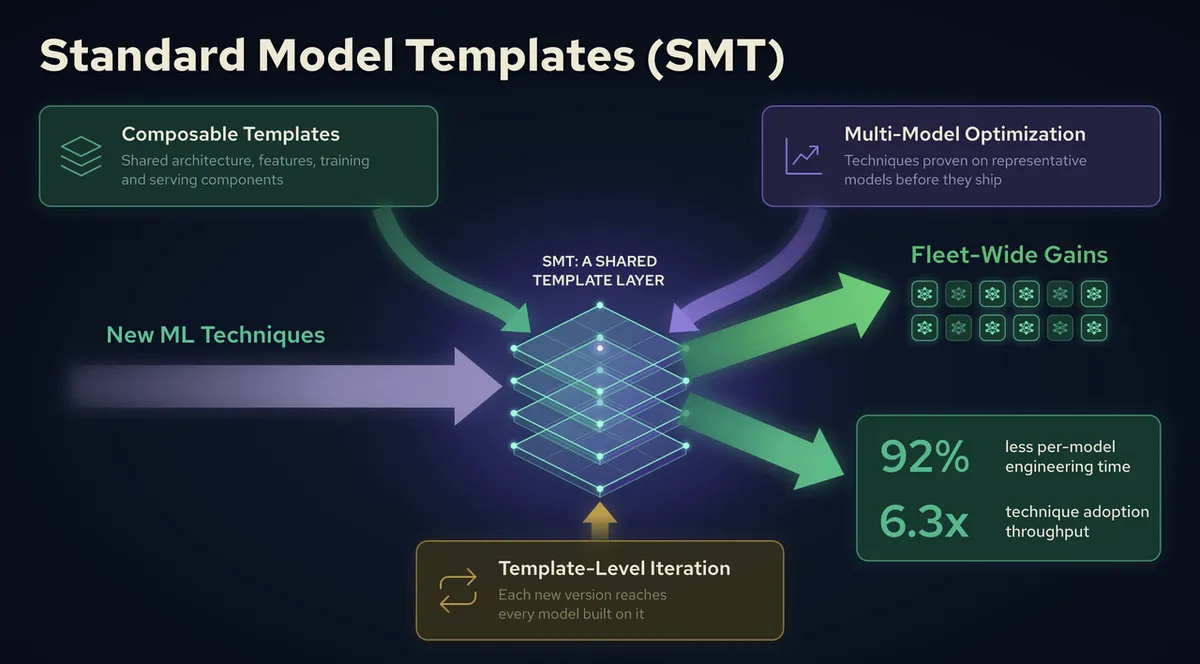
Meta says its template-driven approach to machine learning reduced per-model engineering time by 92% over the last two years. The company used Standard Model Templates to coordinate improvements across its large ads ranking model ecosystem.
- Meta says SMTs reduced per-model engineering time by 92%.
- The approach shipped 5000+ technique-model combinations.
- Offline model quality improved by 0.63% on average at neutral serving capacity.
- Meta reports a 0.86% cumulative online lift covering 70% of models by count.
- The workflow shipped 80 new ML techniques over two years.
Meta shifts from model-by-model development
Meta’s ads ranking systems process billions of daily requests across a diverse range of products and optimization goals. The company says the central engineering challenge has shifted from inventing techniques to propagating them across production models.
As the model fleet expanded, teams faced a growing mix of architectures, features, training settings, serving constraints and platform-specific logic. According to Meta, that fragmentation increased the engineering cost of shipping ideas, raised reliability costs because of additional corner cases, and made it harder to predict the effect of a change across the ecosystem.
Meta says adapting every technique separately for every model causes work to grow linearly with the number of models. It also limits automation because AutoML and optimization systems work best in a structured search space.
Standard Model Templates create shared building blocks
Meta’s response was to introduce Standard Model Templates, or SMTs. The approach organizes model design around a smaller set of reusable templates built from shared components, including architecture choices, feature logic, training settings and serving configurations.
The templates cover major ranking and retrieval patterns across different model sizes. They also package components for feature selection, feature interaction, model parallelism, training configuration and hardware-aware serving. Model-specific logic remains where it is needed, while common elements are represented and maintained as shared parts.
This changes the development process from per-model iteration to template-level iteration. Meta can evaluate a technique on a smaller group of representative models, then propagate it to model groups using the same template. The company says this reduces propagation complexity, supports stronger validation and guardrails, and makes representative-model results a more useful signal for the wider group.
Reported results and a broader optimization system
Over the last two years, Meta says the approach reduced per-model engineering time by 92%, shipped 5000+ technique-model combinations, improved offline model quality by 0.63% on average at neutral serving capacity, and delivered 0.86% cumulative online lift covering 70% of models by count.
Meta also says it shipped 80 new ML techniques through a multi-model optimization workflow. The process evaluates techniques across representative models, weighs aggregate performance against regression rates, and then validates candidates on held-out models before integrating them into a new template version.
The company says the system allows teams to transfer complete model designs between model families, rather than applying isolated components one at a time. It also supports scaling-law-based optimization workflows, allowing cost and performance trade-offs to be learned in template space and applied more broadly.
For Meta, the result is a shared foundation for improving a large model fleet. The company’s source also presents SMTs as a way to give agentic model-building systems structured, known-good design patterns, although the discussion provided here ends before describing the full implementation of that use case.
Engineering at Meta: Design Once, Deploy at Scale: Building a Template-Driven ML Ecosystem