Microsoft research finds AI value is scaling unevenly across businesses
Organizations are seeing substantial results from AI, but far fewer are scaling those gains across their businesses, according to research commissioned by Microsoft from IDC. The study of more than 5,200 senior IT and business leaders identifies Frontier Firms as the organizations most successful at turning AI use into repeatable value.
- Frontier Firms report an average 4x return on AI.
- Only 48% of leaders say they are scaling AI value across multiple business units.
- 93% of Frontier Firms are highly confident they can measure AI value and ROI.
- Only 20% of organizations have a comprehensive, organization-wide skilling strategy.
- Microsoft recommends four disciplines for scaling AI value and maintaining control.
Frontier Firms report higher AI returns
Frontier Firms are the top 10% of organizations on IDC’s AI maturity scale. They report an average 4x return on AI, compared with 2.7x for slow adopters, defined as the bottom 30% on the scale. In addition, 39% of Frontier Firms report returns of 5x or more, compared with 4% of slow adopters.
The research also shows a gap between results and scale. While 66% of leaders say AI has delivered substantial or transformative results, only 48% say they are scaling that value across multiple business units. Agents show a similar pattern, with 36% of organizations still piloting them.
AI is now used in an average of 6.5 business areas. IT infrastructure, cybersecurity and customer service lead adoption, while industry-specific uses are growing fastest. Employee experience, revenue growth, customer experience, innovation and risk reduction rank nearly evenly as areas where AI strengthens the business.
Governance and skills remain major gaps
Only 61% of organizations are highly confident that they can measure AI’s business value and return on investment, compared with 93% of Frontier Firms. Although 65% have an established process for governing agents, only 60% express high confidence in addressing AI security and governance risks.
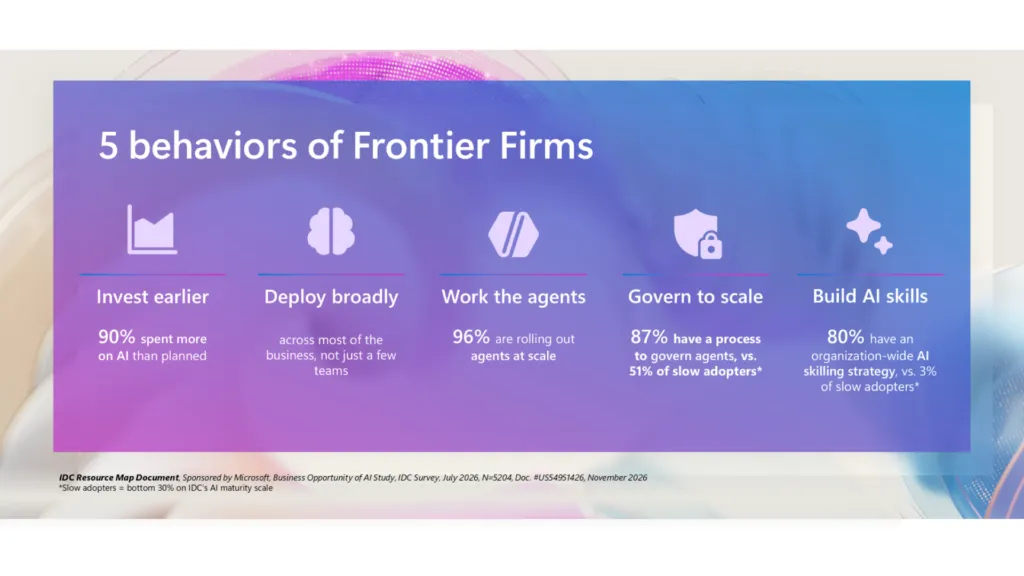
Workforce readiness is another dividing line. Some 67% of leaders say their workforce has high trust in AI, but only 20% report having a comprehensive, organization-wide skilling strategy. By comparison, 80% of Frontier Firms have such a strategy, versus 3% of slow adopters.
Frontier Firms also report a 3.8x return on agents, compared with 3.0x for slow adopters. The figures are leader-reported, and IDC’s research shows association rather than cause. Microsoft says the leading organizations invest ahead of plan, deploy AI broadly, use agents across workflows, govern them and build skills throughout the organization.
Microsoft outlines four disciplines for scaling AI
Microsoft says companies can improve AI value by treating models, agents, governance and measurement as one accountable system. Its four recommended disciplines are unlocking model choice, redesigning workflows around agents, governing decisions and actions, and measuring and optimizing value.
Trust and security, leading-edge technology and model performance each rank as the top platform-selection criteria for 44% of respondents. The research also says 71% of organizations expect AI budgets to rise by 10% or more in the next 12 months, increasing the importance of linking investment and performance data to business outcomes.
Examples in the research include Bristol Myers Squibb, where the RABIT agent helps connect information across meetings and project managers who use it save up to an estimated 20% of their time. Black & Veatch reached 98% adoption of Microsoft 365 Copilot through change management that included early-adopter cohorts. For users and business leaders, the findings frame the next challenge as scaling AI beyond isolated successes while maintaining oversight and investing in organization-wide skills.
Microsoft: Scaling AI value without losing control: Lessons from Frontier Firms