Microsoft to scale Azure Maia to multi-gigawatt deployments from 2027
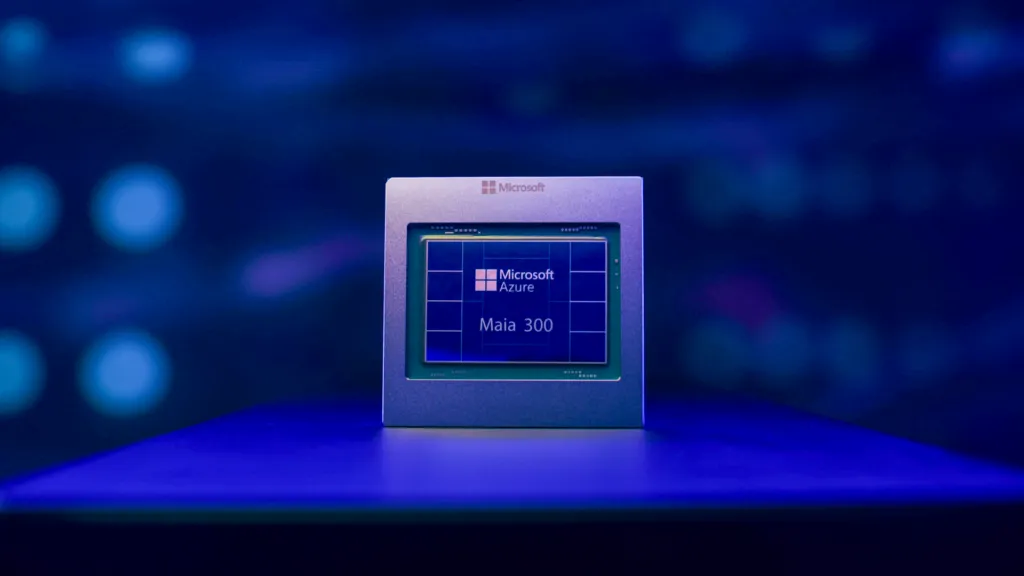
Microsoft plans to scale its Azure Maia chip family to multi-gigawatt deployments starting in 2027, making Maia the primary inference system for its products and services. The company says Maia 200 is already running production workloads, while the third-generation Maia 300 begins production deployments next year.
- Microsoft will scale Azure Maia to multi-gigawatt deployments from 2027, making it the primary inference system for its products and services.
- Maia 200 is in production, running Copilot and OpenAI, MAI and open-source models, with GitHub Copilot and Microsoft Foundry to follow by year end.
- Microsoft expects Maia 300 to deliver 40% more tokens per megawatt than leading GPU-based systems.
- A Maia 300 rack holds 96 accelerators in 167 kilowatts, with 27.6 TB of HBM and 1.7 PB/s of aggregate bandwidth.
- Maia 300 production deployments begin in 2027.
Maia 200 is already in production
According to Microsoft, Maia 200 is now serving production workloads, including Microsoft Copilot, and supports the MAI team as it develops next-generation models. GitHub Copilot and Microsoft Foundry are to follow by the end of the year. Across these workloads, Maia 200 runs OpenAI models, Microsoft's own MAI models and leading open-source model families.
The company says Maia 200 is deploying across the United States, Europe and Australia. Microsoft claims it delivers up to 1.7x more tokens per watt for built-in AI capabilities in Microsoft Teams, Copilot and Cowork experiences, compared with leading GPU infrastructure.
Microsoft says its software and hardware teams collaborate early, because silicon development takes years. The aim is to anticipate model architectures and scale, and to translate that into more memory capacity, higher bandwidth and more accelerators working as a single system. Experience from Maia 200 directly informed the design of Maia 300, according to the company.
Maia 300: an inference-first design
Microsoft describes Maia 300 as a complete intelligent system for newer AI workloads: long-context reasoning, latency-sensitive conversational experiences and sustained, multi-step agentic tasks. It is the third generation of the Azure Maia program and uses an inference-first architecture built for long-context, memory-intensive and decode-heavy workloads.
Microsoft expects Maia 300 to deliver 40% more tokens per megawatt than leading GPU-based systems. In a full 96-accelerator configuration, it offers up to 7x the rack-scale token throughput of Maia 200, the company says.
Key technical details from Microsoft:
- Memory: eight HBM4 stacks provide 18.0 TB/s of peak memory bandwidth within a 950-watt TDP. On-die SRAM is used as a software-managed scratchpad to reduce pressure on HBM.
- Chiplets: a multi-chiplet design separates compute, memory-controller and I/O functions. Compute chiplets are built on TSMC's N2P process node.
- Low precision: support for advanced low-precision formats, including enhanced MXFP4, reduces memory and bandwidth needs for computation and KV-cache storage, allowing larger context windows within the same power envelope.
- Dataflow: a software-defined dataflow architecture and AI-assisted kernel optimization aim to reduce data movement, which Microsoft calls increasingly the bottleneck in large inference systems.
- Networking: a custom AI transport built on Ethernet-based infrastructure is meant to scale from a single rack to datacenter-scale deployments.
Maia 300 rack systems combine 96 accelerators within a 167-kilowatt power envelope, with 27.6 TB of HBM capacity and 1.7 PB/s of aggregate HBM bandwidth. Microsoft says this density lets it serve more simultaneous AI interactions and larger workloads from each rack.
Planned services and what comes next
Microsoft says the two generations together are meant to support multi-step agentic work that will help GitHub deliver coding experiences more efficiently, and cloud-scale model serving for Microsoft Foundry across diverse architectures and deployment environments. They are also intended for inference and data generation for the MAI team, and for latency-sensitive interactions that will help Dragon Copilot scale workflows and reduce clinicians' administrative burden.
The company ties Maia to what it calls Frontier Transformation, a strategy of optimizing from silicon to systems to agents on an open, heterogeneous and model-diverse platform. Microsoft says Maia is a foundational component of its approach to expand access and help customers capture more value from AI.
For customers, the stated payoff is efficiency: more AI output per unit of power and better economics for expanding AI services. The figures are Microsoft's own claims and comparisons against unnamed leading GPU systems. Maia 300 production deployments begin in 2027, and Microsoft has published a technical paper with architectural details. The company said it will share more on its strategy at Microsoft Ignite 2026 in San Francisco and online.
Microsoft: Microsoft to expand Azure Maia system to multi-gigawatt deployments