Microsoft introduces MAI Code 2 models for lower-cost enterprise coding
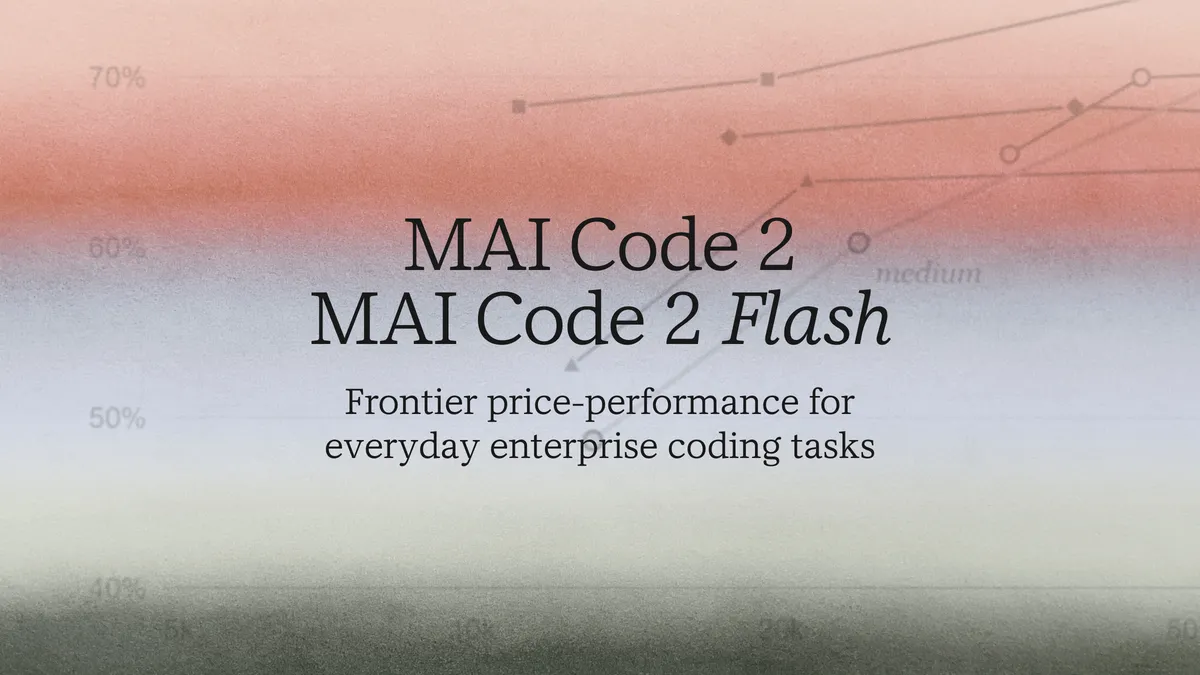
Microsoft has introduced MAI Code 2 and MAI Code 2 Flash, two coding models designed for everyday enterprise development tasks at lower costs than competing models. The company says the models focus on production coding, debugging, routine fixes and high-volume work.
- Microsoft introduced MAI Code 2 and MAI Code 2 Flash.
- MAI Code 2 targets production coding, debugging, multi-file implementation and repo wide reasoning.
- MAI Code 2 Flash is designed for explanations, targeted edits, routine fixes and rapid iterations.
- Microsoft reports MAI Code 2 at 98% of GPT 6.1 Sol’s performance and 40% of its cost.
- The models are not yet tuned for fundamental science research or very long horizon agentic work.
Two models target different coding workloads
Microsoft describes MAI Code 2 as a model for taking code to production, deep debugging, multi-file implementation, repo wide reasoning and user interface work. The company says it is built for common enterprise coding tasks and can produce changes that code maintainers would merge.
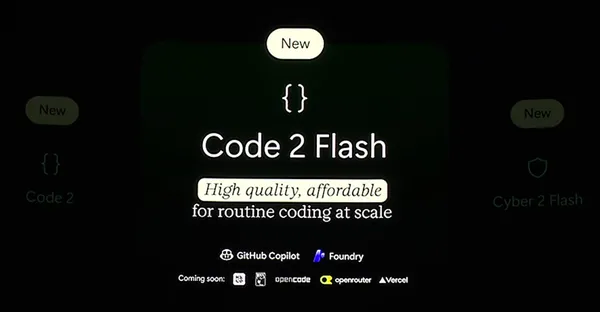
MAI Code 2 Flash is aimed at high-volume work, including code explanations, targeted edits, routine fixes and rapid iterations. Microsoft says the model delivers quality at a much lower cost, making the two models distinct in how they are intended to be used.
Microsoft reports lower costs on coding benchmarks
Microsoft evaluated MAI Code 2 across four benchmarks focused on everyday enterprise coding tasks used in GitHub Copilot: DeepSWE 1.1, Terminal Bench 2.1, SWE-Atlas and FrontierCode v1.1.
According to Microsoft, MAI Code 2 reaches 98% of GPT 6.1 Sol’s performance at 40% of the cost, and 96% of Claude Opus 5.5’s performance at 5% of the cost. The company presents those results as evidence of what it calls frontier price-performance for common enterprise coding work.
Microsoft also says MAI Code 2 is tuned for dashboards and visualizations. In blind frontend app evaluations, reviewers preferred its results over GPT-6 Sol 67% of the time.
For MAI Code 2 Flash, Microsoft reports comparable performance to GPT-6 Luna and Claude Haiku 5.5 at 6 5% and 20% of the cost, respectively, across three coding benchmarks measuring day-to-day, high-volume routine coding tasks.
A narrower focus than frontier research models
Microsoft says it prioritized the coding work its customers do every day to deliver the models’ price-performance. That focus comes with stated limits: the company says MAI Code 2 and MAI Code 2 Flash are “explicitly not yet tuned” for harder problems such as fundamental science research and very long horizon agentic work.
For enterprise users, the announcement positions MAI Code 2 as a choice for larger and more involved software changes, while Code 2 Flash is intended for repeated, routine coding requests. Microsoft’s claims suggest the models are designed to make frequent coding tasks more economical, rather than to cover every type of advanced reasoning workload.
Microsoft AI: MAI Code 2 and Code 2 Flash: Everyday coding at scalable prices | Microsoft AI