MiniMax M3.1 Flash goes free in Kilo, pitched as a cheaper, faster M3
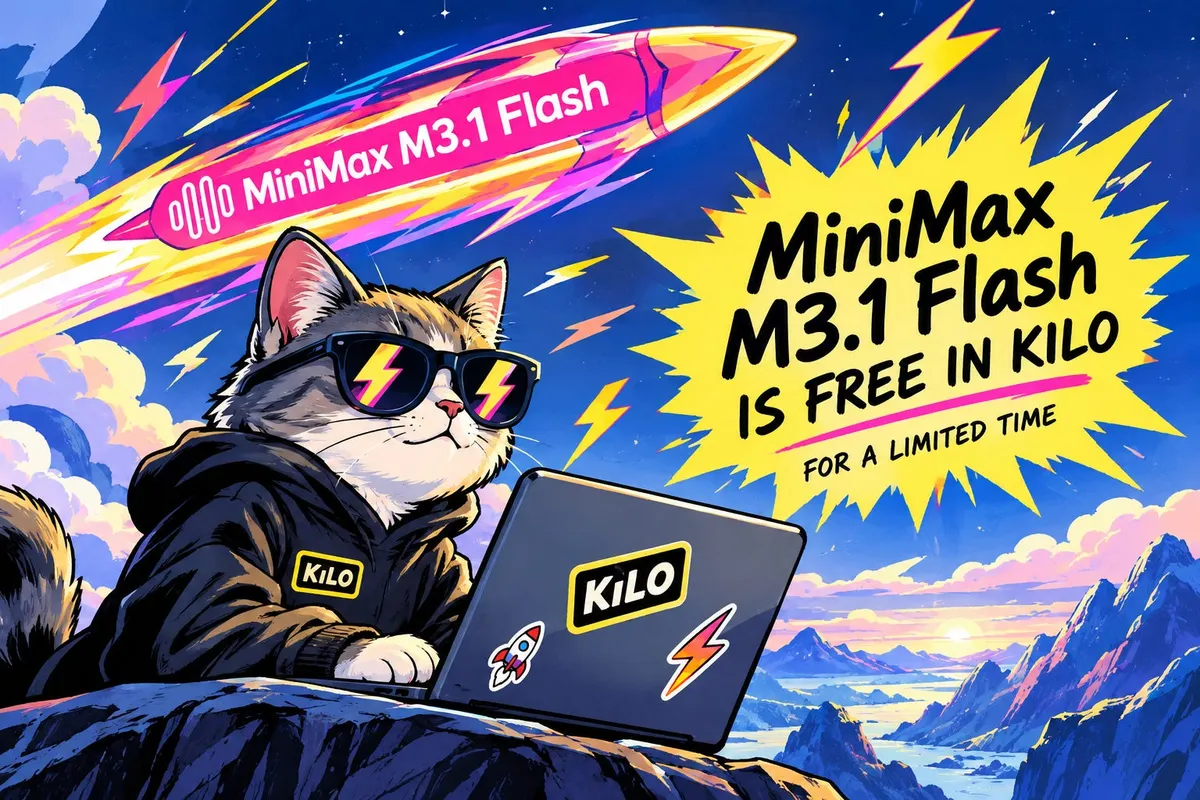
MiniMax M3.1 Flash, the company's newest model, is now available in the Kilo coding platform at no cost for a limited time. According to MiniMax, it delivers frontier-level intelligence at one-third the cost of M3 and three times the speed.
- MiniMax M3.1 Flash is free in Kilo for a limited time, the fourth such MiniMax release there.
- MiniMax claims one-third the cost of M3, three times the speed and 70% cheaper agentic tasks.
- All MiniMax benchmarks are self-reported; Artificial Analysis measured 25.8% on Terminal-Bench 4.0 versus MiniMax's 38.1.
- Priced at $0.15 / $0.60 per million tokens, far below Gemini 3.8 Flash's introductory $0.75 / $3.75.
- Artificial Analysis gives it an Intelligence Index of 42.7, versus 59 for Gemini 3.8 Flash.
A fourth free MiniMax release in Kilo
Kilo says this is MiniMax's fourth limited-time free release on its platform. MiniMax M2 started the pattern and, for a while, was one of the top three models used by Kilo Coders. M2.1 followed as a New Year's gift, and MiniMax M3 was covered in June as the first open-weight model to combine a 1M-token context window, frontier coding and agentic performance, and native multimodality.
M3.1 Flash builds on that M3 foundation. Kilo writes that MiniMax released it after a stealth period in which many agentic engineers tried it in daily workflows under the name Space Bunny. OpenRouter said the Space Bunny stealth model left its platform on October 5th and returned on October 19th as M3.1 Flash. That stealth build processed over 50 trillion tokens, according to the source.
Architecture and efficiency claims
M3.1 Flash is a multimodal mixture-of-experts model. MiniMax's product page lists 428B total parameters with about 23B active, plus sparse attention and a native visual encoder. The sparse attention is MiniMax Sparse Attention (MSA), which replaces the quadratic cost of full attention with KV-block selection. Per the source, this brings per-token compute at 1M context down to roughly 1/20th of the previous generation.
MiniMax says agentic tasks cost 70% less than with its predecessor. It describes the model as delivering frontier-level intelligence across cowork, coding and visual-reasoning tasks at one-third the cost of M3 and three times the speed.
Benchmarks: strong in office work and vision, mixed in coding
Kilo stresses one caveat: every score MiniMax published is self-reported, and no independent replication exists yet.
- Agentic office work: 62.2 on Automation-Bench v1.0.6, ahead of Opus 5 at 50.3 and GPT-5.6 Sol at 45.8. It ties Opus 5 on BankerToolBench at 76.2 and tops LOCA-Bench 256K at 60.3.
- Coding: 73.7 on DeepSWE v1.1, just above GPT-5.6 Sol at 73.0, while DeepSeek-V4.1-Flash-1017 scores 77.0. Terminal Bench 4.0 is its weakest result at 38.1, and SWE Refactor Bench comes in at 23.0 versus 31.0 for Opus 5.
- Vision: 91.0 on BabyVision with tools and 82.5 on CharXiv RQ.
Independent numbers are starting to appear. Artificial Analysis gives the model an Intelligence Index of 42.7, with 48.0% on HLE, 79.7% on AA-LCR and 53.4% on SciCode. It also measured 25.8% on Terminal-Bench 4.0, well below MiniMax's own 38.1. Kilo says harness choices can explain such a gap, but it supports treating vendor numbers carefully. On KiloBench, MiniMax M3 scored 48%, and Kilo suggests watching its leaderboard to see where the Flash variant lands.
How it stacks up against Gemini 3.8 Flash and MiMo
Kilo says Gemini 3.8 Flash set the standard for the Flash tier last month. It scored 59 on the Artificial Analysis Intelligence Index at high effort and 75.3% on KiloBench, and Artificial Analysis measures it at 352 output tokens per second. M3.1 Flash scores 42.7 on the same index, and OpenRouter currently clocks it at about 82 tokens per second.
Price is where MiniMax leads. Gemini 3.8 Flash costs $0.75 input and $3.75 output per million tokens at introductory pricing, rising to $1.50 / $7.50 after December 31. At $0.15 / $0.60, M3.1 Flash costs about one-fifth as much per input token and one-sixth as much per output token.
Kilo also compares it with Xiaomi's MiMo-V2.6-Flash. M3.1 Flash activates around 23B of 428B parameters, while MiMo-V2.6-Flash uses around 15B active out of 309B, combined with Multi-Token Prediction. According to Kilo, M3.1 Flash holds an edge in raw reasoning power and leads in vision, while MiMo offers lower output costs and broader native modality, including audio and speech-to-action agent loops.
What it means for developers
Kilo frames the release as part of a trend it describes in The Age of the Flash Model: the flash tier is becoming the default for always-on agentic engineering, with competition shifting to cost per task, throughput, and whether a model stays on track through long tool-calling loops. Its verdict is that Gemini 3.8 Flash is the better pick when speed matters, and M3.1 Flash when you need volume at the lowest cost.
Kilo suggests a mixed approach: start an agentic project with Gemini, then move to subagents on MiMo and MiniMax. Author Ari Messer recalls telling a panel on open-weight models to "pick your favorite flash model and dive in." The free period in Kilo is limited, and the post does not give an end date.
Kilo Code: MiniMax M3.1 Flash Is Free in Kilo for a Limited Time