MIT’s CheMeleon predicts molecular properties from limited data
MIT researchers have developed CheMeleon, a machine-learning model designed to predict molecular properties when only limited data are available. The open-source system could help researchers reduce the number of molecules they need to synthesize and test when developing drugs and other materials.
- CheMeleon learns from about a million molecules in PubChem.
- It uses about 1,600 molecular descriptors for pre-training.
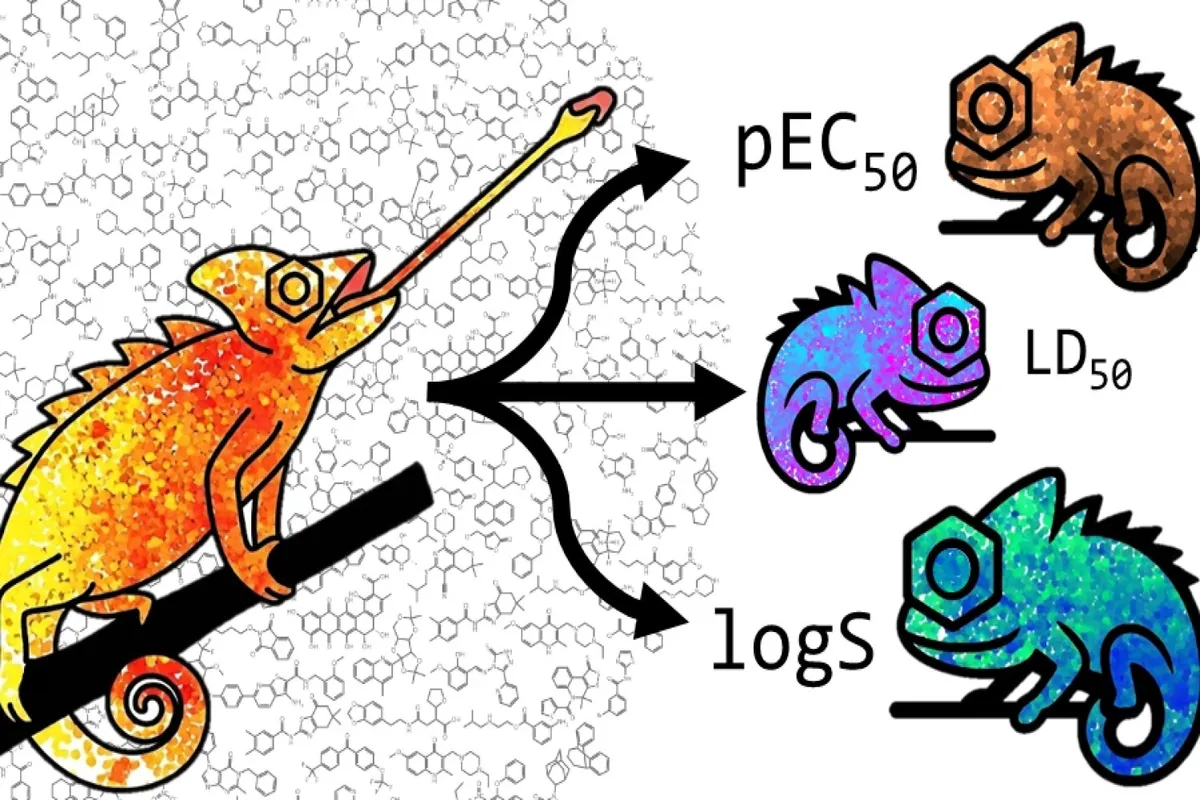
- The model can be fine-tuned for properties including potency, toxicity, and solubility.
- It ranked ahead of other methods across 58 test cases, according to the MIT team.
- CheMeleon is available through the open-source ChemProp package.
A foundation model for chemistry
CheMeleon first learns general patterns in chemistry from about a million molecules in PubChem, a freely available chemical information database maintained by the U.S. National Institutes of Health. Instead of learning one specific property, the model is trained to predict a catalog of about 1,600 molecular descriptors, including features such as molecular weight and the number of oxygens in a molecule.
The MIT team says this pre-training enables CheMeleon to learn relationships between molecular structure and behavior before it is adapted to a particular task. Researchers can then fine-tune the model to predict properties including potency, toxicity, solubility, viscosity, bioactivity, or reactivity with a protein or enzyme.
Designed for low-data research
Many chemical discovery projects lack extensive data, especially when researchers are investigating a recently discovered cellular target or another property that has not been widely studied. CheMeleon is intended to address that problem by starting with knowledge learned from the million-molecule dataset, rather than learning each new task from scratch.
“We don’t look at the literature at all. We just calculate a bunch of molecular descriptors like molecular weight or number of oxygens, among others,” Akshat Shirish Zalte, an MIT graduate student and author of the study, told MIT News. The researchers compared CheMeleon with other foundation models and classical models based on expert-designed principles across 58 test cases. “We see that our model comes out on top,” Zalte said.
According to William Green, the model “drastically reduces the number of molecules that need to be tested experimentally to accurately predict the properties of new molecules.” He said synthesizing and testing many molecules is slow and expensive.
Open-source model already used by companies
CheMeleon was built using ChemProp, an open-source machine-learning package developed and maintained by Green’s group at MIT. Anyone can download CheMeleon through ChemProp and fine-tune it for their own purposes.
MIT News reports that several pharmaceutical companies are already using the model. In an OpenADMET contest focused on predicting properties of previously unsynthesized molecules, nine of the top 20 entries used CheMeleon, according to Green. The model’s research findings were reported in the September 14 issue of the Journal of Chemical Information and Modeling, in a paper by MIT researchers and researchers from BASF SE in Germany.
For drug discovery and materials research, the approach offers a way to narrow the number of candidate molecules before costly laboratory work begins. The source does not claim that CheMeleon can perfectly predict chemical behavior, but presents it as a tool for making early decisions when experimental data are scarce.
MIT News: How to predict the behavior of molecules from scant data