MIT microrobot flies with onboard sensors and computing
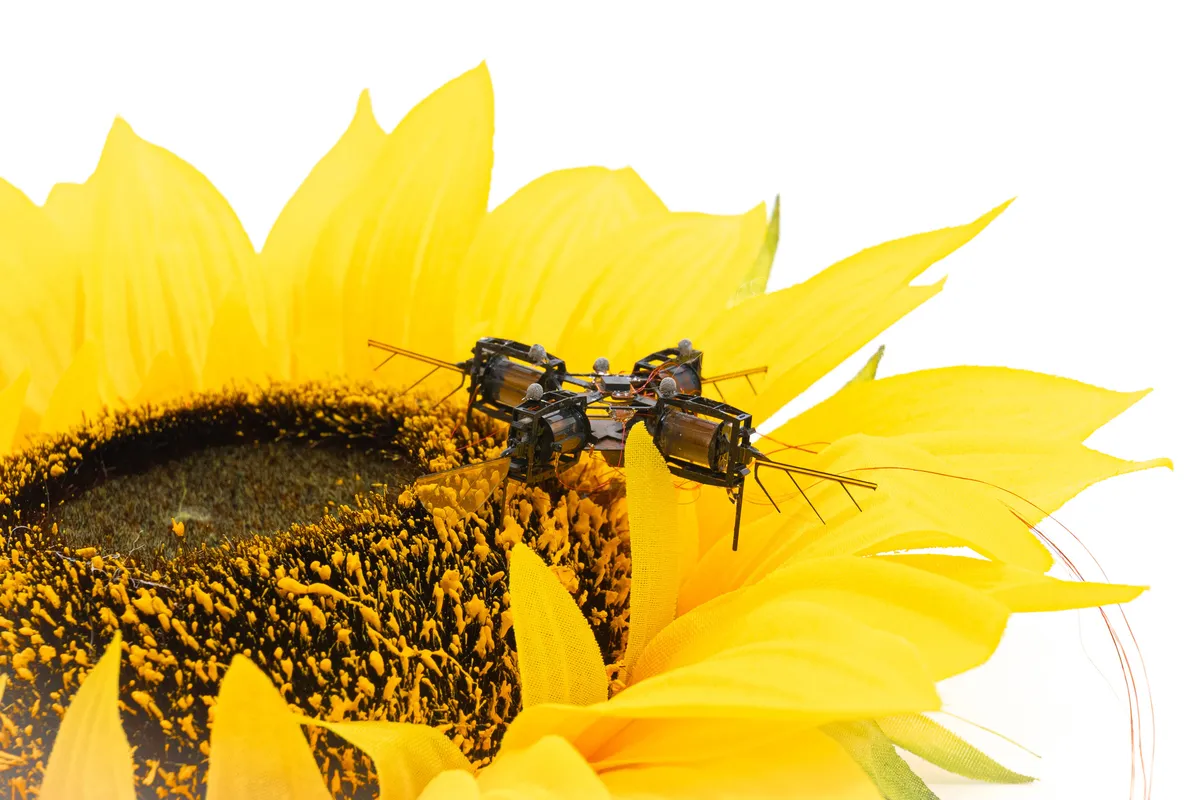
MIT researchers have developed a flapping-wing microrobot that carries its own sensors and computing hardware, allowing it to follow complex flight paths and land on a sunflower without an attached motion-capture system. The robot remains connected to an offboard power source, but the demonstration moves the technology toward potential uses in agriculture and industrial surveillance.
- The microrobot navigated without an attached motion-capture system.
- Its onboard electronics package weighs 244 milligrams.
- The robot achieved a lift-to-weight ratio of 1.9.
- Its actuators grew by 50 percent and net lift forces rose by 46 percent.
- Potential uses include pollination, crop monitoring, and industrial surveillance.
A microrobot that can sense and navigate
Earlier MIT aerial microrobots relied on a laboratory motion-capture system because they could not carry the electronics needed to navigate independently. The latest design includes a sensor suite and a miniature electronics package, enabling the vehicle to estimate its position and orientation while flying.
The robot uses an inertial measurement unit to estimate attitude, an optical flow sensor to estimate lateral flight speed and position, and a time-of-flight sensor to measure height. The researchers also developed an algorithm that rapidly calculates orientation, angular velocity, and position. They found that continuous position estimates produced at a faster rate performed better than slower, more accurate estimates.
In flight tests, the robot hovered at different heights and followed point-to-point trajectories. The researchers report positional errors of only a few centimeters. They also guided it around several plants with a joystick before landing it on a sunflower outside the laboratory's motion-capture environment.
Larger artificial muscles create room for electronics
The robot is roughly the same size and shape as a microcassette and weighs less than a paperclip. It has four wings, each powered by soft actuators, or artificial muscles, that flap rapidly to support agile maneuvers.
To increase its payload, the researchers tuned the radius and length of those actuators. The actuators grew by 50 percent, while the robot's net lift forces increased by 46 percent. The resulting lift-to-weight ratio was 1.9, according to MIT News.
That lift enabled the robot to carry an electronics package weighing 244 milligrams. The package contains the sensors and microcontroller required for onboard sensing and computation. The components were attached to a fiberglass substrate to reduce the effects of vibration during flight.
“This is a really important milestone for the research community. This is the first demonstration of an aerial microrobot that is sensory and compute autonomous,” Kevin Chen, an associate professor at MIT, said in the MIT News report.
Potential applications beyond the lab
The researchers say the small aircraft could eventually support precision agriculture. Microrobots could weave through almond trees or blueberry bushes to pollinate delicate blossoms, or hover near plants to monitor crop health and detect pests before they spread. The source also identifies industrial surveillance as a possible use.
These applications remain potential future uses, since the demonstrated robot still depends on an offboard power source. Even so, onboard sensing and computation remove a major limitation of earlier designs, which had to remain connected to laboratory tracking equipment.
“There are many situations, like pollination or industrial surveillance, where you can’t use a larger robot,” Chen said. The research appears in Science Robotics.