Mobilint's REGULUS edge AI chip is first to use Ceva's NeuPro NPU
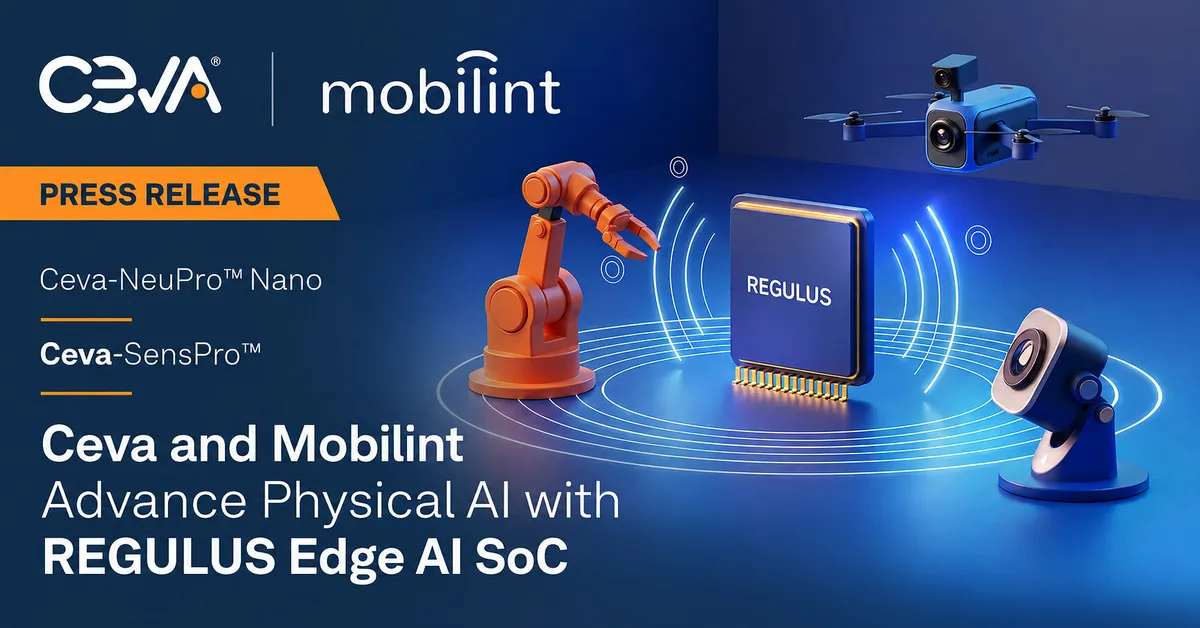
Ceva says Mobilint has deployed its SensPro AI DSP and NeuPro-Nano NPU in the REGULUS edge AI System-on-Chip, the first production deployment of Ceva's NeuPro NPU family. According to the companies, REGULUS delivers 10 TOPS of AI performance at under 3W.
- Mobilint's REGULUS edge AI SoC integrates Ceva's SensPro AI DSP and NeuPro-Nano NPN32 NPU.
- It is the first production deployment of Ceva's NeuPro NPU family.
- According to the companies, REGULUS offers 10 TOPS at under 3W and supports up to 8GB of memory.
- The MLD-R1 AI USB accelerator, based on REGULUS, is now shipping.
What REGULUS combines
Ceva, which licenses silicon and software IP for the Smart Edge, announced that Mobilint, an AI semiconductor company, has integrated two of its technologies into the REGULUS chip: the SensPro AI DSP and the NeuPro-Nano NPN32 NPU. Both sit inside Mobilint's own processing architecture.
REGULUS is designed as a standalone processor for on-device AI. According to the announcement, it delivers 10 TOPS of AI performance at under 3W and supports up to 8GB of memory. The target is real-time AI in power- and space-constrained products, including robotics, drones, machine vision, smart cameras and IoT devices.
A multi-engine design
The chip uses a multi-engine architecture, so different sensing and AI workloads can run on the engine best suited to them. SensPro provides programmable processing for sensing and signal-processing workloads. NeuPro-Nano handles neural processing for always-on inference use cases, which Ceva describes as highly efficient.
Ceva says these blocks complement Mobilint's proprietary AI processing architecture and add flexible sensing and inference capabilities for the varied and changing needs of Physical AI devices, meaning systems that must sense, interpret and respond to their surroundings in real time.
Dongjoo Shin, CEO of Mobilint, said REGULUS "brings together the specialized processing capabilities needed to run sophisticated AI workloads directly on the device within very tight power constraints." Yaron Galitzky, Executive Vice President and General Manager of Ceva's AI Division, called it "an important milestone for Ceva as the first production deployment of our NeuPro NPU family."
Already in a shipping product
REGULUS is already used in commercial products, according to the companies. One is Mobilint's MLD-R1 AI USB accelerator, which was first previewed at COMPUTEX 2026 and is now shipping. It is meant to add on-device AI to existing systems.
MLD-R1 supports computer vision, video analytics and generative AI workloads. The listed applications are smart factories, robotics, machine vision, security, medical devices and digital signage. It works with PyTorch, ONNX, Hugging Face, TensorFlow, TFLite and Keras.
What it means
For Ceva, the deal moves the NeuPro NPU family from design to commercial silicon, which Galitzky described as progress in bringing its AI technology into commercial products. For device makers, the announcement points to a compact option for running inference locally rather than in the cloud, within a tight power budget.
Product information for REGULUS and MLD-R1 is available on Mobilint's website. Mobilint, founded in 2019 and headquartered in Seoul, describes itself as a fabless company focused on NPUs and AI SoCs for edge and on-device AI.
PR Newswire: Ceva and Mobilint Advance Physical AI with REGULUS Edge AI SoC