Neo4j launches GraphRAG kit and explorer for custom knowledge graphs
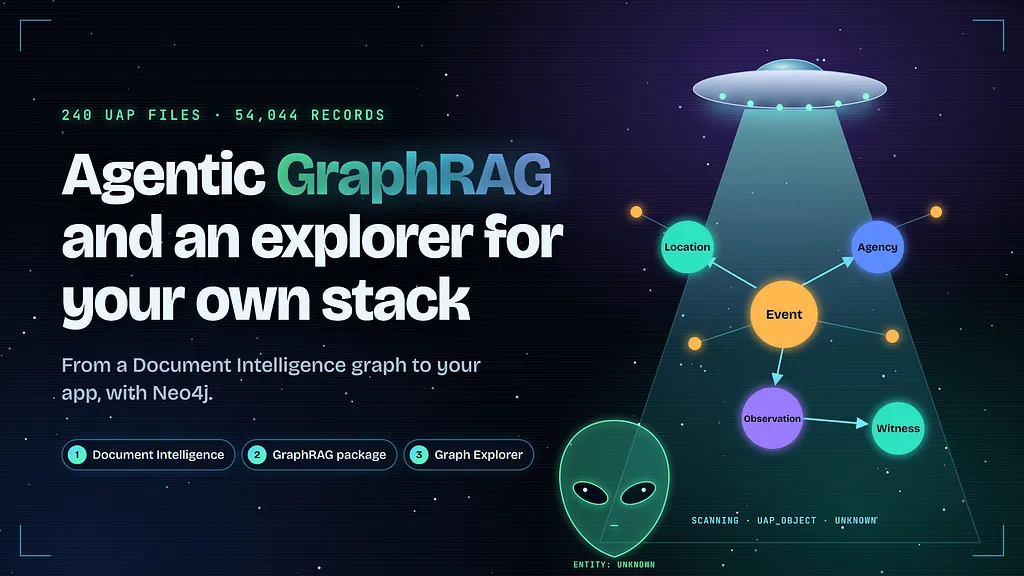
Neo4j has introduced graph-explorer-kit, a Python package and API that let developers query, extend and explore knowledge graphs built in Neo4j Aura. The accompanying Graph Explorer shows retrieved passages, extracted entities and related graph connections while an agent develops an answer.
- Neo4j introduced graph-explorer-kit for building applications on Aura knowledge graphs.
- Zaid Zaim tested the workflow on 240 released UFO documents.
- The resulting graph contained 54,044 records and 58,429 relationships.
- The Graph Explorer displays passages, entities and related graph context.
- The kit supports Microsoft Foundry and OpenAI chat and embedding models.
From documents to a connected graph
The project addresses a common progression described by Neo4j AI Developer Advocate Zaid Zaim: users begin with files, create a knowledge graph with Document Intelligence, and then need to connect that graph to an application. Document Intelligence turns files into a graph inside Neo4j Aura, including source files, chunks with embeddings, extracted entities and relationships, plus links from entities back to the passages and PDFs where they originated.
Zaim tested the workflow on 240 released documents about UFO sightings. The material includes typed reports and memos, with individual sightings sometimes appearing in witness statements, intelligence summaries and redacted memos that disagree. Of 10,214 prepared pages, 6,759 had a usable text layer, 1,499 needed OCR and 1,956 were judged illegible. The resulting graph contained 54,044 records, 58,429 relationships and 24,971 passages.
A kit for applications and agentic retrieval
Built on Neo4j’s neo4j-graphrag library, graph-explorer-kit keeps a project’s domain configuration in a Python dataclass called ProjectSpec. That configuration covers the schema, extraction rules, example Cypher and seed questions. Developers can call a retriever from their own code, provide its tools to an agent or use the HTTP API.
The /api/ask endpoint returns an answer, retrieved context and related graph context as JSON. /api/ask/stream provides the same work as server-sent events. The agent can use hybrid vector, fulltext and graph search, execute Cypher for counting and listing matches, look up an entity or inspect the graph overview. Writes are rejected by the Cypher tool.
Neo4j says the graph can answer questions that a single passage cannot. In the New Mexico example, one passage describes what witnesses saw while another identifies the investigating agency. The graph connects those details through an event, its location, agency and witness observation. Developers can choose vector, hybrid, vector and graph, hybrid with graph, or text2cypher retrieval strategies.
Explorer adds a visual interface
The Graph Explorer is a client of the same API, opened by running graphrag-serve in a browser. It displays matched passages first, followed by extracted entities and one hop of neighbouring records as the model writes. Its views include a graph of connected records, label types, schema details and a timeline of dated events.
Users can ask follow up questions in the same Aura instance and add a newly released PDF. Scanned documents are processed with OCR, and newly added graph content is highlighted. Neo4j cautions that the related graph rings are context rather than a trace of every claim, and that noisy scans can produce incorrect records, such as agency names read from date stamps.
The project is available through the graph-explorer-kit repository. Its instructions cover cloning the project, configuring Neo4j and model settings, preparing the graph and starting the local server. The kit supports chat and embedding models from Microsoft Foundry or OpenAI. Neo4j says the approach gives developers a route from their own documents and schema to an application that combines semantic retrieval, graph relationships and an interactive view.
Neo4j: Agentic GraphRAG and an explorer for your own stack