NIH Offers $100,000 for AI Discoveries in Kidney Disease Data
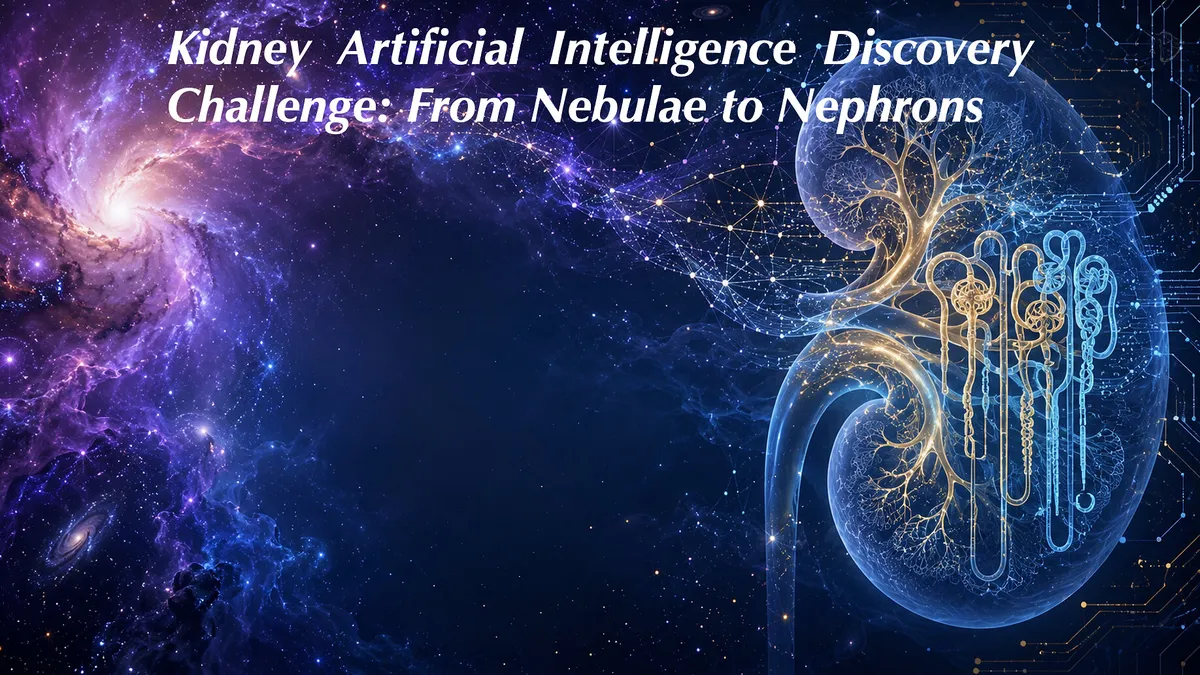
The National Institutes of Health has launched a $100,000 challenge asking researchers to use artificial intelligence, machine learning and computer vision to find overlooked patterns in kidney disease data. The Kidney Artificial Intelligence Discovery Challenge will draw on methods used in astronomy to detect rare signals.
- NIH launched the Kidney Artificial Intelligence Discovery Challenge on Nov. 5, 2026.
- Researchers will analyze publicly available Kidney Tissue Atlas data.
- The challenge offers up to $100,000 across three cash prizes.
- Submissions are due by April 29, 2027.
- Winners will be announced Sept. 1, 2027.
Researchers will examine kidney atlas data
The challenge, titled From Nebulae to Nephrons, is administered by NIH's National Institute of Diabetes and Digestive and Kidney Diseases, or NIDDK. It is facilitated by HeroX, a platform and open marketplace for crowdsourced solutions.
Participants will work with publicly available information from the Kidney Precision Medicine Project Kidney Tissue Atlas. The data includes whole-slide biopsy images, spatial and molecular data, and clinical information. Researchers are being asked to identify rare or unexpected disease signatures that traditional analysis methods may miss.
NIDDK created the Kidney Precision Medicine Project to map kidney cell types, tissue structures and disease pathways. The challenge is intended to extend that work by applying computational techniques to data from kidney pathology.
Astronomy provides the model for anomaly detection
The challenge takes inspiration from astronomy, where artificial intelligence-based anomaly detection has helped researchers find rare gravitational lenses in archival telescope images. NIDDK is asking whether related methods can reveal hidden discoveries in kidney disease data and support advances in precision nephrology.
“This challenge invites researchers to bring fresh computational eyes to kidney data that has never been examined this way,” said Dr. Robert Star, Director of NIDDK's Division of Kidney, Urologic and Hematologic Diseases, according to the announcement.
Star added that adapting anomaly-detection methods from fields such as astronomy could uncover patterns that deepen understanding of kidney disease and move researchers closer to more personalized patient care.
Challenge timeline and judging criteria
The submission window runs from Nov. 5, 2026 through April 29, 2027. Judging is scheduled for April 30 through June 30, 2027, with winners to be announced on Sept. 1, 2027.
Entries will be assessed using three criteria: discovery and novelty of findings, worth 50 points; technical approach and performance, worth 30 points; and scientific interpretability and usability of results, worth 20 points.
NIDDK anticipates awarding up to three cash prizes from a total purse of $100,000. First place is set at $50,000, second place at $30,000 and third place at $20,000. Researchers can register and review eligibility and submission requirements at herox.com/KidneyAI.
Why the challenge matters for kidney research
Kidney disease affects approximately 35.5 million people in the United States, according to the announcement. NIH says critical gaps remain in understanding how the disease develops, progresses and responds to treatment.
By opening the Kidney Tissue Atlas to approaches drawn from another research field, the challenge could give researchers a way to search for disease signatures that conventional analysis has overlooked. The stated focus on novelty, interpretability and usability means submissions will be judged both on what they discover and on how clearly those findings can be understood and used.