nTop and CoreWeave Run 10,000 LES Drone Simulations in 32 Hours
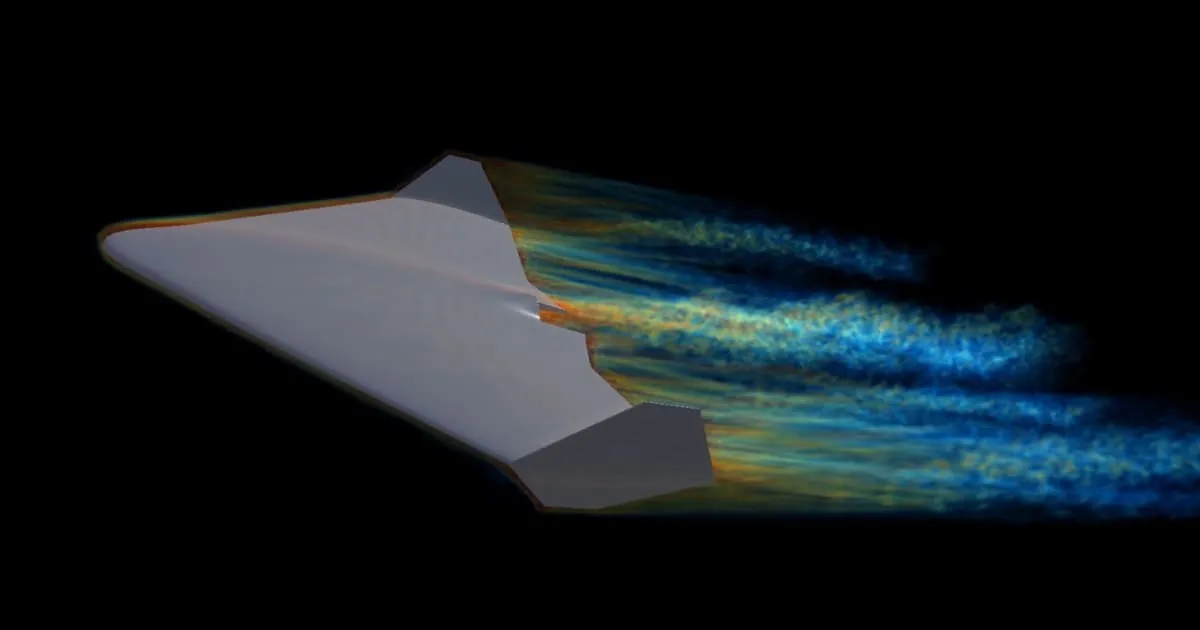
nTop and CoreWeave say they ran 10,000 Large-Eddy Simulations (LES) of drone designs within 32 hours, using nTop Fluids on CoreWeave's GPU cloud. The companies claim the result meets a goal from NASA's CFD Vision 2030 Study four years ahead of schedule.
- nTop and CoreWeave ran 10,000 Large-Eddy Simulations of drone designs in 32 hours, according to CoreWeave.
- The study covered 2,400 drone planform variants across five angles of attack, using nTop Fluids on CoreWeave Cloud.
- The run was headless, with no manual intervention needed to fix software or infrastructure issues.
- The companies say the result meets a NASA CFD Vision 2030 goal four years early.
- LES is far more compute-intensive than RANS and has typically been limited to one-off calculations.
What the proof of concept tested
The two companies, with CoreWeave's physical AI team involved, ran a joint proof of concept to find out how much a single simulation engineer could accomplish in roughly one day. According to CoreWeave, the test case simulated aerodynamics for different drone designs, using nTop Fluids software on CoreWeave Cloud.
nTop is a computational design and simulation platform used by aerospace, defense and advanced manufacturing teams to build complex geometry that traditional CAD cannot handle reliably. Its solver, nTop Fluids, runs computational fluid dynamics (CFD) natively on GPUs. CoreWeave describes its cloud as purpose-built for AI workloads and accelerated by the latest NVIDIA GPUs.
According to the post, the full study ran headless, with no manual intervention required to fix software or infrastructure issues, and scaled reliably end to end.
Why Large-Eddy Simulation is costly
The team chose LES because it is a higher-fidelity approach than the Reynolds-Averaged Navier-Stokes (RANS) methods most engineering teams rely on. RANS averages turbulence into statistical approximations, which is fast but loses important physical detail. LES resolves the large turbulent structures in the flow and models only the smallest scales. That makes it significantly more accurate and orders of magnitude more compute-intensive, according to the post.
Because of that cost, LES has historically been reserved for one-off "capability" calculations rather than large-scale design studies. Turbulence matters in practice: the post notes that it is a major source of viscous drag, and that approximately 30% of global energy consumption is spent overcoming drag in transportation systems.
How the 10,000 simulations were set up
The team used a Design of Experiments methodology to explore the design space systematically. Each design was described by parametric variables, such as airfoil thickness, varied across predefined ranges. Sampling these combinations produced a diverse population of drone geometries.
- 2,400 drone planform geometry variants were considered.
- Each was tested across five angles of attack, for a total of 10,000 simulations.
- The base geometry was a fully parametric Group 3 long-endurance fixed-wing UAS, built in nTop.
Angle of attack is the orientation of the wing relative to the oncoming airflow, which changes as a drone climbs, descends or maneuvers. Testing several angles shows how each design performs across a range of flight conditions. Each simulation yields aerodynamic fields such as pressure and velocity on the drone's surface and in the surrounding flow, plus metrics like the drag coefficient. The companies also published a live dashboard to explore the full test matrix.
The NASA CFD Vision 2030 claim
CoreWeave ties the result to NASA's CFD Vision 2030 Study, which says engineers must be able to "conceive, create, analyze, and interpret a large ensemble of related simulations in a time-critical period (e.g., 24 hours)" to routinely affect critical engineering decisions. The post argues that running ten thousand LES in near-day turnaround bridges the gap between high-fidelity physics and massive capacity computing, and calls the work a milestone reaching that target four years early.
What it means for engineering teams
The companies present the demonstration as a sign of what becomes feasible when scalable software meets purpose-built infrastructure: more simulations, shorter turnaround and higher fidelity. CoreWeave argues that engineering teams and OEMs increasingly expect automation, autoscaling and resilience from cloud providers, and says Kubernetes can run HPC applications with no measurable performance penalty versus bare metal, citing a study.
The post positions the proof of concept as an example of cloud HPC that keeps the performance expectations of legacy HPC workflows while adding the portability and automation of cloud-native infrastructure. The results come from the companies' own test case on one drone geometry, so broader claims would need further testing.