NVIDIA Nemotron 3.5 Super VL Brings Multimodal Reasoning to Enterprise Agents
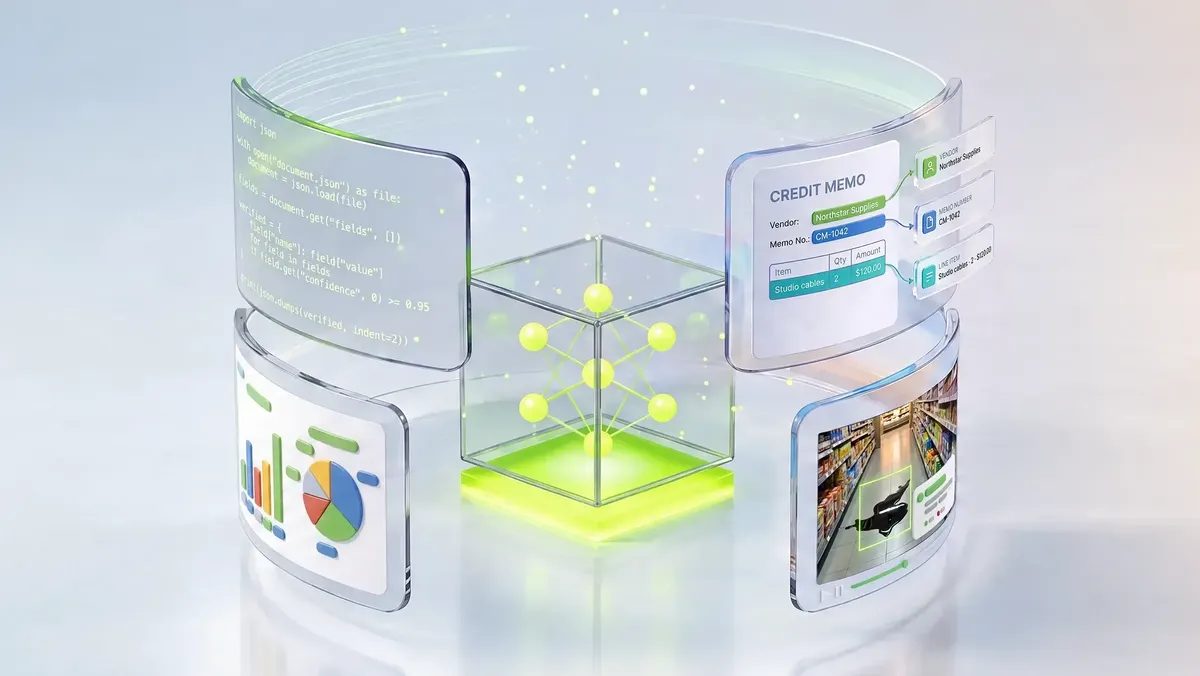
NVIDIA has introduced Nemotron 3.5 Super VL, an open and customizable multimodal model built for specialized agentic workflows. According to NVIDIA, it uses a 120B-parameter mixture-of-experts architecture that activates 12B parameters per token, and it handles text, image, document and video inputs in a single model.
- Nemotron 3.5 Super VL is an open multimodal model with 120B parameters in total and 12B active per token.
- NVIDIA claims up to 5x higher throughput for agentic tasks on a single GPU versus other open models in its size category.
- It scored 80.8% on CharXiv, against 63% for Nemotron 3 Nano Omni.
- Scale AI, Ramp and AI21 report or expect gains in cost, latency, throughput and accuracy after post-training.
- NVIDIA is releasing open datasets on Hugging Face, including 45 vision-language datasets, for fine-tuning and RL.
One model for text and visual agent tasks
NVIDIA says enterprise agents are taking on longer and more complex workflows. A single request can involve reading a document, checking information across sources, following company policy and calling several tools. Nemotron 3.5 Super VL is aimed at that kind of work.
The model combines reasoning, instruction following and tool use with text, image, document and video understanding. According to NVIDIA, this means teams can handle text and visual tasks without deploying separate text and vision-language models or passing task context between them.
On a single GPU, the company says the model delivers up to 5x higher throughput for agentic tasks compared to other open models in its size category. NVIDIA also reports over 600 TPS on Artificial Analysis Intelligence Index agentic tasks on the Baseten endpoint.
NVIDIA lists several target workflows:
- Coding: testing and validating code, analyzing errors and recommending fixes.
- Web research: searching websites, connecting information and verifying answers.
- Document intelligence: extracting information from tables, charts and page layouts to produce summaries and reports.
- Cybersecurity: identifying vulnerabilities and triaging threats.
- Video understanding: extracting information for search, content review and incident analysis.
In a system of models, NVIDIA positions Nemotron 3.5 Super VL for specialized, multistep work. Smaller models such as Nemotron 3.5 Lightning handle high-volume text tasks, while frontier models such as Nemotron 3 Ultra handle complex planning and orchestration.
Customization and early adopter results
Developers can post-train the model with NVIDIA NeMo using their own data, tools, policies and workflows. NeMo AutoModel supports supervised fine-tuning (SFT) and low-rank adaptation (LoRA), while reinforcement learning is used to improve performance in agentic environments that reflect organizational workflows. NVIDIA also points to NeMo RL and NeMo Gym for RL and environment-based evaluation.
Alongside the model, NVIDIA is releasing open datasets on Hugging Face. They include agentic tool-use and conversational data, finance reasoning and tool-calling datasets, instruction-following and chat data, long-context transduction and translation data, fairness data, and 45 vision-language datasets. Organizations can adapt and deploy the open weights in supported local, data center or cloud environments.
NVIDIA cites three examples of post-training:
- Scale AI post-trained the model for automated vendor credit processing at Skydance Corporation. Inference cost for this workload will decrease by 40x and latency by 5x, according to NVIDIA.
- Ramp is converting receipt images into structured JSON containing merchant information, dates and payment data. The company expects up to 50% higher throughput and 10x lower latency.
- AI21 post-trained the model for threat intelligence and vulnerability analysis at AI safety and security company Alice, improving accuracy by 40%.
Visual training and benchmark results
The model's visual training covers charts, tables, optical character recognition (OCR), multipage documents and video understanding. A two-stage SFT pipeline trains the language and vision components, combining visual evidence with reasoning, chat, safety, long-context data and agent trajectories.
NVIDIA says diverse training data generated with NeMo Data Designer helped the model understand complex charts. On CharXiv, a chart-reasoning benchmark, the model scored 80.8%, compared with 63% for Nemotron 3 Nano Omni. With Python code interpretation, it reached 84%. NVIDIA also describes the model as one of the top open models on the OCRBench v2 leaderboard.
On agent evaluations, NVIDIA reports that Nemotron 3.5 Super VL scores higher than Nemotron 3 Ultra on Hermes Bench and LangChain behavioral evaluations:
- Hermes Bench: 63.44% for Nemotron 3.5 Super VL, against 56.33% for Nemotron 3 Ultra.
- LangChain Evals: 87.05%, against 84.3%.
The evaluations span Hermes, LangChain, OpenClaw, OpenCode, Pi, Codex and Claude. The model was built with support from Nemotron Coalition organizations: datasets from Perplexity helped improve mid-training, and environments from Prime Intellect enabled better teacher models.
Inference efficiency and what it means for teams
NVIDIA says the model uses LiLiCorr speculative decoding, NVFP4 quantization with quantization-aware distillation, multi-token prediction and context reuse to improve inference efficiency on platforms including NVIDIA DGX Spark. The company adds that for always-on agents, efficiency determines how much work a deployment can complete, since throughput, token usage, tool calls and the steps needed to reach a correct result all affect task completion time.
For organizations building agents, the release offers an open-weight model that can be tuned to domain terminology, tool interfaces and policies, rather than relying on separate text and vision models. The adopter figures come from NVIDIA's own account, and some, such as the Scale AI and Ramp numbers, are stated as expected or forthcoming results for specific workloads. NVIDIA points readers to the Nemotron 3.5 technical report, a usage cookbook on GitHub and NVIDIA NIM for optimized deployment.
NVIDIA Developer: NVIDIA Nemotron 3.5 Super VL Powers Specialized Agents with Multimodal Reasoning