NVIDIA Unveils Simulation Tools for More Precise Robot Skills
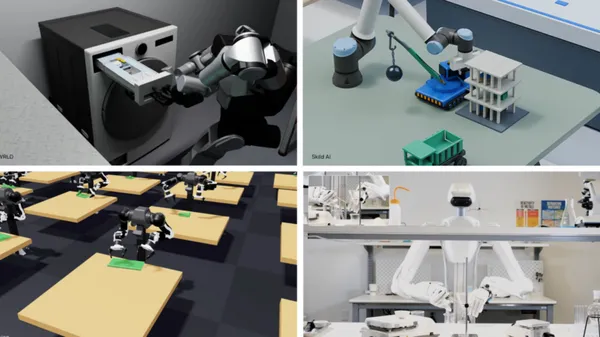
NVIDIA is introducing open robotics technologies at the Conference on Robot Learning in Austin, Texas, aimed at teaching robots delicate tasks such as aligning gears, connecting cables and assembling small components. The company is also presenting GR00T 2, simulation updates and evaluation tools for developing more capable physical robots.
- NVIDIA introduced GR00T 2, an open world action model for robot manipulation.
- GR00T 2 achieved 95% average success with five demonstrations across 50 tasks.
- Isaac Lab 3.0 with Newton delivered up to 2.5x the training throughput in a benchmark.
- AlphaNIST trained one policy across 20 precision assembly tasks.
- Isaac Lab Arena 0.4 adds scaled evaluation for changing industrial conditions.
GR00T 2 targets dexterous robot skills
NVIDIA describes GR00T 2 as an open frontier world action model built on NVIDIA Cosmos. Trained on diverse robot and human data, including 100,000 hours of NVIDIA open source human egocentric data, the model is designed to help robots learn manipulation skills.
According to NVIDIA, GR00T 2 completed 40 of 50 evaluated tasks at least once without task-specific demonstrations. It achieved 71% average success across 50 tasks with one demonstration per task, rising to 95% with five demonstrations. The model can also learn from human demonstrations and transfer skills between different robot bodies without robot demonstrations.
NVIDIA says AI agents can use GR00T 2’s application programming interface and supporting tools to run skills in sequence and recover from errors. Nexuni is testing the model for robotic laundry handling, while Foxconn is applying it to factory automation for server manufacturing. Siemens is evaluating it across industrial use cases, and MicroAGI is using a version post-trained through reinforcement learning for Ethernet cable swapping with a YAM robotic arm.
Isaac Lab and Newton bring training into simulation
NVIDIA’s Isaac Lab 3.0 open source robot learning framework lets researchers set up training environments with simulation-ready assets, switch between NVIDIA PhysX and Newton physics solvers, select renderers for perception based training and apply a reinforcement post-training library to foundation models such as GR00T.
Newton, NVIDIA’s open source physics engine, adds support for deformable objects such as cables and cloth, as well as complex articulated systems including robotic hands with many interacting joints. NVIDIA says Isaac Lab 3.0 with Newton achieved up to 2.5x the training throughput of Isaac Lab 2.3 with PhysX in a vision based dexterous manipulation benchmark.
In another example, AlphaNIST uses Isaac Lab to train one policy across all 20 tasks on the NIST Assembly Task Board. NVIDIA says it achieved more than 98% training success, compared with 81% for separate per task policies, while using roughly 39x less GPU time. Success Guided Sampling from the University of Washington and NVIDIA focuses practice on tasks a policy succeeds at about half the time, and can scale training beyond a million parallel environments.
Benchmarks aim to expose failures before deployment
NVIDIA is also presenting Isaac Lab Arena, an open source framework for scaled policy evaluation. It allows developers to create repeatable evaluations and run policies across thousands of variations in parallel. The resulting analyses show which conditions lead to failures, helping researchers decide what to address in later training runs.
The developer preview of Isaac Lab Arena 0.4 is arriving at CoRL. NVIDIA says DexBench and VABAR are among the first new open benchmarks designed to measure robot dexterity and adaptability across industrial tasks using Isaac Lab Arena and Newton. The source describes these tools as part of a broader move from robot locomotion toward manipulation, where simulation can help researchers train, test and refine skills before using physical machines.
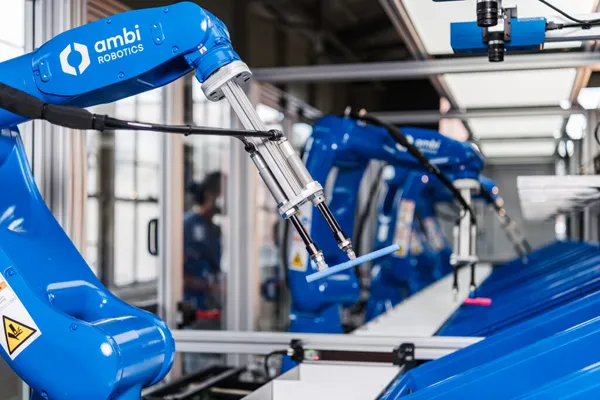
NVIDIA is working with partners including Ambi Robotics, Bosch Research, Dexmate, Dyna Robotics, FieldAI, Flexion, Noitom Robotics, Siemens, Skild AI, RLWRLD, UC Berkeley, Walden Robotics and the University of Washington. The company’s examples suggest the immediate focus is on giving researchers and industrial developers more ways to rehearse complex work, identify weaknesses and improve robot performance before deployment.