NVIDIA RTX Spark Aims to Put Coding, Testing and Deployment on One PC
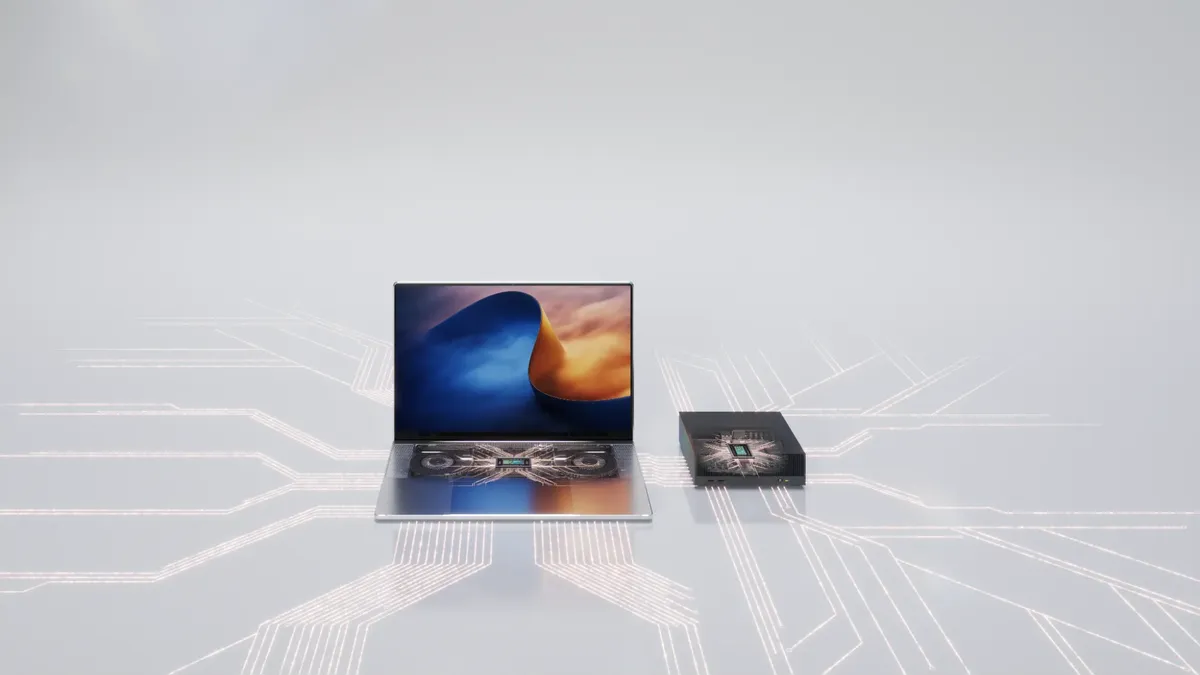
NVIDIA says its RTX Spark laptops and compact desktops let developers run local coding agents and handle coding, testing and deployment on a single machine. According to NVIDIA, the platform combines the GB10 system-on-a-chip with up to 128GB of unified memory and 1 petaflop of FP4 AI compute.
- NVIDIA RTX Spark pairs the GB10 system-on-a-chip with up to 128GB of unified memory and 1 petaflop of FP4 AI compute.
- NVIDIA claims 4.6x coding-agent, 2.7x fine-tuning and 1.8x compilation performance versus Intel Panther Lake 12Xe.
- With Microsoft, NVIDIA is adding the first PyTorch-CUDA build and Python 3.15 native by default for Windows on Arm.
- Nemotron 3.5 Bolt 74B-A9B 24GB is a 2-bit quantized, fully open source MoE model built for local agents.
- Decision models in llama.cpp and Unsloth let agents pick actions up to 200x faster, according to NVIDIA.
One machine instead of a split workflow
NVIDIA describes a shift in how software gets built: developers have moved from writing every line by hand to directing agents that write most of the code. The company says the resulting workflow is spread across a laptop, a cloud model API and a cloud VM. RTX Spark is meant to bring those pieces together.
Developers can work in Windows, including a new Windows Developer Config created with Microsoft. According to NVIDIA, it installs the top development frameworks, mutes notifications, enhances the terminal and can move the task bar to the side. They can also use Windows Subsystem for Linux to get the same environment and dependencies they would use when deploying to the cloud, so no code migration is needed.
Because the machine has an NVIDIA GPU, NVIDIA says developers can test and deploy to 150 million RTX PCs as well as virtually all the clouds that run on NVIDIA GPUs. The memory and compute also allow coding models such as Qwen 3.8 Flash Next to run locally, which NVIDIA says reduces cloud coding agent token consumption.
Performance claims and the Windows on Arm stack
NVIDIA argues that development has moved from a CPU-bound to a GPU-bound workload, since developers now run inference for coding agents, fine-tune models and still compile code. Compared with Intel's Panther Lake 12Xe, the company says RTX Spark delivers 4.6x performance on coding agents, 2.7x on fine-tuning and 1.8x on code compilation.
NVIDIA's footnote says the figures normalize an Intel Core Ultra X9 388H to 1.0. The tests were AA-AgentPerf-local with Qwen3.8-27B, Unsloth LoRA with Llama-3.1-8B, and Linux kernel compilation using the Phoronix Test Suite.
NVIDIA also worked with Microsoft to expand the Windows on Arm developer landscape. New releases include:
- the first PyTorch-CUDA build
- the first Python release that is native by default, Python 3.15
- over 2,000 ready-to-use Conda packages
- Arm-compatible versions for more than 97% of the top 15,000 Python packages
The company adds that developers get access to CUDA-X libraries, including FlashInfer and NeMo tools, plus a repository of NVIDIA Skills that teach agents to use CUDA-X libraries without deep CUDA knowledge.
Local coding agents and new Nemotron model
NVIDIA says it worked with agents including GitHub Copilot, Pi, Hermes and OpenClaw. The improvements include optimized recipes for deploying local models, OS-level sandboxing through NVIDIA OpenShell and/or Microsoft Execution Containers, and hybrid prompt routers that send prompts to local models when they are good enough and escalate to the cloud when needed.
GitHub Copilot now supports local AI through Windows ML, which works with llama.cpp as a backend. The HydraFusion prompt router has been upgraded to support local models, and the new MAI 1.1 Coding Flash model can run locally on RTX Spark. Pi, an open-source coding agent with a lightweight terminal interface, is optimized for the platform. JetBrains has launched native support for Junie Local, which reads code, edits files and runs tests while the model and code stay on the machine. It sizes its context window to the GPU's available memory.
NVIDIA also introduced Nemotron 3.5 Bolt 74B-A9B 24GB, a mixture-of-experts model with 74B parameters, 9B of them active, packed into 24GB through 2-bit quantization. NVIDIA says it is faster than most popular dense models and smarter than most popular MoE models with a similar memory footprint. It will run at launch through llama.cpp, vLLM, Ollama, Unsloth and LM Studio, and is fully open source, including training data, weights and recipes.
Decision models, media SDKs and porting apps
Decision models are now supported in llama.cpp and Unsloth on RTX Spark and GeForce RTX GPUs. NVIDIA says they let agents choose what to do next, such as classifying requests or selecting an action, up to 200x faster than traditional agents that rely on lengthy reasoning loops.
The NVIDIA AI for Media SDKs are also available, with a Python wheel on PyPI supporting video super resolution, frame generation and TrueHDR. C++ SDKs are on NGC for RTX Spark and Windows on Arm.
For existing Windows applications, NVIDIA advises assessing Windows on Arm dependencies first, then choosing a native Arm64 build or using Arm64EC to migrate components step by step. Developers should test installation, functionality, performance and the NVIDIA and CUDA paths their app uses.
What it means for developers
For developers, the pitch is a single PC that can host the coding agent, the model, the test environment and the deployment target, with less reliance on cloud tokens. The performance figures come from NVIDIA's own comparison and are tied to the specific tests listed above. NVIDIA directs readers to its RTX Spark systems page for purchasing options and to an AI Development playbook for setting up Windows and an agent.
NVIDIA Developer: Code, Test, and Deploy on One Machine with NVIDIA RTX Spark