OpenRouter launches beta localization in eight languages
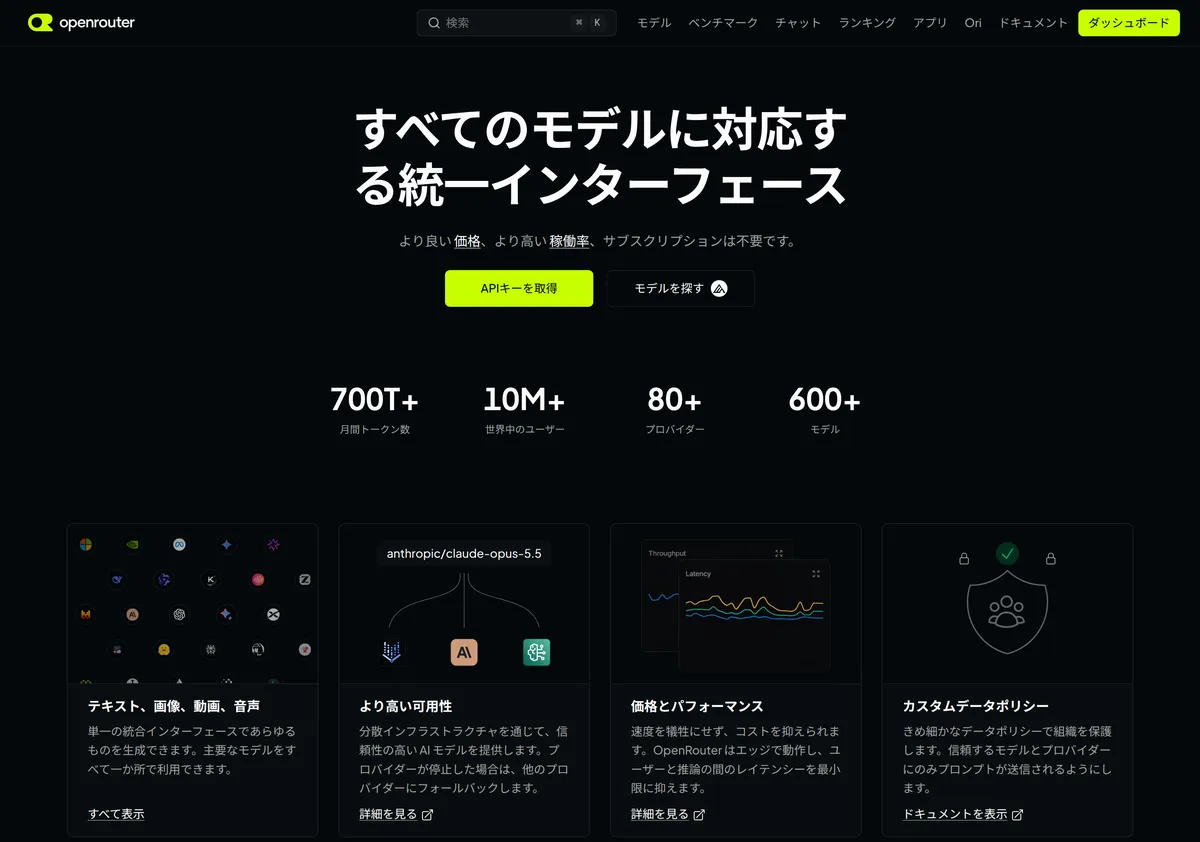
OpenRouter has launched beta localization in seven languages alongside English, covering Chinese, Spanish, Brazilian Portuguese, German, French, Japanese and Korean. The company says its automated pipeline updates translations daily and sends failed or disputed results through retries and human review.
- OpenRouter localization is in beta across seven languages besides English.
- The daily pipeline detects changed strings and stores translations in Git.
- GPT-6.1 Sol passed 99.2% of 254 model-comparison cases on the first try.
- Failed translations can pass through retries, verification and human review.
- The system can require about 20 model calls per string per language in the worst case.
Seven languages join English
The localized versions are available in 简体中文, Español, Português (Brasil), Deutsch, Français, 日本語 and 한국어. Users can switch languages from the account menu or visit language-specific addresses such as openrouter.ai/ja and openrouter.ai/ko/models.
OpenRouter says localization is starting in beta. The company’s website contains 16,918 English strings, and some change every day. A one-time translation would therefore become outdated quickly, so the company built a system that identifies changed strings, translates them and checks the results as part of its daily development process.
How the translation pipeline works
Translations are stored as JSON catalogs in Git alongside the code. OpenRouter uses the open-source General Translation runtime to wrap strings in its React code, while the translated files load locally at runtime. Until a changed string is translated, the site continues to show the English source.
Each entry includes a fingerprint of its English source. When that source changes, the fingerprint no longer matches and the translation returns to the queue. This allows the system to find stale entries without retranslating the whole catalog.
The pipeline has five stages: extraction, translation, code checks, verification and review. New or changed strings are sent to GPT-6.1 Sol in batches of up to 40, with UI roles, glossary rules and style notes included in the request. Code checks reject problems involving ICU placeholders, plural branches, rich-text tags, whitespace and forbidden product-term forms.
A second call to the same model verifies each translation against the English text. Critical or major problems send the string back to the translator with the verifier’s objections attached. Failed batches can be retried in smaller pieces, with up to 4 check passes by default and a setting that can rise to 20. The translator receives up to 3 retries after its first attempt.
OpenRouter says the worst case is about 20 model calls per string per language. If the verifier is unavailable, the pipeline writes nothing and leaves the string in English. Each daily batch becomes a pull request, where an AI reviewer posts findings and a person makes the merge decision.
Why OpenRouter chose the heavier model
OpenRouter’s model comparison covered 254 cases. GPT-6.1 Sol passed 99.2% of cases on the first try, compared with 91.7% for the smaller GPT-6 Luna. The company says GPT-6 Luna was weakest in Korean and Japanese, and that some of its hardest failures continued through every retry because General Translation could not compile the responses.
For those 254 cases, GPT-6.1 Sol cost $1.94 compared with $0.57 for GPT-6 Luna, about 3.4 times as much. OpenRouter says it accepts the higher cost because a translation that does not converge can require more time and effort to repair.
The company also removed a separate judge model after testing showed it sent too much correct work back for retranslation. With the verifier in place, disabling the judge reduced first-pass accuracy from 99.2% to 98.8%, while leaving the final result unchanged.
What the system means for users
The system is designed to keep localized pages aligned with OpenRouter’s changing English interface rather than treating translation as a one-time project. Reviewers can turn reported mistakes into glossary rules, style notes, overrides or future test cases.
OpenRouter acknowledges that some errors still pass the automated checks. In those cases, the pull request flag brings the issue to the person responsible for merging it. For users, the fallback is an English string when a translation cannot be safely produced, while the beta gives them access to seven additional languages as the company continues refining the process.
OpenRouter: How We Built a Self-Correcting Localization System for OpenRouter