Palo Alto Networks Named a Leader in 2026 Gartner PAM Magic Quadrant
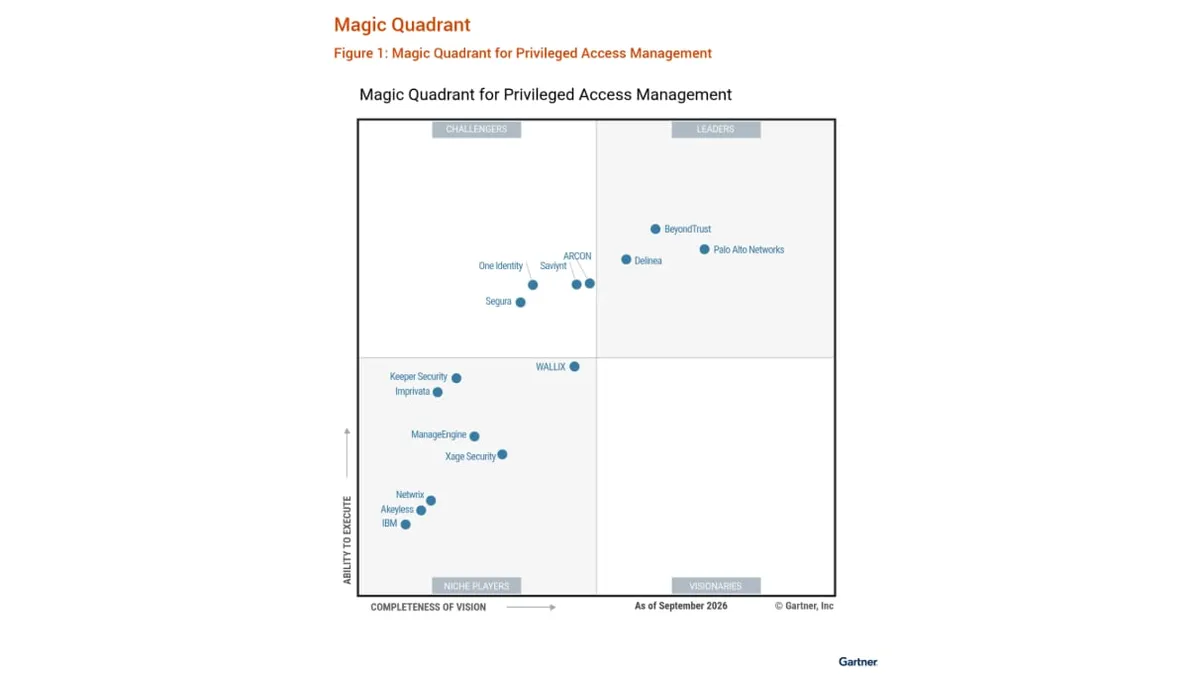
Palo Alto Networks says it has been named a Leader for the eighth consecutive time in the 2026 Gartner Magic Quadrant for Privileged Access Management. According to the company, it is again positioned furthest in Completeness of Vision, as in every edition of the report.
- Palo Alto Networks says it is a Leader in the 2026 Gartner Magic Quadrant for Privileged Access Management for the eighth consecutive time.
- The company says it is positioned furthest in Completeness of Vision, as in every edition of the report.
- It is the first report to carry the Palo Alto Networks name; the PAM product line is called Idira.
- The company cites a 109 to 1 ratio of machine identities to humans and says Idira added native SPIFFE/SVID support for workloads and AI agents.
- Gartner notes its publications are opinions, not statements of fact.
Eighth Leader placement, first under the Palo Alto Networks name
In a blog post dated Oct 26, 2026, Sonny Singh of Palo Alto Networks said the company is recognized as a Leader in the 2026 Gartner Magic Quadrant for Privileged Access Management. The report evaluates providers on Ability to Execute and Completeness of Vision. Palo Alto Networks says it has been positioned furthest in Completeness of Vision in all eight reports it has appeared in for this category.
The 2026 edition is also the first to carry the Palo Alto Networks name. The privileged access product line is called Idira, and the company says that since Idira joined forces with Palo Alto Networks, its PAM platform sits inside the larger cybersecurity company, where privileged access connects to real-time threat detection and response, AI security and Unit 42 threat intelligence. The report cited is by Paul Mezzera, Shubham Gera, Tarun Rohilla and Scott Brinker, dated 21 October 2026.
Gartner states that its publications consist of opinions and should not be construed as statements of fact, and that it does not advise technology users to select only vendors with the highest ratings.
Why the company says PAM must change for AI
The post argues that identity is now the attack surface. According to Palo Alto Networks, frontier AI lets attackers move faster, and they increasingly log in rather than break in. The company says machine identities now outnumber humans 109 to 1, and that AI agents, which need access to enterprise systems to do useful work, are entering the workforce.
From that, the company concludes that PAM must extend beyond vaulted administrator credentials to discover, control and govern privilege across the enterprise. It describes Idira's Modern PAM platform as combining vaulted access and zero standing privileges (ZSP) with secrets management, workload security and identity governance. The company says it is bringing ZSP to every modern target, including cloud, apps and Kubernetes, and that Idira added native SPIFFE/SVID support to deliver short-lived cryptographic identities to workloads and AI agents.
The post also includes a short explainer on the difference between the two access models. Vaulted access protects stored privileged credentials, while ZSP removes standing privileged access by granting permissions for a specific task and revoking them when the task or authorized period ends. Modern PAM, it says, can combine both approaches.
How Palo Alto Networks says it helps customers modernize
The company lists three areas where it says it delivers on modernization. The first is data-driven innovation: it says its Transformation Decision Engine uses customer environment data to quantify the value of PAM modernization, and pairs that with years of experience guiding PAM implementations.
The second is customer experience. Idira, according to the post, guides cross-functional security teams through the shift from standing access to ZSP, supported by the Idira Blueprint, hands-on training and an active peer community. The third is scale and reach. The company says its security platform sees identity risk across the whole attack surface, so a stolen or abused privilege becomes a signal that defenses can act on in the moment.
What it means for buyers
For organizations choosing PAM tools, the post signals where Palo Alto Networks wants to compete: governing human, machine and AI agent access in one approach, and linking privileged access to broader threat detection. These are the company's own claims and positioning, and the placement reflects Gartner's opinion rather than a verdict on any single product. The post says the company intends to "stay furthest ahead" of attackers using frontier AI models and of enterprises deciding how fast to move.
Palo Alto Networks: Palo Alto Networks Named a Leader in the 2026 Gartner® Magic Quadrant™ for Privileged Access Management