Palo Alto Networks and NVIDIA Move Agentic AI Security Onto BlueField DPUs
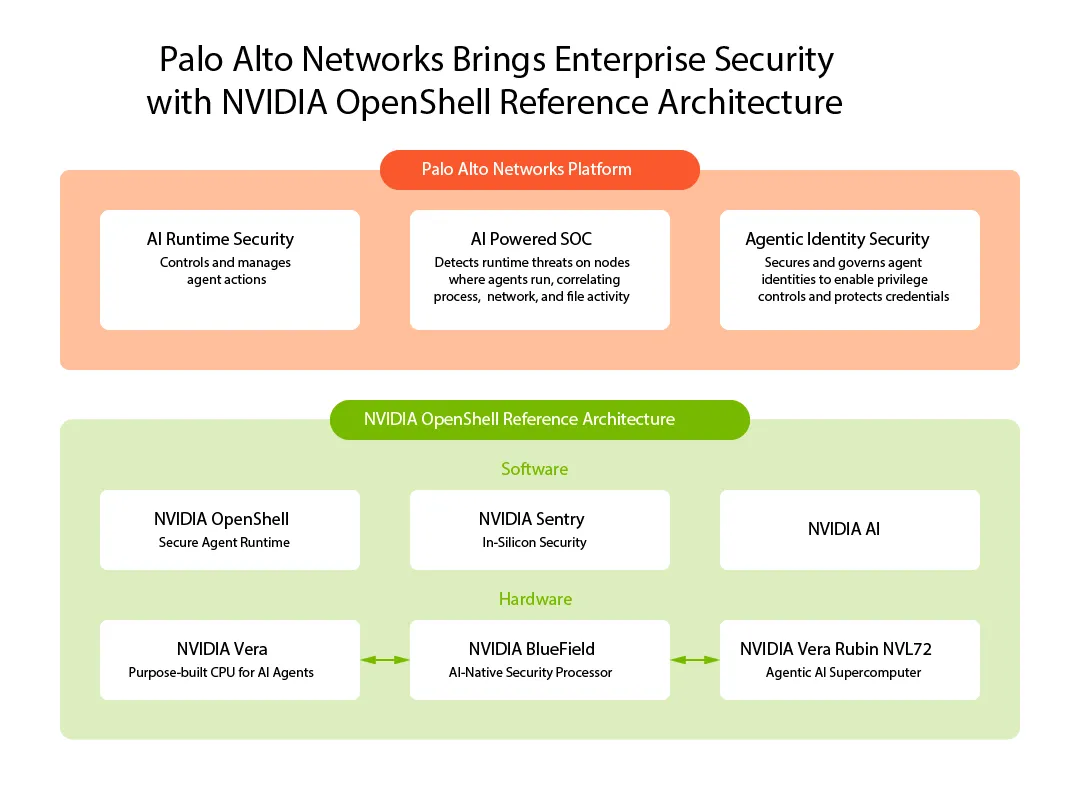
Palo Alto Networks says its AI Runtime Security on NVIDIA BlueField DPUs is now generally available across AI factory and industrial edge deployments. The company also described identity, security operations and partner work built around the NVIDIA OpenShell Reference Architecture for safe AI agents.
- Palo Alto Networks says AI Runtime Security on NVIDIA BlueField DPUs is now generally available for AI factory and industrial edge deployments.
- The company says offloading security from the host increases token throughput and strengthens runtime protection.
- An integration of agentic identity security with NVIDIA Sentry on BlueField is still to come.
- Cortex XSIAM is integrated with NVIDIA DOCA Argus to feed host runtime signals into an AI-driven SOC.
- Deloitte and World Wide Technology are named partners for planning and deploying secure NVIDIA AI factories.
Runtime protection moves off the host
According to Palo Alto Networks, AI is shifting from answering questions to taking action, with agents using tools, accessing enterprise data and carrying out work across systems. That makes an agent's identity, its authority and its actions into security decisions.
The company argues that the AI factory conversation has centered mainly on compute capacity and token generation, and that runtime security is now just as essential. Its reasoning: agents can be steered past their guardrails, and a compromised host cannot be trusted to accurately report what occurred. Security teams therefore need visibility and enforcement that operate independently of the host.
Palo Alto Networks AI Runtime Security on NVIDIA BlueField DPUs isolates security processing in a dedicated infrastructure domain. Because BlueField sits in the path between agents and the models, data and services they access, policies are enforced in silicon, which the company says puts them beyond the reach of a compromised host. The capability covers both GPU-accelerated AI workloads and CPU-based agent runtimes. Offloading security from the host node brings increased token throughput and stronger runtime protection, according to the company.
For deployment at scale, Palo Alto Networks says its work with Spectro Cloud manages the deployment and operation of AI Runtime Security on BlueField DPUs, from the data center to distributed edge environments.
Identity and SOC integrations
The second area is identity. An agent may act for a person, a team or an autonomous business process, and often needs access to several tools and data sources. Broad, persistent access creates risk, while overly restrictive access limits usefulness. Palo Alto Networks is advancing an integration between agentic identity security and NVIDIA Sentry on BlueField. The aim is to give each agent a verifiable identity, grant access suited to its task and make its actions attributable.
Once available, the solution is meant to deliver zero-trust protection and tamper-resistant auditing for agents by moving security controls, including identity, to the BlueField DPU, separate from the host operating system. This integration is not yet available.
On the operations side, the company has announced an integration of Cortex XSIAM with NVIDIA DOCA Argus, which monitors host activity from BlueField's independent trust domain. Security operations teams get runtime signals that do not rely on an agent installed on the monitored host. Combined with network, cloud and identity data in an AI-driven SOC, this lets teams investigate AI infrastructure in the context of the wider enterprise.
In the described architecture, agents run within the NVIDIA OpenShell secure runtime on the NVIDIA Vera CPU. Observability is offloaded to the BlueField DPU. NVIDIA Sentry, built on DOCA Argus, inspects memory and network out-of-band to detect threats without slowing AI inference. When malicious events or policy violations occur, DOCA Argus streams alerts to Cortex XSIAM for automatic correlation. Palo Alto Networks says it is continuing to develop broader fleet visibility and more comprehensive response workflows.
Partners and what it means for enterprises
Palo Alto Networks is also working with strategic vendors, including Deloitte and World Wide Technology (WWT), to help customers plan and deploy secure NVIDIA AI factories. Deloitte's Silicon-to-Service offering, combined with its Secure AI Foundations, helps organizations implement AI use cases on NVIDIA AI infrastructure through validated architectures and managed services. WWT's AI Proving Ground lets customers evaluate and test an integrated stack before committing to production.
The post also lists an AI gateway on NVIDIA Vera CPU systems among the five connected areas, though it gives no further detail on it.
For enterprises, the message is that agent pilots need controls that keep pace with production use. The company frames the requirements as runtime protection, governed identities, independent visibility and a unified way to manage controls. Customers weighing agent rollouts on NVIDIA infrastructure can use the generally available runtime protection now, while the identity integration remains a future step.
Palo Alto Networks: Advancing Agentic AI Security with Palo Alto Networks and NVIDIA