Pegatron Shows Vera Rubin NVL72 Rack and Liquid-Cooled Servers at OCP 2026
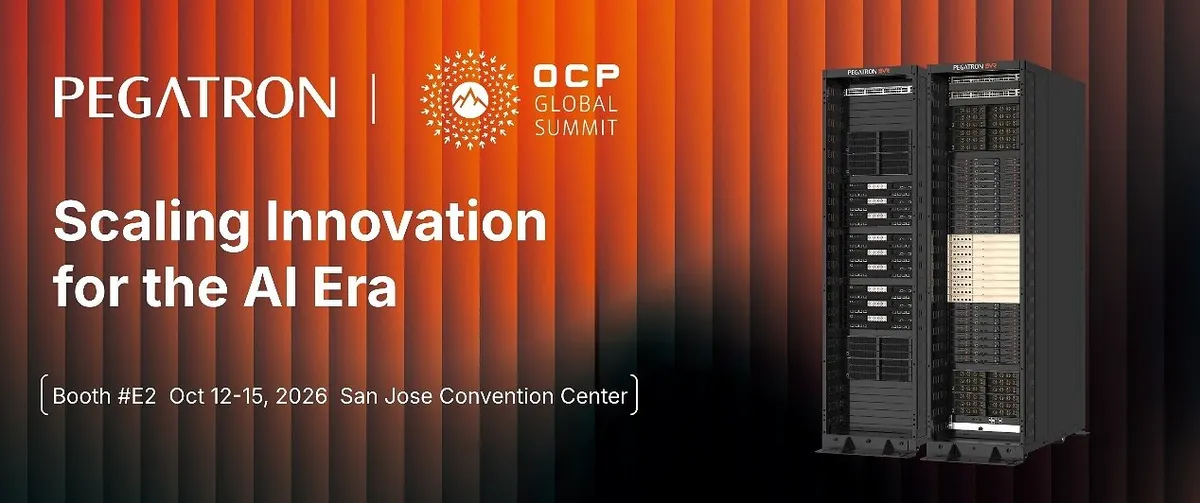
Pegatron will present a range of liquid-cooled AI servers and racks at OCP Global Summit 2026, led by the RA4803-72N3, a rack-scale platform built on the NVIDIA Vera Rubin NVL72. Under the theme "Scaling Innovation for the AI Era," the company says it will show how AI platforms become production-ready systems, racks and clusters for data centers.
- Pegatron will exhibit at OCP Global Summit 2026 under the theme "Scaling Innovation for the AI Era."
- The RA4803-72N3 rack integrates 72 NVIDIA Rubin GPUs and 36 NVIDIA Vera CPUs with fully liquid-cooled integration.
- The AS210-2T1-8H3 is a 2U liquid-cooled HGX Rubin NVL8 system, with rack options for up to 64 or 72 GPUs.
- AMD EPYC 9006-based storage and compute servers include a 2U model supporting up to 32 E3.S NVMe SSDs.
- Pegatron links digital-twin simulation, thermal validation and rack-level testing to its manufacturing workflow.
Vera Rubin NVL72 rack at the center
According to Pegatron, the RA4803-72N3 integrates 72 NVIDIA Rubin GPUs, 36 NVIDIA Vera CPUs, 6th generation NVIDIA NVLink and fully liquid-cooled rack-level integration. The company says the platform highlights its ability to engineer and manufacture complex rack-scale AI systems and to move from design to cluster deployment.
Pegatron argues that deploying AI infrastructure at scale takes more than compute performance. It lists system-level engineering, liquid cooling, power architecture, open standards, manufacturing readiness and rigorous validation as requirements. The company says it combines these through OCP-aligned architectures, including ORv3 busbar, DC-MHS and OCP 3.0 network adapters.
Vera CPU, Groq 3 LPX and HGX Rubin NVL8 systems
Beyond the flagship rack, Pegatron will show an NVIDIA Vera CPU liquid-cooled system and NVIDIA Groq 3 LPX, which it positions as answers to the infrastructure needs of agentic AI. The release describes NVIDIA Vera as the CPU for agents, optimized to execute tool calls, sandboxed code and reinforcement-learning loops between model steps. At rack scale, it provides dense capacity to run alongside GPU infrastructure for orchestration and data processing in AI factories. NVIDIA Groq 3 LPX extends the NVIDIA Vera Rubin platform for highly interactive, latency-sensitive inference.
Pegatron will also present the AS210-2T1-8H3, a 2U fully liquid-cooled NVIDIA HGX Rubin NVL8 system. It combines dual Intel Xeon 6 processors, AMD EPYC 9006 processors or NVIDIA Vera CPUs with a baseboard of eight NVIDIA Rubin GPUs. Rack-scale configurations include the RA4800-64H3, which supports eight systems and up to 64 GPUs, and the RA4800-72H3, which supports nine systems and up to 72 GPUs in a 48U liquid-cooled rack.
AMD EPYC 9006 compute and storage
The portfolio also covers compute and storage built on AMD EPYC 9006 Series processors. The SS201-1A1 is a 2U single-socket storage server supporting up to 32 E3.S NVMe SSDs for high-throughput AI data pipelines. The GS203-2A2 and GS205-2A2E are 2U dual-socket platforms aimed at enterprise, cloud, HPC and data-intensive workloads.
Pegatron says the AMD EPYC 9006 processors offer up to 256 cores and 512 threads, high memory bandwidth and PCIe Gen 6 connectivity. The platforms incorporate OCP 3.0, DC-MHS and flexible power architectures, including 48VDC busbar configurations for OCP racks.
From digital twin to factory floor
Pegatron says it is extending its capabilities through workflows aligned with the NVIDIA DSX AI factory platform. At its facilities, digital-twin simulation and optimization are connected with physical manufacturing, automated production, thermal validation and system to rack level run-in testing.
"A key measure of AI infrastructure is how efficiently it can move from engineering to deployment," said Gary Cheng, President and Co-CEO of Pegatron. He added that the company's approach helps customers "move faster from AI infrastructure design to production deployment."
For buyers of AI data center hardware, the showcase signals that Pegatron is pitching validated, rack-level delivery rather than individual servers. The release gives no pricing or availability details.