Pika Enact turns AI video creation into a live directing experience
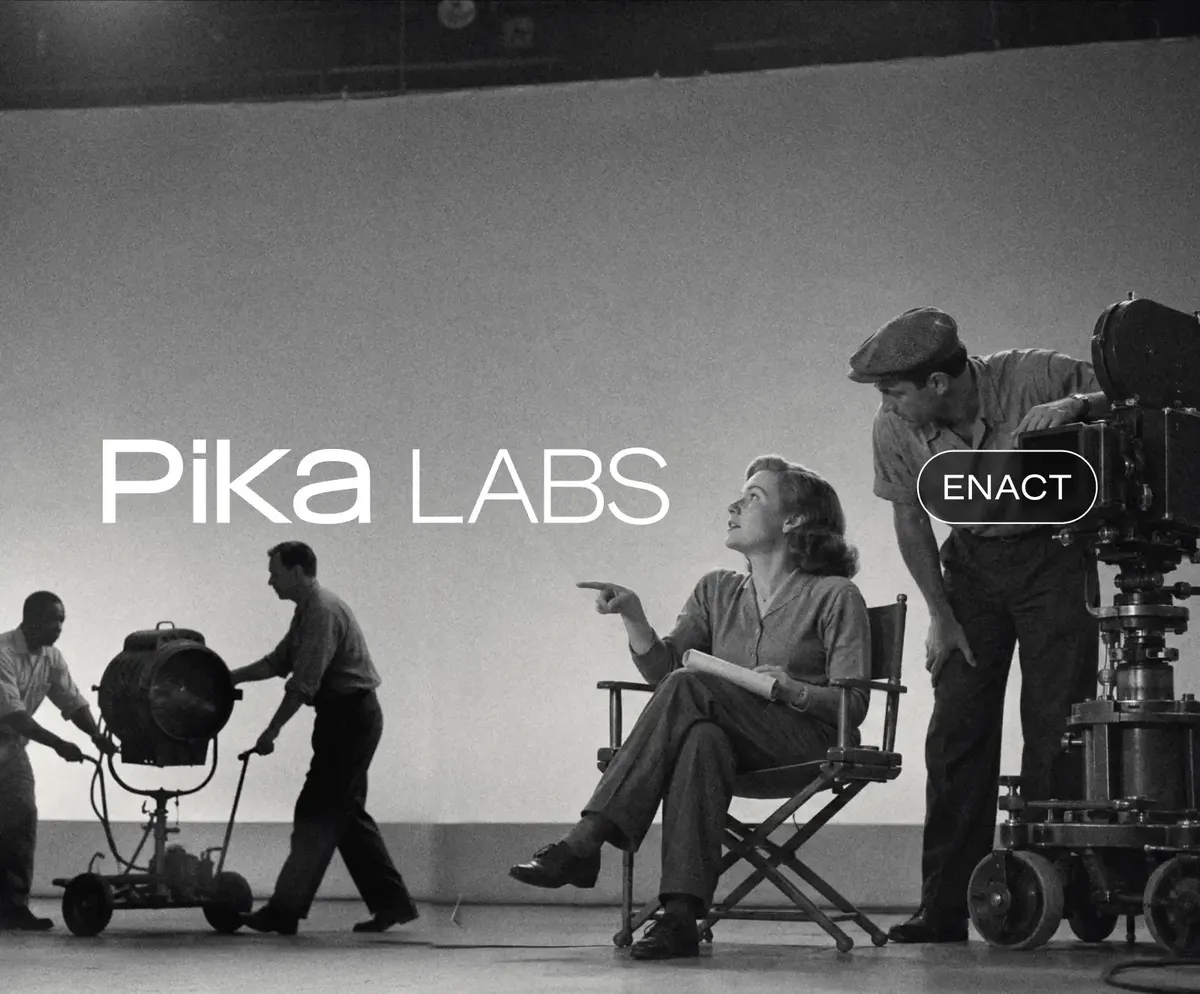
Pika has introduced Pika Enact, an experimental live-streaming environment designed to let creators direct AI-generated scenes in real time. Built on Pika H3 Flex, the system generates video and sound in sub-second chunks while carrying scene context forward.
- Pika Enact is an experimental live-streaming environment built on Pika H3 Flex.
- Live Staging lets users drag actors or objects through a playing scene.
- Live Actor Direction supports spoken or typed notes to AI actors.
- Pika says low-latency staging responds in under 0.4 seconds.
- The system also includes real-time camera control.
A live set instead of a prompt box
Pika describes Enact as a research preview that mimics the experience of directing on set. Rather than waiting for a complete video generation, creators can interact with a running scene, give new direction and see the result as the scene continues.
The system supports three interaction modes: Live Staging, Live Actor Direction and Live Camera Control. Together, they allow a creator to reposition people or objects, communicate with actors and move the camera around a live scene using a mouse, voice or text.
Moving people and objects during playback
Live Staging lets creators drag an actor or object into a new position while the video is playing. Pika says the model generates the moved subject together with the surrounding scene, adapting its pose, lighting and shadows to the environment. The company also says the process avoids cut-out edges, holes left in the original position and a separate compositing pass.
According to Pika, the model generates video 1.8× faster than playback on a single server. In its low-latency setting, the picture responds in under 0.4 seconds, including decoding. The mouse is sampled 24 times per second, while the system uses short video chunks to reduce the time between an input and the resulting image.
Pika says it trained this capability with a physics-driven synthetic data engine. Starting from an untouched video, the engine animates a 3D stand-in along a drag path, then generates target clips while recording mouse positions and button states. The resulting before-and-after pairs are used for training and evaluation.
Directing actors through conversation
Live Actor Direction turns people in a generated video into AI actors that can respond to notes while the scene runs. A creator can ask an actor to move, change dialogue or alter emotion. Pika says actors respond conversationally in their own voices, and that the video generates picture and sound 1.75× faster than playback.
The mode is built around rehearsal. Creators can give notes and iterate on a performance before calling “Action” to produce a fresh continuous take. According to Pika, the actors remember previous instructions and events in the scene. Each is described as an AI agent with a distinct personality, its own logic and the ability to respond in character.
Pika Enact remains an experimental research preview. The announcement presents it as a step toward a more interactive form of AI video creation, where users can shape staging, performance and camera movement during generation rather than communicating only through a prompt.
Pika: Research Preview: Pika Enact