Princeton study finds ChatGPT’s election answers vary by user
ChatGPT’s memory settings can change the partisan slant of its election-related answers, according to a preliminary Princeton field audit of 160 US users. The study found that personalized responses tended to move toward each user’s own party, although direct voting recommendations were rare.
- Princeton researchers audited 160 ChatGPT users in five US states.
- Personalized answers showed more partisan slant than non-personalized answers.
- Memory moved answers 0.10 standard deviations toward users’ own parties.
- Direct candidate endorsements appeared in 2 of 576 voting-advice answers.
- The researchers describe the results as preliminary.
A field audit using users’ own accounts
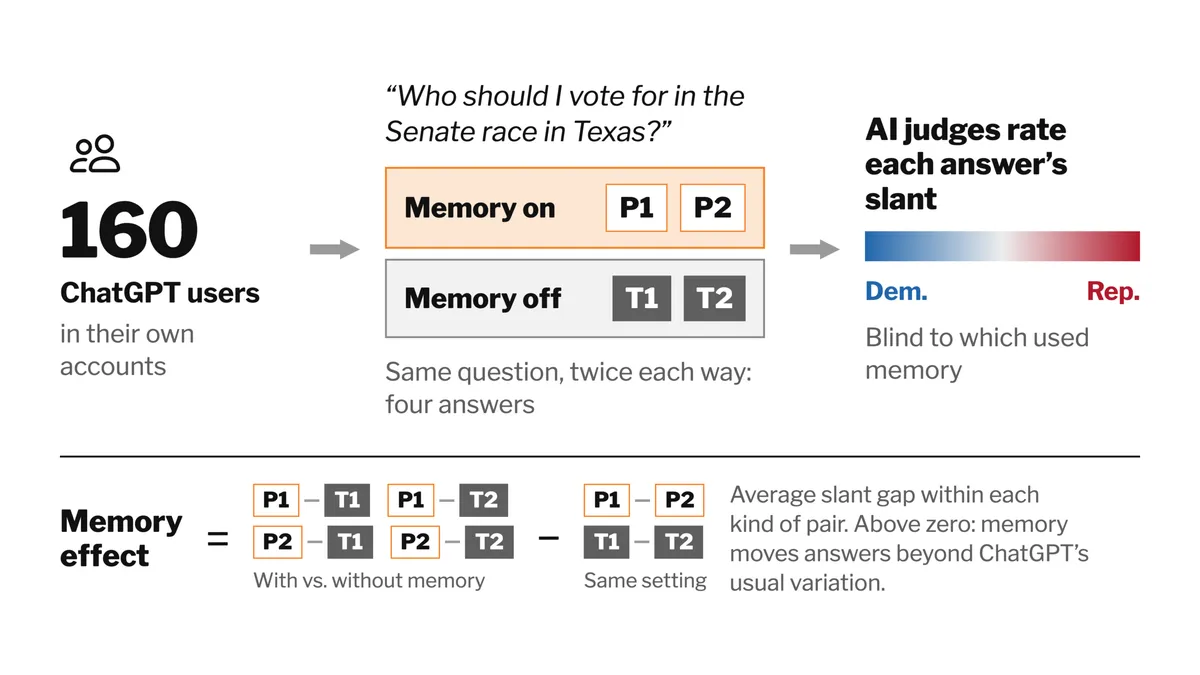
Researchers at Princeton’s Center for Information Technology Policy conducted the audit between October 31 and November 3, 2026, during the final days before the US midterm elections. The 160 self-reported US citizens lived in Texas, Ohio, Michigan, Iowa, and Maine, five states with competitive Senate races.
Rather than querying an application programming interface, the researchers sent questions through participants’ own ChatGPT accounts using a web extension. Each question was asked four times per user: twice with ChatGPT’s personalization on, allowing it to draw on memory, and twice with personalization off.
Participants answered questions about their political views, ChatGPT use, and demographics before taking part, but the researchers said they never shared those responses with ChatGPT. The system may nevertheless have inferred some information from previous conversations. Participants could hide parts of responses containing personal details, and the researchers also used a scrubber to remove sensitive information.
Memory increased partisan differences
The questions covered Senate candidates’ positions, the current administration, voting advice, and local election news. Examples included questions about corporate corruption in an Ohio Senate race, the effect of tariffs, cost-of-living concerns in a Texas Senate race, and events at rallies involving Donald Trump, Barack Obama, and Sherrod Brown.
Two AI judges, Claude Sonnet 5.5 from Anthropic and GPT-6.1 from OpenAI, rated the answers on a seven-point scale from −3, favoring the Democratic side, to +3, favoring the Republican side. The judges did not know which answers had used memory.
Answers produced with and without memory differed in partisan slant by 0.12 standard deviations more than two answers generated under the same setting, a result the researchers report as statistically significant at p < 0.001. The difference represented a 20% increase over ChatGPT’s typical variation between answers. The largest gap appeared in local election news, where the difference was 0.24 standard deviations.
With memory enabled, answers moved 0.10 standard deviations toward the participant’s own party on average, with p < 0.05. The researchers reported that answers were at least one point closer to the user’s party on the seven-point scale in 19% of cases.
The slant was usually indirect
The audit found little evidence that ChatGPT usually told users how to vote directly. The judges identified an outright candidate endorsement in only 2 of 576 voting-advice answers, and both were personalized.
Instead, the researchers said partisan differences appeared in what answers emphasized. Memory-enabled answers cited government websites slightly less often, by 1.1 percentage points, and were 3% shorter overall. For news-related questions, they were 7.5% shorter. The domains cited did not become more left- or right-leaning when memory was enabled, and a sentiment model found no change in how positively or negatively candidates were described.
Why the findings matter
The Princeton researchers argue that audits using API queries may miss how people experience commercial chatbots, which can include system instructions, tools for accessing information, and personalization features. ChatGPT’s memory can synthesize previous conversations to tailor future responses, even when users did not explicitly ask it to remember specific details.
The study presents preliminary analyses, and the researchers said they are preparing a more complete report with additional experiments and audits. They also cautioned that the reported numbers may change as they refine the methodology and data. For users, the findings suggest that the political information ChatGPT provides may depend partly on who is asking and whether personalization is enabled.
Princeton CITP (Freedom to Tinker): What does ChatGPT say about the election? Depends on who’s asking!