PwC and Harvey Build Pillar Two Tax AI Assistant for Global Research
PwC and Harvey have built a Pillar Two Tax AI Assistant that brings OECD rules and local legislation into one research tool. Harvey says the assistant has been rolled out to more than 17,000 PwC users across 21 countries.
- The assistant combines OECD Pillar Two rules with local material across 21 countries.
- It uses vetted public sources, refreshed weekly, with new documents added monthly.
- A custom agent tests FY2025 transitional CbCR safe harbours and calculates indicative top-up tax.
- More than 17,000 PwC users have access across 21 countries.
- Usage exceeded 70,000 activities across more than 24,000 conversation threads.
A single tool for global and local tax rules
Pillar Two is the OECD framework that sets a 15% global minimum effective tax rate for multinational groups with consolidated revenue of €750 million or more. Harvey says more than 8,000 multinational groups are in scope, while 45 jurisdictions have taken steps to introduce the Global Anti-Base Erosion, or GloBE, rules.
The framework is global, but its implementation varies by country. Those differences affect what a group must file, when it must file, and how much top-up tax it may owe. PwC and Harvey say tax teams face particular difficulty determining which financial data each jurisdiction requires and interpreting local legislation alongside the OECD rules.
The Pillar Two Tax AI Assistant is a specialist research tool within Harvey designed to address both issues. It combines the OECD Pillar Two rules with country-specific material supplied by PwC network firms and currently covers 21 countries.
Research, comparisons and cited answers
The assistant uses vetted public sources, including enacted and draft legislation, tax authority guidance and other official publications such as government consultations. Online sources are refreshed weekly, new documents are added monthly, and the content is reviewed quarterly.
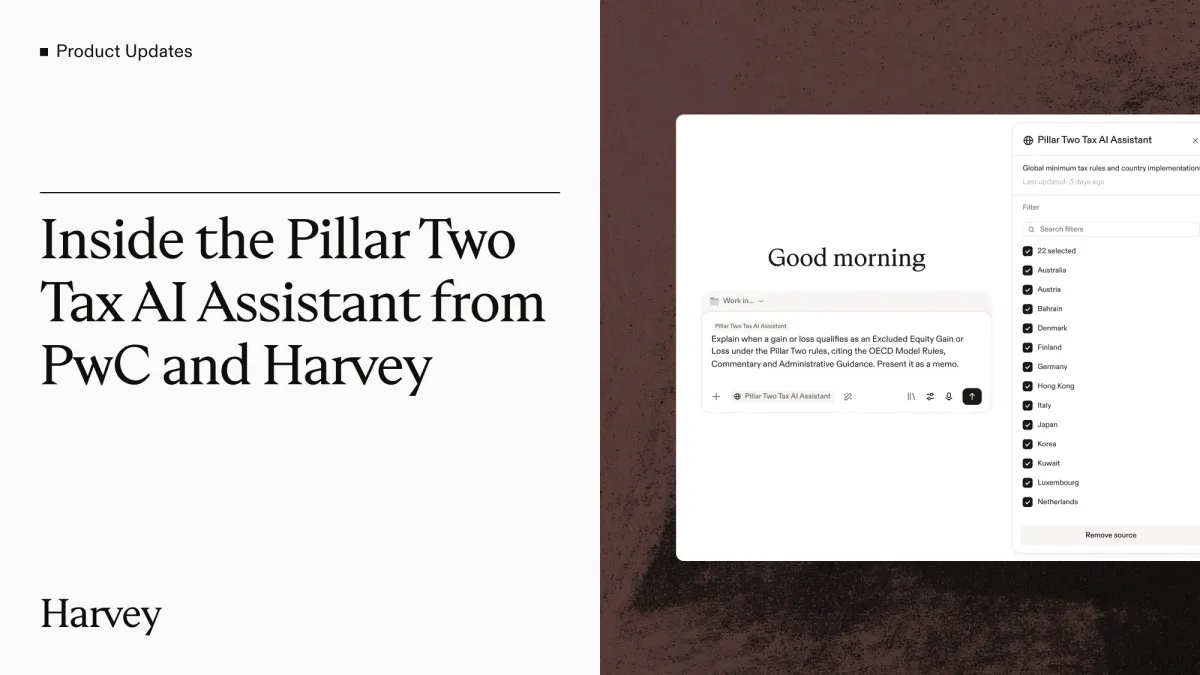
Users can select the assistant as a source in Harvey and filter research by country. The tool supports cross-border research into filing obligations, deadlines and local requirements, while side-by-side comparisons help users identify differences between jurisdictions. It can also analyze a group's own facts, explore scenarios affecting top-up tax, and assess whether simplifications or safe harbours could apply.
The assistant can draft memos covering the rules, effective tax rate calculations, safe harbours and exclusions. It also helps users prepare reports and emails. Its answers include citations linking to the underlying legislation and guidance, allowing teams to verify the analysis.
“The module significantly improves the efficiency of my day-to-day Pillar Two work by helping me quickly navigate filing obligations, deadlines, and jurisdiction-specific requirements,” said a PwC Senior Associate, International Tax, Japan.
A custom agent tests safe harbours
PwC and Harvey also created a custom Harvey Agent that turns the assistant's knowledge into an analytical dashboard. The agent tests each jurisdiction in a group against the FY2025 transitional CbCR safe harbours: the de minimis test, the simplified ETR test and the routine profits test.
It normalizes and reconciles the underlying data, flags breaks and, where a jurisdiction fails all three tests, calculates an indicative top-up tax and shows whether it would be collected locally or at the parent. The agent also lists open questions by priority, links results to source data and compares results across reporting perimeters.
Its output includes an Excel workbook with live formulas for the ETR calculation and a self-contained interactive HTML view. Harvey says the example demonstrates how PwC's Pillar Two expertise can be combined with Harvey's custom agent capabilities.
Already deployed across PwC
Harvey says the assistant is PwC's go-to tool for Pillar Two technical research. It has recorded more than 70,000 user activities across more than 24,000 conversation threads. Monthly use grew roughly 17x, from about 700 activities in October 2025 to more than 12,000 in September 2026.
PwC has also rolled out the assistant to clients, with positive feedback. Harvey will demonstrate the Pillar Two Tax AI Assistant and the Pillar Two Agent at the PwC Tax Evolution Summit on November 18 in Madrid, Spain.
For tax professionals, the product's significance lies in bringing frequently changing country rules, data checks and deliverable preparation into one workflow. The reported deployment and usage figures indicate that PwC is using the system at scale for a tax regime that requires both global comparison and detailed local analysis.