PyTorch Conference 2026: TPU, Trainium Backends and Nine New Members
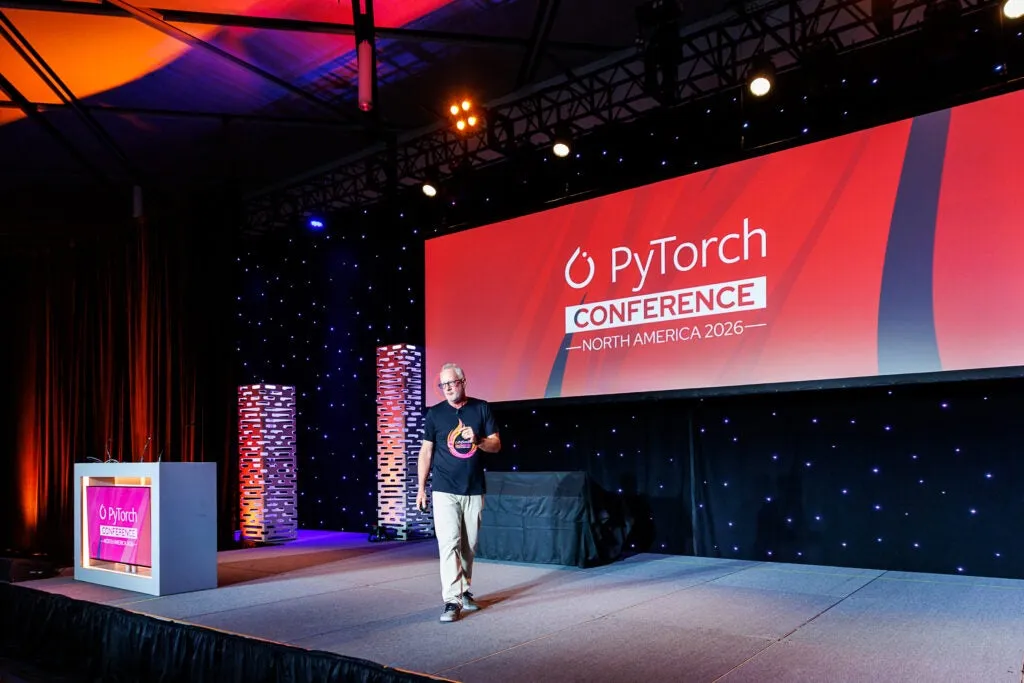
PyTorch Conference North America 2026 in San Jose drew more than 3,500 attendees and brought announcements on native PyTorch backends for Google TPUs and AWS Trainium, along with nine new PyTorch Foundation members. The event ran on October 20 and 21, with extra programming on October 19.
- PyTorch Conference North America 2026 drew 3,500+ attendees to San Jose on October 20, 21.
- TorchTPU, a Google and Meta collaboration, brings a native PyTorch backend to Google TPUs.
- TorchNeuron entered public beta under Apache 2.0 for AWS Trainium (Trn2 and Trn3).
- Nebius, Nscale and Shopify joined as Platinum members, among nine new members.
- Shopify says its continual learning loop with PyTorch and vLLM cut serving costs by 96%.
Native backends for more chips
The PyTorch Foundation says its goal is open source software to train and serve models on any chip, in any cloud, for any agent. Several announcements pointed in that direction.
TorchTPU is an open source collaboration between Google and Meta that introduces a native PyTorch backend for Google TPUs. It supports eager execution and torch.compile, with validated integrations for TorchTitan (training), vLLM and SGLang (inference) and Ray (orchestration). According to the announcement, moving a workload can require only a device change, while peak performance can require additional changes to shapes, sharding and operations.
TorchNeuron is an open source native PyTorch backend for AWS Trainium and the corresponding Amazon EC2 instances Trn2 and Trn3. It lets researchers run PyTorch workloads with a single configuration change, and supports DTensor, torch.distributed and TorchTitan. The public beta launched on October 20 under Apache 2.0.
IBM described how torch-spyre turns Inductor's decisions into executable programs for its Spyre hardware. A FlyDSL update on October 21 described an optional backend for AMD MI350-series GPUs that keeps existing implementations for unsupported workloads.
Training, kernels and on-device inference
TorchTitan expanded model support across its 5D parallelism stack and added reinforcement learning through TitanRL. According to the project, TitanRL keeps the same model implementation across pretraining, post-training and execution inside vLLM, using asynchronous rollouts.
Zephon's TorchTitan integration preserves global batches when training resumes on a different GPU count. In a test with a 1B-parameter model, every global batch hash matched when training resumed from a 16-GPU checkpoint on 8, 32 and 64 GPUs. The guarantee requires a fixed data recipe and global batch size, and floating-point reduction order can still affect training losses.
Helion's integration with NVIDIA CompileIQ adds compiler controls to kernel autotuning. Developers can evaluate Advanced Control Files next to settings such as tile sizes and warp counts, tune offline and pin the chosen configuration. Compiler defaults stay a candidate in the search.
ExecuTorch now offers a Cortex-M backend that runs PyTorch models on Arm Cortex-M CPUs with Arm CMSIS-NN acceleration. It supports the Scalar, DSP and MVE/Helium tiers from a single workflow.
Nine new Foundation members
Nebius, Nscale and Shopify Inc. joined as Platinum members. LightSeek Foundation and Lablup Inc. joined at Silver level. Four Associate members were added: SKOPOS INDIA FOUNDATION, Siksha 'O' Anusandhan, Messiah University and Valencia College.
Nscale first entered the ecosystem through Ray. Following its planned acquisition of Anyscale, the company behind Ray, Nscale has committed to continued investment in Ray's development and contributor community. Ray has been governed under the Foundation since it joined in October 2025. Nebius has supported vLLM with compute for development, testing and benchmarking, including multi-node work on large models such as DeepSeek R1.
Shopify's work was featured in a keynote by Cody Mazza-Anthony. According to the Foundation, Shopify uses a continual learning loop with PyTorch and vLLM to compress production failures into model weights every day, beating frontier-model quality and cutting serving costs by 96%.
Mark Collier, Executive Director of the PyTorch Foundation, said: "Open systems learn faster when more people, projects, and organizations are working together, creating compounding gains."
Training and community events
Day 0 on October 19 included a PyTorch Associate Training, a Jupyter Day, the LF AI & Data Summit 2026 and the From Academia to Adoption Workshop. The training was an in-person, instructor-led program built around the PyTorch Certified Associate (PTCA) exam, and completion included a voucher for the exam. The workshop looked at how research software can become reliable, reusable tools that others can adopt.
What it means
For developers, the announcements widen the range of hardware that PyTorch code can target, with TPUs and Trainium now covered by native backends and AMD and IBM hardware moving forward through compiler work. The source notes that migration can be simple, but peak performance may still need tuning. The growing membership, including infrastructure providers and a large retailer platform, shows continued industry investment in the Foundation's projects.