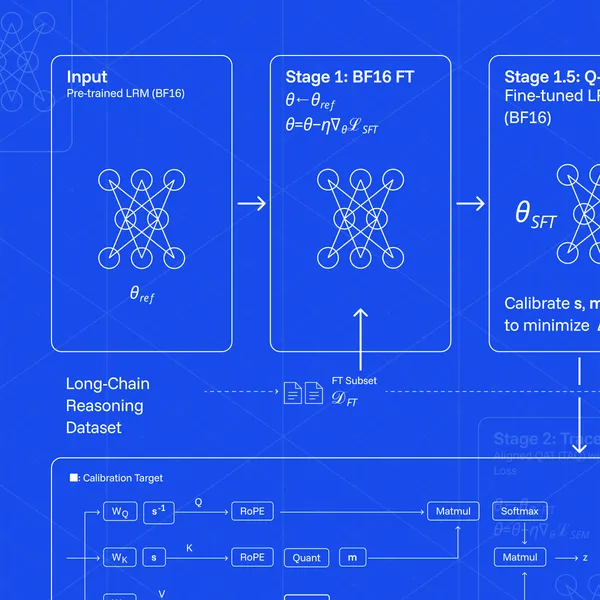
Rebellions Highlights ReQAT, a 4-Bit Quantization Training Method

Rebellions has published a page titled “ReQAT: Achieving Full-Precision Reasoning Accuracy with 4-bit Floating-Point Quantization-Aware Training.” The page is dated Nov 10, 2026 and labels the work “[ICML].”
- Rebellions published a page about ReQAT on Nov 10, 2026.
- The title links ReQAT to ICML.
- The work targets full-precision reasoning accuracy with 4-bit floating-point quantization-aware training.
- The source provides no results, benchmarks, model details or availability information.
A publication focused on 4-bit training
The publication centers on ReQAT, a method whose full title links four elements: reasoning accuracy, full-precision results, 4-bit floating-point representation and quantization-aware training. The title presents the work as an attempt to achieve full-precision reasoning accuracy while training with 4-bit floating-point quantization.
The source does not provide technical details about ReQAT, including its model architecture, training procedure, datasets, evaluation tasks or results. It also does not include performance figures or comparisons with other methods.
What the title says about the research goal
Quantization reduces the numerical precision used to represent values in an AI system. In the title, Rebellions specifically refers to 4-bit floating-point quantization-aware training, indicating that quantization is considered during training rather than only after a model has been trained.
The stated objective is to preserve “full-precision reasoning accuracy,” as written in the publication title. However, the source does not define how full-precision accuracy is measured or identify the full-precision system used as a reference.
The information currently provided
Rebellions lists ReQAT under “Publications” and associates it with ICML through the “[ICML]” label in the title. The page includes sharing options for Facebook, LinkedIn and X, along with a Copy URL option.
The page also lists related Rebellions publications. These include an ISSCC entry about a quad-chiplet AI SoC with a full-chip scalable mesh over a 16Gbps UCIe-Advanced die-to-die interface for large scale AI inferencing, a Hot Chips entry about LightTrader, and publications concerning the ATOMUS machine-learning system-on-chip.
For readers evaluating the significance of ReQAT, the available source establishes the research topic and its stated goal, but not the method's measured results, implementation details or availability. Those details would be needed to assess how the approach affects AI inference hardware or deployed models.