IVADO Group Publishes 48 Practices for Responsible AI Procurement
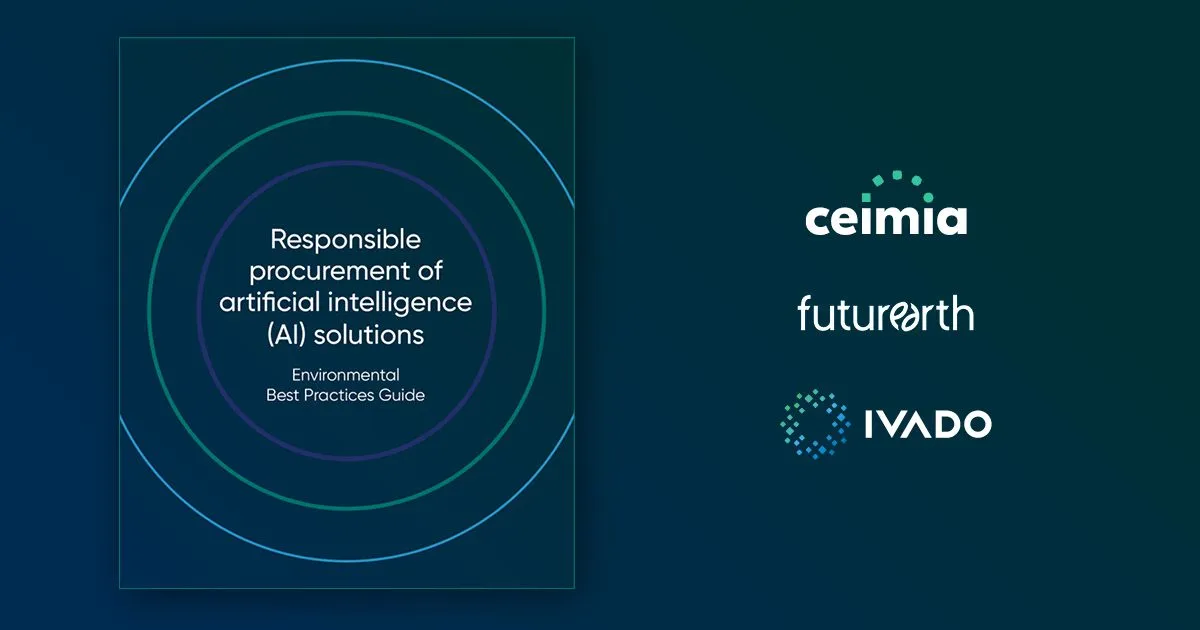
IVADO, CEIMIA and Future Earth Canada have published 48 environmental best practices to help organizations procure and deploy AI solutions more responsibly. The guide is aimed primarily at procurement professionals and teams in public-sector organizations.
- The guide presents 48 best practices for responsible AI procurement.
- The practices are organized into six sequential steps.
- The guidance focuses on environmental impacts across AI’s life cycle.
- It is primarily intended for public-sector procurement professionals.
- A free webinar introducing the guide is scheduled for November 27, 2026.
A guide focused on AI’s environmental life cycle
The guide, titled Responsible Procurement of Artificial Intelligence (AI) Solutions: Environmental Best Practices Guide, addresses the environmental effects associated with AI throughout its life cycle. These include energy and water consumption, greenhouse gas emissions, depletion of mineral resources and electronic waste.
IVADO, CEIMIA and Future Earth Canada said organizations that acquire or deploy AI solutions can influence technology choices through their procurement decisions. The organizations also highlighted the role of the public sector as a major purchaser of technology solutions that can help steer the market toward more responsible and sustainable practices.
48 practices across six procurement steps
The publication organizes its 48 best practices into six sequential steps, covering the process from identifying a need to assessing the performance of a selected solution:
- Define and challenge the need for AI
- Establish a responsible governance framework
- Anticipate the potential impacts of AI
- Prepare the statement of requirements
- Train teams on the framework for AI use
- Measure and disclose the solution’s performance
The approach is designed to be gradual and adaptable to each organization’s circumstances. Instead of pursuing perfection, the guide advises organizations to prioritize actions that have the greatest impact with the least effort, and then expand their efforts over time. An accompanying matrix helps users rank practices according to their ease of implementation and potential to reduce environmental impacts.
Research collaboration and next steps
IVADO led the project with CEIMIA and Future Earth Canada. CIRAIG, affiliated with UQAM and Polytechnique Montréal, led the research and drafting process, with support from ECPAR. The Government of Québec contributed guidance and feedback and took part in the expert advisory committee.
“Procurement is a key moment for any organization seeking to use AI responsibly,” said Réjean Roy, IVADO’s Director of Training and Knowledge Mobilization. He said the guide would help teams understand available options and their potential impacts while addressing organizational needs and environmental concerns.
Sophie Fallaha, Executive Director of CEIMIA, described the publication as a “practical roadmap” for making environmentally responsible choices. According to Fallaha, organizations can select solutions that meet technological needs while minimizing their environmental footprint and supporting ethical and sustainable use.
ECPAR and its partners will introduce the guide in a free webinar on November 27, 2026, from 10:30 a.m. to noon. The publication gives public-sector procurement teams a structured way to include environmental considerations before selecting or deploying AI solutions.