Wenge AI shows ScienceOra designing hydrogen catalysts at Tencent summit
Wenge AI has demonstrated an AI-assisted workflow for designing hydrogen-production catalysts at the 2026 Tencent Global Digital Ecosystem Summit. The workflow runs on ScienceOra, the company's research decision platform, and covers literature analysis, candidate design, experimental planning and industrial decision support.
- Wenge AI demonstrated ScienceOra's hydrogen-production catalyst design workflow at the 2026 Tencent Global Digital Ecosystem Summit.
- The demo covered a high-entropy alloy catalyst for the alkaline hydrogen evolution reaction.
- The workflow spans literature analysis, candidate design, experimental planning and industrial decision support.
- A previously disclosed collaboration reported a 38% activity improvement and a design stage cut from several months to 30 minutes.
- ScienceOra is available on Tencent WorkBuddy with more than 30 research expert agents and skills.
A five-step workflow for catalyst design
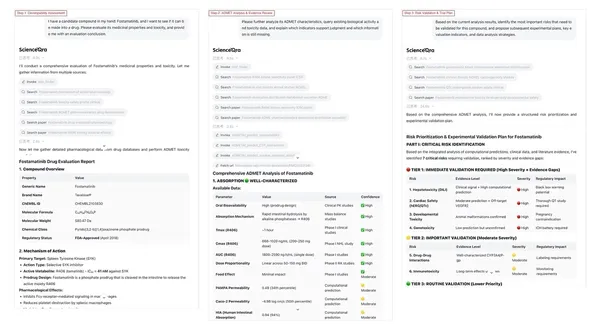
According to Wenge AI, the demonstration showed how AI for Science (AI4S) can connect literature analysis, catalyst candidate design, experimental planning and industrial decision support. The company says this helps materials researchers turn scientific evidence into actionable research plans.
ScienceOra is described as Wenge AI's intelligent research decision platform, built on the ScienceOne Scientific Foundation Model. For specialist tasks such as materials development, it brings together scientific models, professional literature, research data and tools to support information access, research-plan development and scientific decision-making.
From literature to candidate designs
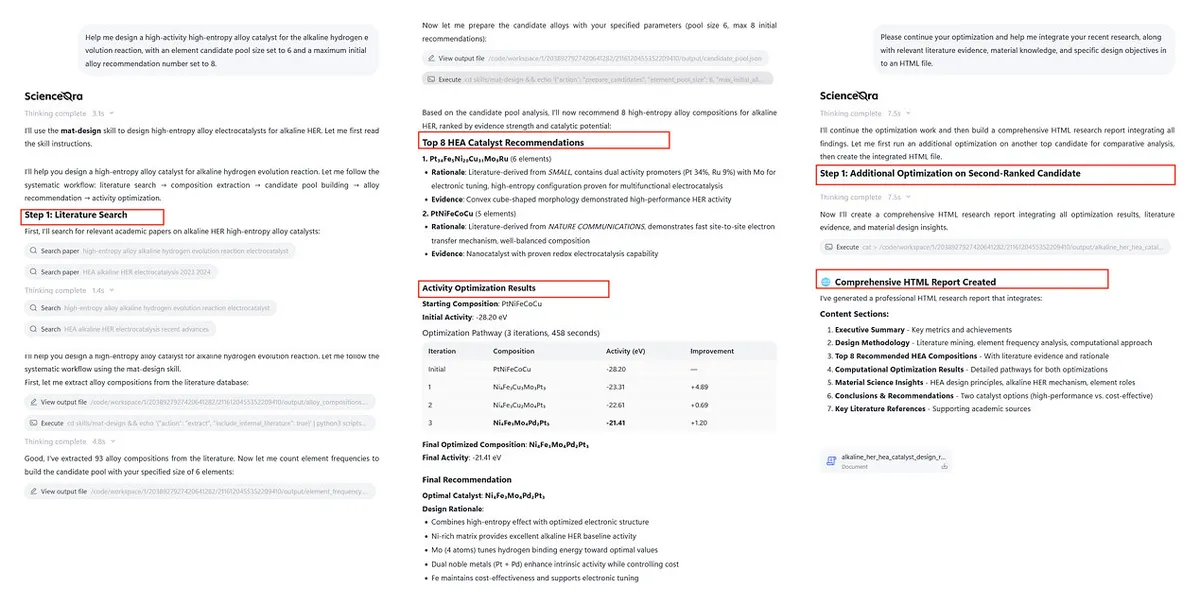
The demonstration focused on the design of a high-entropy alloy catalyst for the alkaline hydrogen evolution reaction. To meet the need for high activity and durability, ScienceOra searched professional literature and drew on published research methods and elemental properties to support candidate designs. It also cross-checked optimization proposals against relevant literature, giving researchers references they could review and verify.
Wenge AI stresses that the workflow does not simply generate material formulations. Instead, it links documentary evidence, materials knowledge and specific design objectives to support more targeted analysis of candidates. Researchers remain responsible for assessing scientific validity and deciding on later research directions.
Experimental planning and industrial decision support
For experimental planning, the platform can help develop research protocols around candidate designs and organize experimental variables. It can also produce testing standard operating procedures (SOPs) and related reference information for later validation.
For industrial use, ScienceOra can support comparative analysis across several dimensions:
- feasibility of scaled hydrogen production
- performance at industrially relevant current densities
- durability
- raw-material availability
- compatibility with mass-production synthesis processes
It can then help establish decision priorities, screening criteria and process-improvement recommendations. Candidate designs, experimental plans, process recommendations and references can be consolidated into a structured research report, so R&D teams can weigh scientific evidence alongside engineering constraints. The company adds that experimental testing and scientific validation remain essential parts of materials research.
Earlier results and availability on WorkBuddy
Wenge AI points to a previously disclosed industry-research collaboration on hydrogen-production catalyst design, in which ScienceOra supported literature analysis and research-plan development. The collaboration reported a 38% improvement in catalyst activity and reduced the design stage from several months to 30 minutes. These figures come from the company's own account of that project.
ScienceOra was also recently made available on Tencent WorkBuddy, with an initial offering of more than 30 research expert agents and skills. They cover literature analysis, research hypotheses, plan design, modeling and simulation, validation analysis and research communication.
What it means for research teams
Wenge AI says the demonstration illustrates how AI4S is moving beyond general information processing toward support for research workflows and industrial R&D decision-making. For materials teams, the pitch is a tool that keeps references reviewable and leaves final scientific judgment with researchers. The source gives no pricing or wider availability details beyond the WorkBuddy listing. More information is available at the ScienceOne portal, scienceone.ai.
Wenge AI (1956.HK) provides AI technology and service platform products for enterprises and was founded by a team of AI scientists from the Chinese Academy of Sciences.