Six US AI Companies Sign Voluntary White House Accord on AI Safety
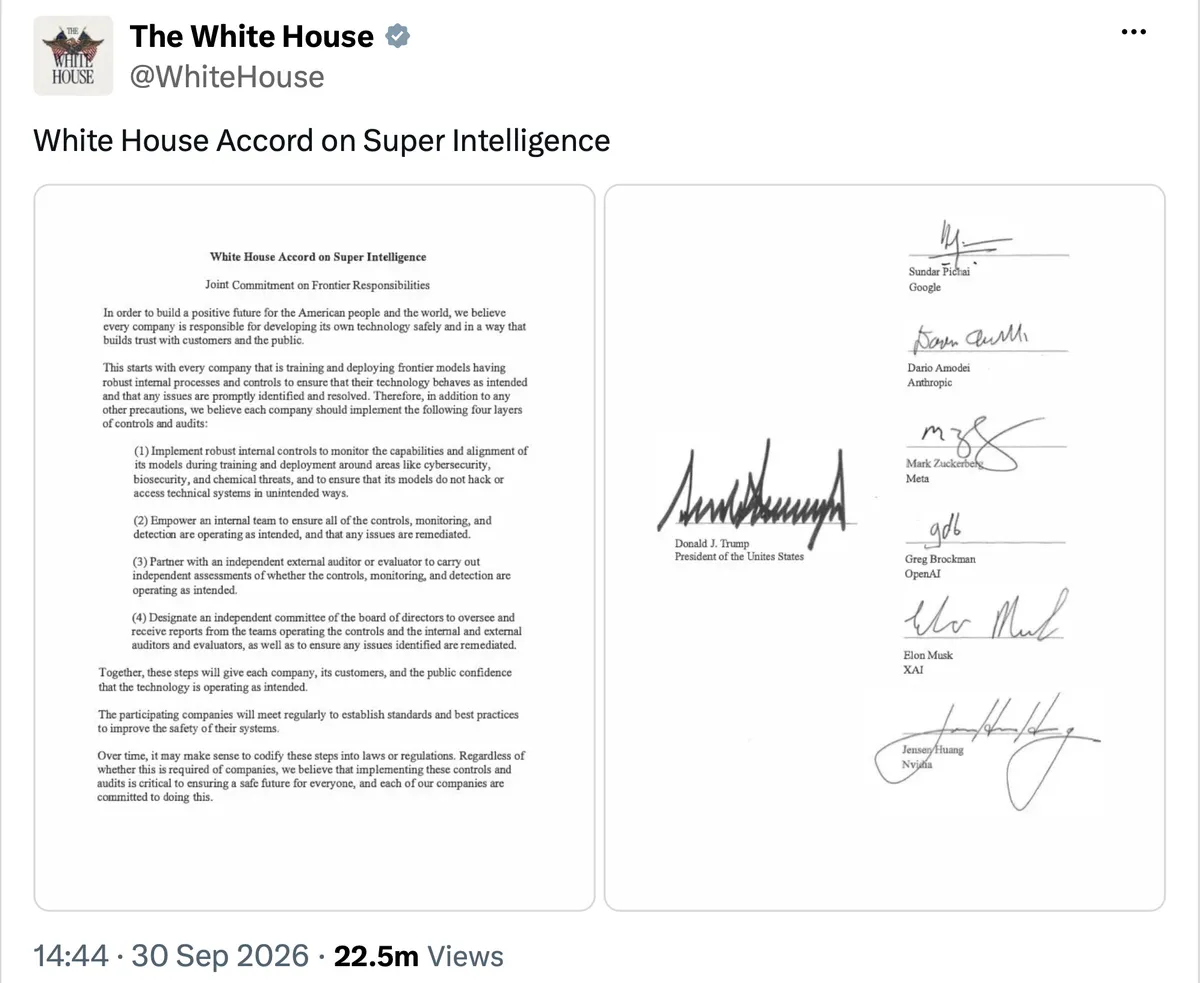
Six US AI companies have signed "The White House Accord on Super Intelligence," a document listing four voluntary safety commitments, according to the Center for AI Safety's newsletter. The signatories are OpenAI, Anthropic, Google, Meta, xAI and Nvidia.
- OpenAI, Anthropic, Google, Meta, xAI and Nvidia signed "The White House Accord on Super Intelligence," published September 29.
- The Accord lists four voluntary commitments: internal controls, an internal oversight team, independent external assessments, and a board-level independent committee.
- The companies say they "will meet regularly to establish standards and best practices," which CAIS says could work like the antitrust waiver Dario Amodei sought.
- The Accord states that "it may make sense to codify these steps into laws or regulations" over time.
What the Accord commits companies to
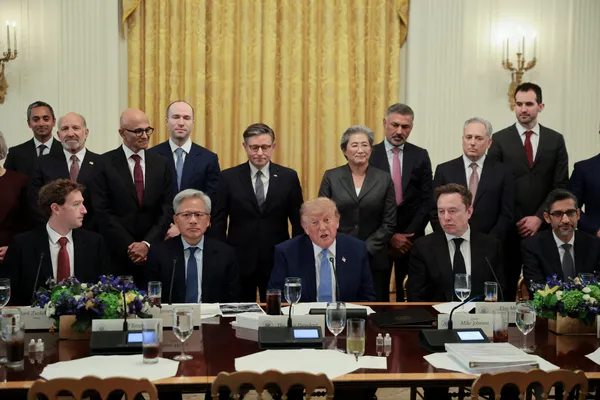
President Trump hosted representatives of the major US AI companies at the White House on September 29 and published the Accord the same day. The Center for AI Safety (CAIS) notes that the term "super intelligence" here refers broadly to AI, in line with Trump's preferred name for the technology.
The document states that "every company is responsible for developing its own technology safely." It lists four voluntary commitments. Companies should:
- implement internal controls to monitor AI models during training and deployment;
- establish an internal team to oversee these controls and address any issues;
- have an external party conduct independent assessments of these safety practices;
- designate an independent committee of the board of directors to receive reports from both the internal and external evaluators.
The Accord still leaves AI companies to self-regulate. CAIS says the commitments do not appear to go much further than existing pledges by frontier AI companies. As an example, it points out that Anthropic and OpenAI had recently said they would embed external evaluators with "employee-like access."
Regular meetings and the antitrust question
CAIS argues that one line may matter more than the four commitments. The Accord says the companies "will meet regularly to establish standards and best practices to improve the safety of their systems."
Anthropic CEO Dario Amodei has called for companies to work together to "pace the frontier" of AI development. According to CAIS, he has also noted that such cooperation could effectively breach antitrust law, and that the US government would "need to issue a narrow waiver" to enable safety discussions. A lawsuit has already been filed accusing Anthropic, OpenAI, xAI and Google of breaching antitrust law by agreeing "to reduce the quality of their products and the rate at which those products improve."
CAIS writes that if the Accord's statement on regular meetings effectively works as the waiver Amodei sought, it could be the most important aspect of the document. The newsletter describes the Accord as something that "may enable companies to cooperate on safety without antitrust concerns."
A possible shift in Trump's approach
The Accord also leaves the door open to government requirements. It states: "Over time, it may make sense to codify these steps into laws or regulations."
CAIS sees this as a possible change of tone. It notes that Trump has recently taken an anti-regulatory position, saying he will not do anything to "stifle" the technology and labeling claims about AI risk a "hoax." The Accord, by contrast, "appears to take seriously the risks posed by AI systems and the need for safety measures," in CAIS's reading.
For now, the document remains effectively industry self-regulation. Whether the companies' regular meetings produce shared standards, and whether any of the commitments are later written into law, is not settled by the text as described by CAIS.
Other items in the newsletter
The same edition covers the launch of Team Human on October 3, a public movement led by more than 60 well-known creators, including Mark Rober, Kurzgesagt and Rebecca Zamolo. It asks people to sign a statement calling on governments to pursue a global AI slowdown through international agreements. According to the campaign, signatures will be delivered to policymakers in the US and EU this fall.
CAIS also released a free, non-technical Coursera course, Introduction to AI Safety, on October 2. It takes about four hours and has three modules covering AI progress, major risks, and approaches to governance.
Center for AI Safety: AISN #83: Six AI Companies Sign White House Accord