SK hynix wins safety and cybersecurity certifications for AI memory
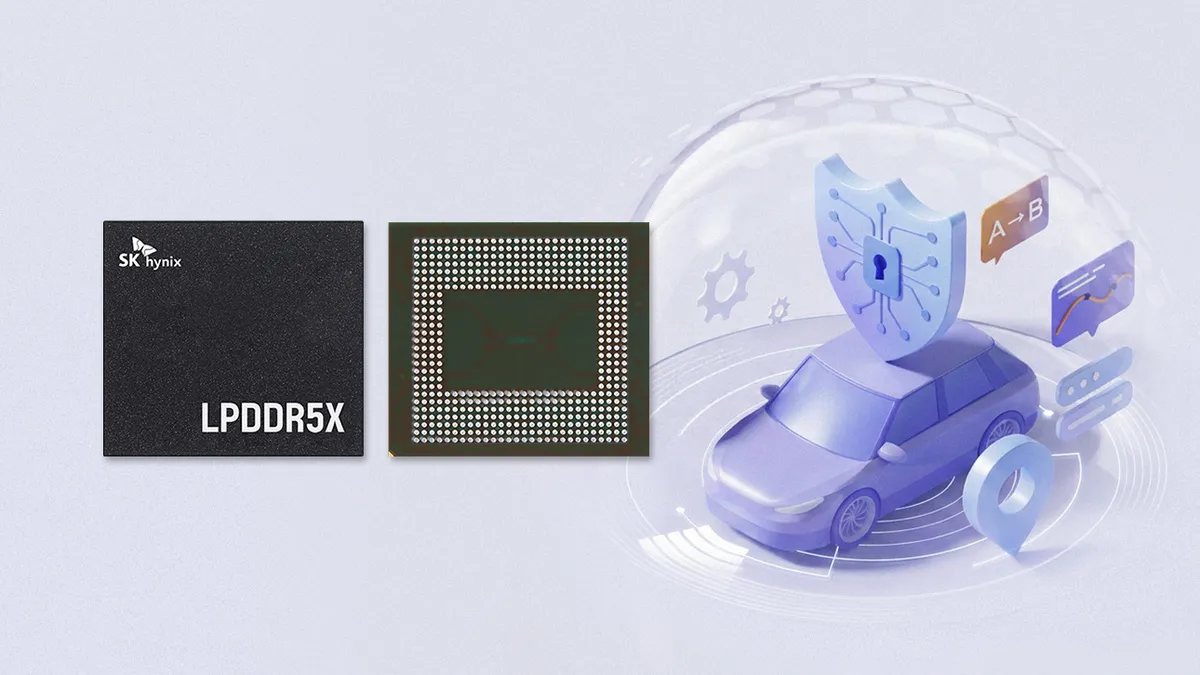
SK hynix has secured international certifications covering functional safety and cybersecurity for its LPDDR5X memory and product development processes. The company says the credentials support its expansion into physical AI applications including robotics, smart factories, autonomous driving and software-defined vehicles.
- SK hynix's LPDDR5X earned IEC 61508 SIL 3 certification.
- Its Cybersecurity Management System was certified against ISO/SAE 21434.
- The LPDDR5X certification covers continuous-mode safety and its development process.
- The credentials support applications in robotics, smart factories, autonomous driving and SDVs.
- SK hynix now cites certifications spanning functional safety, cybersecurity and information security.
LPDDR5X reaches IEC 61508 SIL 3
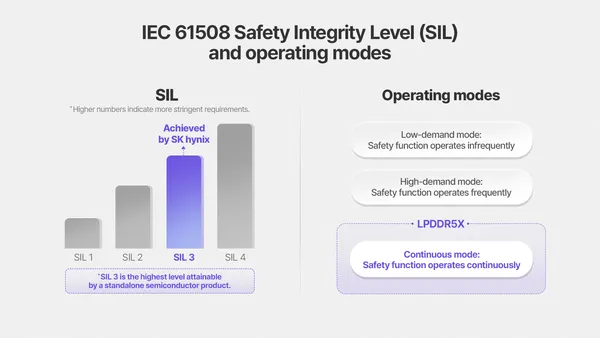
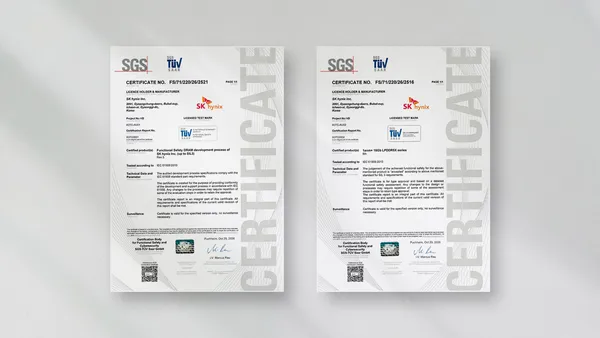
SK hynix said its LPDDR5X DRAM has obtained Safety Integrity Level 3, or SIL 3, certification under IEC 61508, an international standard for industrial functional safety. The assessment was conducted by SGS-TÜV Saar, involving SGS Korea and SGS Japan.
IEC 61508 classifies safety levels from SIL 1 to SIL 4, with higher levels representing more stringent requirements. According to SK hynix, SIL 3 is the highest level attainable for a single memory semiconductor. Its LPDDR5X was designed and validated to support continuous mode, which requires safety to be maintained in real time without interrupting system operation.
The certification applies to both the LPDDR5X product and the development process behind it. SK hynix said this demonstrates that safety requirements can be incorporated consistently into current and future products. The company plans to address functional safety requirements for customers developing robotic platforms and System-on-Chip solutions, using LPDDR5X's low-power and high-performance characteristics for edge devices.
Cybersecurity process covers the product lifecycle
Alongside the functional safety certification, SK hynix obtained Cybersecurity Management System certification based on ISO/SAE 21434, the international standard for automotive cybersecurity. The standard requires cybersecurity activities to be managed across the product lifecycle, from development and mass production through operation and decommissioning, using threat analysis and risk assessment.
SK hynix said its assessment verified procedures covering product development and mass production. These include threat response, security requirements definition, design and validation, and vulnerability management.
The company linked the certification to the growing use of software-defined vehicles and external communication networks. In autonomous vehicles, memory stores and transfers data including sensor inputs, AI computation results and encryption keys. SK hynix said tampering with or exposing this data could compromise the integrity of the vehicle system.
A broader certification portfolio
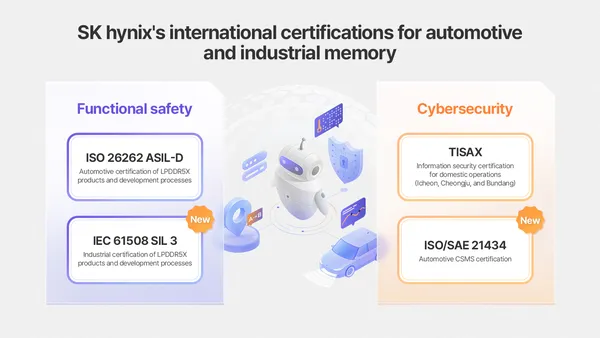
The latest certifications extend SK hynix's earlier safety and security credentials. The company previously obtained ISO 26262 ASIL-D automotive functional safety certification, which addresses unintended system failures, and TISAX certification, an automotive information security framework that SK hynix described as the first of its kind obtained by a company in the memory sector early last year.
SK hynix said its portfolio now covers functional safety through ISO 26262 and IEC 61508, cybersecurity through ISO/SAE 21434, and information security through TISAX. The company said this expands its functional safety capabilities beyond automotive applications into areas such as robotics and smart factories.
What this means for physical AI customers
Physical AI refers to AI systems that perform tasks in the real world. Robots and vehicles that sense their surroundings, make decisions and execute actions require protection against both unintended failures and malicious attacks.
SK hynix said the certifications strengthen its credentials as a memory supplier for customers in autonomous driving and software-defined vehicle markets. They also provide a basis for serving industrial physical AI applications, including real-time robotics control and smart factories. The company's claims are focused on independently assessed processes and product reliability, rather than on a new memory product or a stated release schedule.