Supermicro and Nokia bring NVIDIA Aerial RAN Computer to the network edge
Supermicro is working with Nokia to deploy AI-RAN from distributed cell sites to centralized network hubs, using the NVIDIA Aerial RAN Computer platform. According to Supermicro, the shared infrastructure lets radio and AI workloads run side by side closer to the access network.
- Supermicro is working with Nokia to deploy AI-RAN from cell sites to centralized network hubs using the NVIDIA Aerial RAN Computer platform.
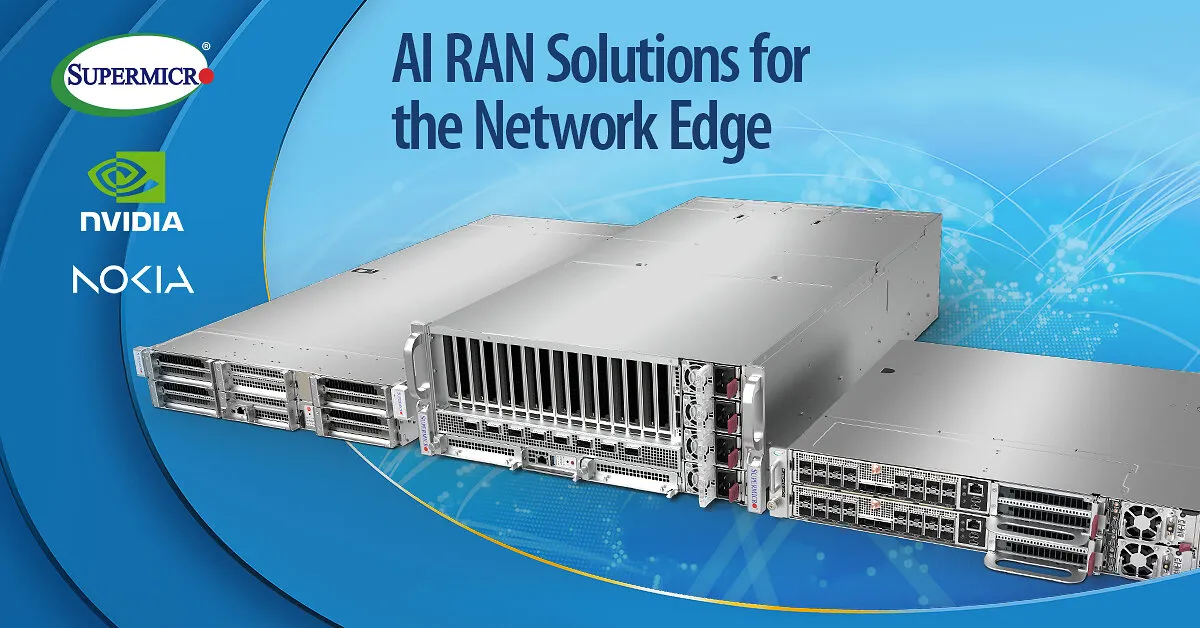
- Systems cover three tiers: ARC MGX 2U Short-depth for cell sites, ARC MGX 2U for aggregation sites, and ARC MGX 4U with up to eight RTX PRO 6000 Blackwell Server Edition GPUs for core hubs.
- The dual-node ARC-Pro delivers up to 1.6 PFLOPS of FP4 AI performance, according to Supermicro.
- Supermicro's ARC servers are generally available now; the 2U ARC-Pro is due for general availability in the first half of 2027.
Radio and AI workloads on shared infrastructure
Super Micro Computer, Inc. (NASDAQ: SMCI) says it is now working with Nokia to roll out Artificial Intelligence-Radio Access Networks (AI-RAN). The solution pairs Nokia's RAN technology and network expertise with the NVIDIA Aerial RAN Computer platform, supported by Supermicro's AI-optimized infrastructure.
By placing accelerated compute nearer to the access network, operators can run radio and AI workloads on the same hardware. Supermicro says this supports applications that need proximity and predictable service levels, including voice AI, vision AI and physical AI, as well as internal uses such as autonomous network operations.
The company also states that embedding accelerated compute into the RAN improves spectral efficiency, automates network operations and optimizes energy use, while opening opportunities for edge AI services. The platform offers modular, right-sized CPU and GPU configurations for sites ranging from cell sites to MSO and aggregation locations, with NVIDIA ConnectX technology providing high-speed, software-defined networking.
Hardware for three tiers of the network
Supermicro describes systems for NVIDIA ARC across three types of location.
- Distributed cell sites: The ARC MGX 2U Short-depth platform brings inference closer to radios, users and applications. The dual-node ARC-Pro combines an NVIDIA Grace C1 CPU and an NVIDIA RTX PRO 4500 Blackwell Server Edition GPU per node in a 429 mm chassis, delivering up to 1.6 PFLOPS of FP4 AI performance, according to the company. The ARC-Compact, a 1U short-depth system, targets edge networking functions such as Service Management and Orchestration.
- Centralized MSO and aggregation sites: The ARC MGX 2U supports higher-throughput, coordinated inference. Buyers can choose between dual NVIDIA Vera CPUs or dual x86 processors, plus two NVIDIA RTX PRO 6000 Blackwell Server Edition GPUs. These systems handle multi-cell workloads such as coordinated scheduling and beamforming, along with voice, vision and physical AI.
- Core network hubs: The ARC MGX 4U offers high-density, air-cooled inference with up to eight NVIDIA RTX PRO 6000 Blackwell Server Edition GPUs. The 4U servers carry dual x86 CPUs and up to 6 TB of DDR5 memory for large-scale inference and model update workloads. An optional NVIDIA ConnectX-8 switchboard provides PCIe Gen 6 for faster GPU-to-GPU interconnectivity.
The MGX line is based on NVIDIA MGX, which the release describes as a modular reference architecture for accelerated computing that helps system builders design future-compatible systems faster.
Partner statements and availability
Charles Liang, president and CEO of Supermicro, said AI-RAN is "redefining networks for AI, turning mobile infrastructure into a shared foundation for connectivity, AI for RAN, AI on RAN, and broader distributed AI services." He added that the work with Nokia and NVIDIA is meant to help operators prepare for AI-native 6G.
Emma Falck, President of Mobile Infrastructure at Nokia, said the combination gives operators "a practical way to bring RAN and AI workloads together across their networks." Soma Velayutham, VP of Telecoms at NVIDIA, said Nokia and Supermicro are helping operators deploy NVIDIA Aerial RAN Computer solutions across diverse network environments.
On timing, Supermicro says its servers for NVIDIA ARC are generally available now. The ARC MGX 2U with dual Vera processors is on show at the company's booth at NVIDIA GTC Berlin, October 20 to 22, 2026, and is due later this year. The 2U ARC-Pro is planned for customer testing later this year, with general availability in the first half of 2027.
What it means for operators
For mobile operators, the pitch is a single hardware foundation for both network functions and AI services, with a software-driven path toward 6G. Supermicro says the approach improves network economics through higher spectral efficiency on 5G today and protects infrastructure investment through a software-upgradeable path. Whether operators see those gains will depend on deployments, as the release gives no customer names or measured results.