Supermicro Begins Shipping AMD EPYC 9006 Servers for AI and HPC
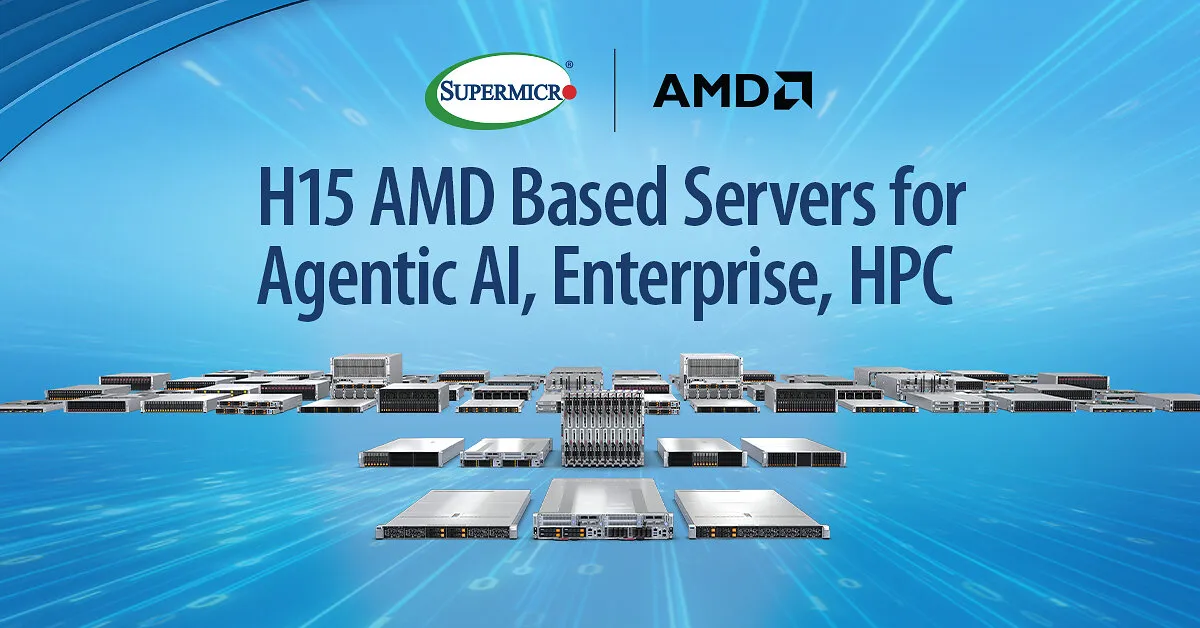
Supermicro has begun shipping its H15 generation server portfolio, powered by 6th Gen AMD EPYC 9006 Series processors, for cloud, high-performance computing and agentic AI workloads. The company says the systems combine higher core density, memory bandwidth and PCIe throughput with support for AMD Instinct GPUs.
- Supermicro is now shipping its H15 server portfolio with 6th Gen AMD EPYC 9006 processors.
- The portfolio targets cloud, HPC, enterprise, AI inference and agentic AI workloads.
- Supermicro says H15 provides up to 33% more cores and 2× PCIe bandwidth.
- Helios uses AMD Instinct MI455X GPUs, while Helion uses 6th Gen AMD EPYC CPUs.
- The portfolio includes more than 20 optimized systems and storage capacity of up to 4.8 PB per system.
H15 servers target demanding infrastructure workloads
The H15 portfolio, formerly associated with AMD EPYC 9006 processors codenamed "Venice," is a core component of Supermicro's Data Center Building Block Solutions architecture. The ready-to-ship range includes high-density systems designed for cloud environments, HPC, enterprise applications and AI inference.
Supermicro says the portfolio offers up to 33% more cores, 2× PCIe bandwidth and 1.6 TB/s per socket memory bandwidth. The company also says its designs deliver 2.6× higher memory bandwidth and enable 1.8× higher tokens per second for frontier-model host nodes compared with previous generations of AMD CPUs. Those performance claims come from Supermicro's announcement.
The company says the H15 systems achieved multiple SPEC CPU world records on its 2U Hyper and CloudDC platforms. Hyper is a dual-socket system for enterprise applications, AI inference, virtualization and cloud workloads, while CloudDC is a single-socket platform built around the Open Compute Project Data Center Modular Hardware System specification.
A portfolio spanning servers, storage and GPUs
Supermicro's AMD EPYC 9006 portfolio includes SP7 and SP8 socket servers, ranging from workstations and edge systems to multi-node and enterprise GPU platforms. The company lists more than 20 optimized systems across the portfolio.
Other systems include FlexTwin, a liquid-cooled two-node compute platform; GrandTwin, a high-density two-node architecture for scale-out environments; Petascale Storage, which supports up to 4.8 PB per system; and SuperBlade, available in single-socket and dual-socket configurations with air- and liquid-cooled versions.
The systems are designed to work with next-generation GPUs, including AMD Instinct accelerators. AMD also highlighted the combination of EPYC CPUs with Instinct GPUs, AMD Pensando networking and modular designs. Dan McNamara, AMD's senior vice president and general manager for Compute and Enterprise AI, said the platforms are intended to help organizations "deploy AI infrastructure faster, improve utilization, reduce energy use, and lower total cost of ownership" according to the announcement.
Helios and Helion extend the offering to rack scale
Alongside the H15 servers, Supermicro and AMD are collaborating on Helios and Helion rack-scale solutions. Both are designed for large-scale and agentic AI deployments, with different priorities.
Helios is built for GPU performance and uses AMD Instinct MI455X GPUs for frontier-model training and high-throughput inference. Helion focuses on compute performance and deployment flexibility, using 6th Gen AMD EPYC CPUs. Both platforms integrate with Supermicro's DCBBS architecture and combine rack-scale design, AMD compute and integrated software innovations.
Michael McNerney, Supermicro's senior vice president of Marketing, said the companies are providing "a faster, more efficient path to an agentic AI infrastructure." For users, the announcement means Supermicro's AMD-based systems are now shipping across a broad range of form factors, while Helios and Helion are positioned as options for organizations planning larger AI deployments.