Synopsys Launches AgentEngineer Agents and Autopilot Platform
Synopsys has introduced AgentEngineer, a portfolio of domain-specific long-horizon agents that can reason, plan and execute complete engineering workflows, built on its new Autopilot Platform. According to the company, it is the industry's broadest portfolio of its kind, covering work from silicon to systems.
- Synopsys announced AgentEngineer, a portfolio of domain-specific long-horizon agents for silicon-to-systems workflows.
- The agents run on the Synopsys Autopilot Platform, which offers orchestration, skills, memory, telemetry and governance.
- The platform is open, letting customers choose Synopsys, partner or third-party models, tools and agents.
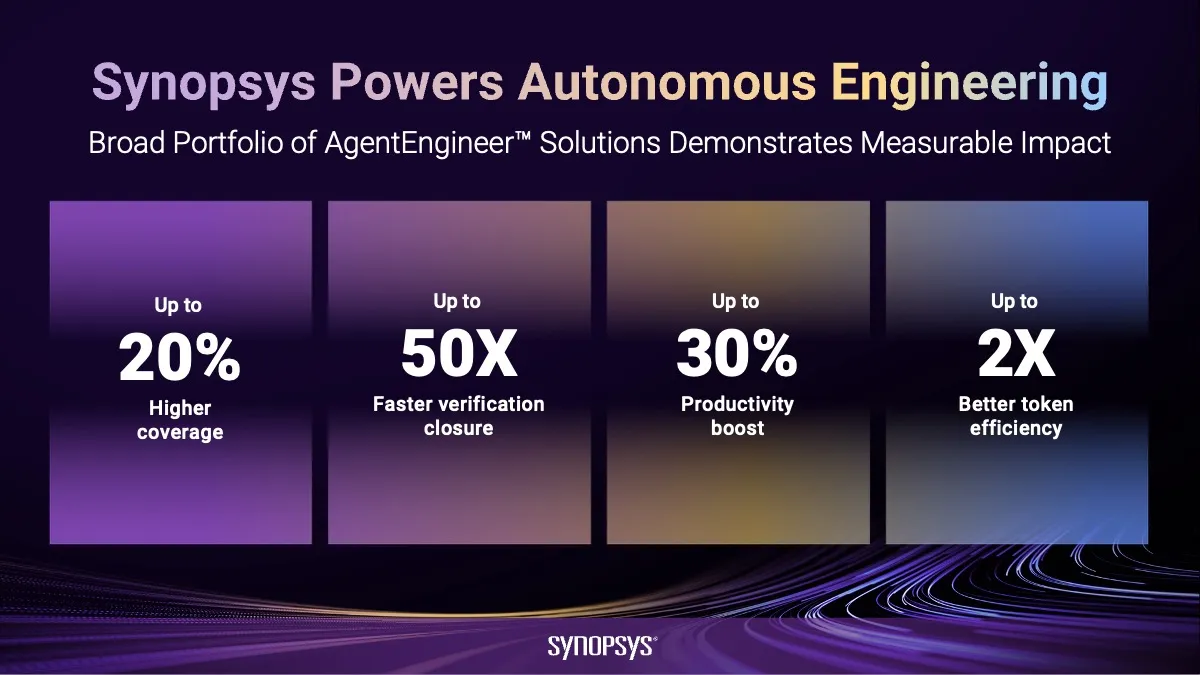
- Synopsys cites up to 50x faster verification closure, 20% higher coverage and 2x better token efficiency.
- AheadComputing and Fujitsu provided customer comments on the technology.
What Synopsys announced
Synopsys, Inc. (Nasdaq: SNPS) announced Synopsys AgentEngineer solutions on Sept. 28, 2026. The company says the agents cover verification, system validation, implementation, analog, manufacturing, and simulation and analysis domains. They are built on the Synopsys Autopilot Platform, which Synopsys describes as a comprehensive, open and secure foundation for autonomous engineering.
According to Synopsys, the agents help teams accelerate engineering productivity, improve design quality and reach faster closure on critical workflows, while optimizing token efficiency and reducing latency.
Ravi Subramanian, Chief Product Management Officer at Synopsys, said customers are "re-engineering their engineering workflows across semiconductor and systems products to keep pace with increasing system complexity and tight market windows." He said the portfolio helps them accelerate the shift from AI-assisted design to autonomous engineering, built on trusted EDA and simulation and analysis engines.
Long-horizon agents and task-level agents
The AgentEngineer solutions are long-horizon, domain-specific agents that sit in one unified platform environment. Alongside them, Synopsys offers task-level agents that apply its engineering expertise to targeted jobs. The company lists several examples:
- Autonomous coverage closure
- Software bring-up and validation
- Multi-die 3DIC assembly
- PPA closure
- Analog layout synthesis and design migration
- Mask synthesis
- Combustion, resonance and signal integrity
Synopsys says the two types of agents together enable autonomous execution of cross-domain tasks. It attributes their effectiveness to engineering context and workflow intelligence derived from its EDA and simulation and analysis ground-truth engines.
How the Autopilot Platform works
The Autopilot Platform provides orchestration, skills, memory, telemetry and governance for autonomous engineering workflows. Synopsys says it gives AI systems a trusted environment to coordinate activities, access design knowledge and execute actions while keeping enterprise-grade security and control. The company highlights four design points:
- Optionality: customers can choose among Synopsys, partner and third-party infrastructure, models, data, agents, workflows and ecosystem integrations, with security and data integrity preserved.
- Context intelligence: powered by Synopsys' cognitive model, it combines domain knowledge and tools, reusable skills and persistent memory to help agents interpret design intent.
- Security and data management: access controls, encryption and runtime guardrails protect the intellectual property of customers, partners and Synopsys.
- Efficiency: privileged APIs and reasoning over proprietary context are meant to deliver better results at significantly lower token cost and latency.
Customer results
Synopsys cites results from market leaders, including up to 50x faster verification closure, 20% higher coverage, a 30% productivity boost, and 2x better token efficiency, along with lower latency. These figures come from the company's announcement.
Alon Mahl, VP of Verification at AheadComputing, said the Synopsys Implementation AgentEngineer helped reduce manual engineering effort and accelerate design convergence, from RTL handoff through implementation, ECO and signoff. Toshio Yoshida of Fujitsu said his team achieved a 10, 30% productivity boost in RTL code generation with Synopsys Verification AgentEngineer capabilities, driven by efficient generation of SystemVerilog assertions, wrapper modules and parameterized modules, as well as code refactoring.
What it means for engineering teams
The announcement positions Synopsys' move from tools that assist individual tasks toward agents that handle whole workflows, from design through verification and systems development. For chip and systems teams under pressure from growing complexity and short market windows, the company argues this can shorten closure times. The open architecture is aimed at customers who want to mix Synopsys technology with their own or third-party models and tools. The reported results come from early engagements with customers and have not been independently verified.