Synopsys shows GPU speedups of up to 40x in EDA and simulation at GTC Berlin
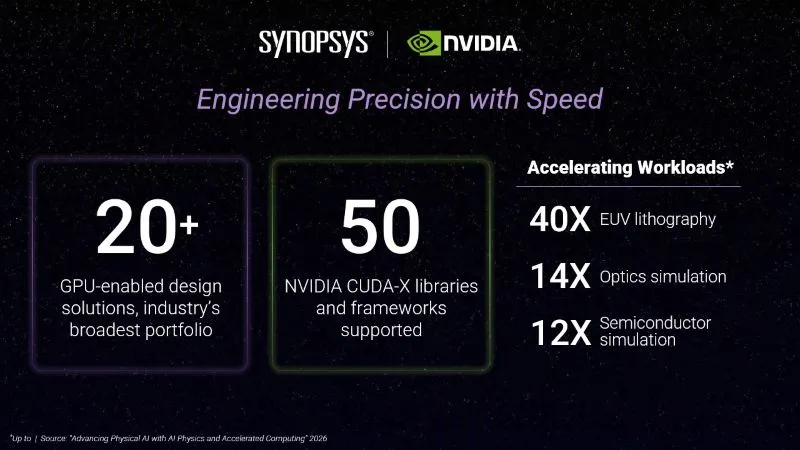
Synopsys is presenting more than 20 GPU-enabled EDA and multiphysics solutions at NVIDIA GTC Berlin, now supporting 50 NVIDIA CUDA-X libraries and frameworks. According to the company, customer results include a 12x speedup at Infineon and up to 40x at Imec.
- Synopsys shows more than 20 GPU-enabled EDA and multiphysics solutions at NVIDIA GTC Berlin and supports 50 NVIDIA CUDA-X libraries and frameworks.
- Infineon reports a 12x speedup in 3D breakdown simulation using Sentaurus Device with NVIDIA cuDSS.
- Imec benchmarks show up to 40x speedup for S-Litho using NVIDIA CUDA-X libraries.
- Ansys Speos on NVIDIA GPUs cut a lighting simulation from more than 4.5 hours to just under 19 minutes versus CPU.
- iPronics reports up to 13x solver speedup with Ansys Lumerical FDTD on NVIDIA H100 GPUs.
GPU-enabled portfolio and the speed versus precision tradeoff
Synopsys says it is attending NVIDIA GTC Berlin to showcase its portfolio of more than 20 GPU-enabled Electronic Design Automation (EDA) and multiphysics solutions. The company says it now supports 50 NVIDIA CUDA-X libraries and frameworks and is applying AI to speed up design and simulation analysis cycles.
The stated aim is to reduce the persistent tradeoff between speed and precision in product development. According to Synopsys, rising system sophistication and performance are driving higher compute requirements for engineering workflows. The company describes its partnership with NVIDIA as a foundation for accelerating physical AI, virtual prototyping, and silicon and system design.
Synopsys also says European engineering teams in automotive, aerospace, semiconductor and AI infrastructure are using its tools to move more development and validation into virtual environments. This is meant to widen design space exploration and shorten the wait for predictive insights into silicon and system performance.
Customer results in automotive, semiconductors and lighting
On the automotive side, Synopsys says it is now part of the NVIDIA Halos safety ecosystem and is integrating the newly announced NVIDIA Halos SAFE. The workflow is described as physics-based and traceable, spanning sensor simulation, virtualization, digital twins and safety analysis. Ansys AVxcelerate real-time sensor simulation supplies high fidelity stimuli for software-in-the-loop and hardware-in-the-loop testing, while Ansys medini connects synthetic ground-truth data to hazards and safety requirements in a structured safety case.
Several performance figures were released:
- T-Systems: using a FORVIA HELLA-approved automotive exterior lighting workload in T-Systems' sovereign Industrial AI Cloud, running Ansys Speos on NVIDIA GPUs cut simulation runtime from more than 4.5 hours to just under 19 minutes versus a CPU configuration.
- Infineon: using Synopsys Sentaurus Device with NVIDIA cuDSS, the power semiconductor company achieved a 12x speedup in 3D breakdown simulation for next-generation power devices.
- Imec: the research hub uses GPU-accelerated S-Litho in computational lithography workflows to model advanced DUV, EUV and High-NA EUV processes. Benchmarks on Imec's model show up to 40x speedup using NVIDIA CUDA-X libraries.
Photonics for AI data centers
Synopsys also highlights photonics work. iPronics is using Ansys Lumerical FDTD and NVIDIA H100 GPUs in an AWS cloud environment to develop photonic technologies for AI-scale data centers. According to Synopsys, it achieved up to 13x solver speedup compared with a 96-core CPU environment, and a 20-point edge-coupler parameter sweep dropped from approximately nine days to 18 hours.
Alcyon Photonics uses Ansys Lumerical to design photonic building blocks such as directional couplers and integrated subsystems for datacenter transceivers. Electromagnetic simulations and accurate foundry process models help the company analyze fabrication tolerances, alignment sensitivities and broadband optical performance, with the goal of greater tape-out confidence.
What it means for engineering teams
The figures are reported by Synopsys and its customers in the context of specific workloads, so they describe particular setups rather than general gains. They show where GPU acceleration is being applied: device simulation, lithography modeling, optical design and automotive sensor and lighting simulation.
For engineering teams, shorter simulation times can mean more design variants explored before committing to hardware. Synopsys is presenting at booth #7011 during NVIDIA GTC Berlin. The company also lists several NVIDIA announcements from the event that involve its collaborations, including the general availability of NVIDIA cuDSS.