Tripo AI Launches Agentic Canvas for Node-Based 3D Workflows
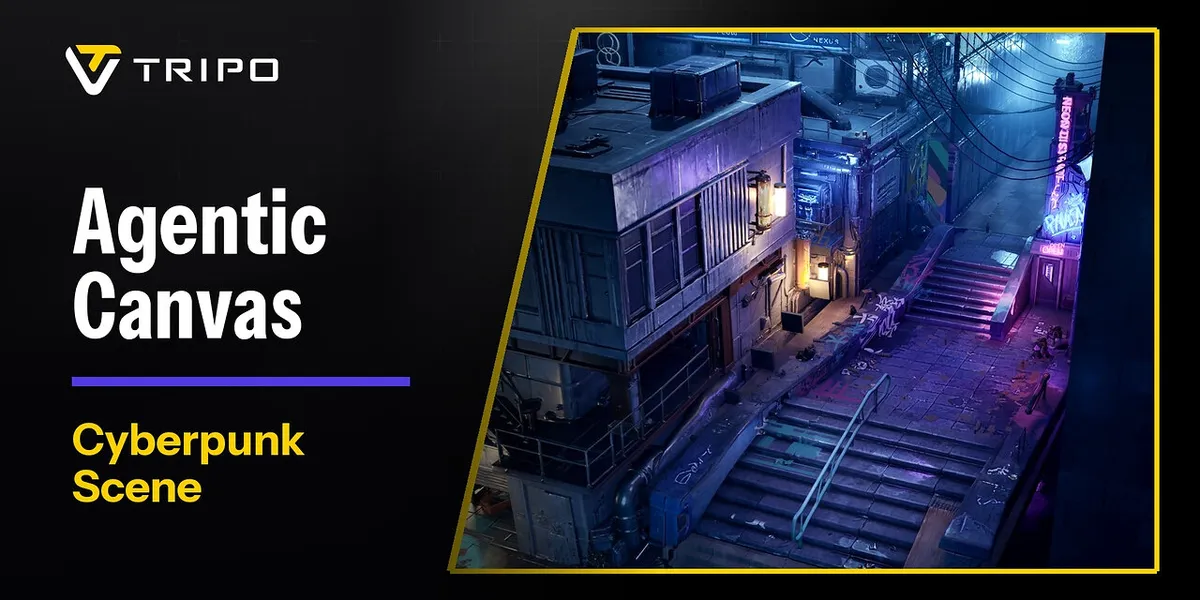
Tripo AI has launched Tripo Agentic Canvas, an AI agent that builds and runs 3D workflows on a visual, node-based canvas. According to the company, users can inspect, edit and reuse the workflows it generates.
- Tripo AI launched Tripo Agentic Canvas, an AI agent that builds 3D workflows on a node-based canvas.
- Nodes cover operations such as texturing, retopology, Smart UV, PBR processing, segmentation and rigging.
- Workflows can be inspected, edited, saved, duplicated, reused and applied to multiple assets through batch processing.
- An AI 3D Lab node offers conversational tools to refine assets and can turn conversations into reusable task instructions.
- Agentic Canvas expands Tripo Studio, and Tripo also offers an API for developers.
How Agentic Canvas works
Agentic Canvas turns ideas, reference images and existing assets into connected workflows, according to Tripo AI. The workflows link steps from 3D generation and asset refinement through to export. The company says the tool is built to make the best use of Tripo's 3D-native foundation models.
On the canvas, each node represents an individual operation, and connections pass the output of one step to the next. Users can add capabilities such as:
- texturing
- retopology
- Smart UV
- PBR processing
- segmentation
- rigging
These nodes can be connected into workflows tailored to a given project. Users can ask the agent to generate a workflow, then inspect the results, adjust individual nodes and refine the process.
Reusable workflows and the AI 3D Lab node
Workflows can be saved, duplicated and reused, and batch processing lets users apply them across multiple assets. Tripo says this goes beyond one-off asset generation: instead of rebuilding a workflow for every asset, users can adapt an existing one to keep results consistent across projects and asset sets.
The workspace also includes an AI 3D Lab node. It offers conversational tools for inspecting and refining specific assets, or for generating new results from upstream nodes. According to the company, it can also turn conversations into reusable task instructions.
Tripo describes the combination of AI assistance and visual control as a way to help new creators handle multi-step 3D tasks, while allowing professionals to scale repetitive production processes.
Target uses and place in Tripo's product line
Tripo lists game development, 3D printing, product design and e-commerce, film, animation, and visualization as supported areas. Example uses include producing game assets, preparing printable models, generating consistent product variations, and refining characters and props.
Agentic Canvas expands Tripo Studio, the company's platform for individual 3D generation and editing, by letting users connect tools into editable, reusable workflows. Tripo also offers an API for developers who want to integrate generative 3D capabilities into their own applications.
What it means for 3D creators
The launch shifts Tripo's offering from creating single assets toward building processes that can be customised and scaled across projects, in the company's own framing. For newcomers, the agent is meant to lower the barrier to multi-step 3D work. For professional teams, the saved and batch-capable workflows target repetitive production tasks where consistency matters. The source does not give pricing or availability details.
PR Newswire: Tripo AI Unveils Agentic Canvas to Make AI 3D More Accessible and Scalable