TypeSafe's Jev Model Turns AI Into a Typed, Smart 'If Statement' for Code

TypeSafe's Jev is an AI decision model for classification, scoring and routing that returns typed answers software can use directly, instead of text that code has to parse. At a hackathon hosted by CodeRabbit and TypeSafe in San Francisco, TypeSafe's Allie Laabs explained how developers should think about it.
- TypeSafe's Jev returns typed answers (a choice, a score or a yes/no probability) instead of text that code must parse.
- TypeSafe lists the price at $0.042 per million input tokens, with output free, and reports response times of 70 to 500 milliseconds.
- According to Vercel, nearly 13% of paid AI Gateway teams used Jev within 24 hours of the September 15 early access launch.
- TypeSafe's cookbook found batching 13 questions into one call was 12.2 times cheaper and 10 times faster than asking one at a time.
- TypeSafe warns that injected or argumentative text can move Jev's answer, so untrusted input needs checking.
A model that skips the text step
Jev is built for cases where a program needs a decision, such as which queue a support ticket belongs in. The usual approach, Laabs said, is to turn the program's state into a prompt, let a model write text, and then parse that text back into a value the code can branch on. "We started in machine space and we ended in machine space," she said, "yet we did this extremely expensive bridge through text and through a human interface layer. Why?"
With Jev, developers send a state, such as a ticket, a transaction or a tool call, along with typed questions. According to the CodeRabbit write-up, it returns one of three answer types:
- Choice: one option from a list you define, plus a probability for every option and a confidence value.
- Score: a rating on a rubric you define, plus a probability for every point on the rubric and a confidence value.
- Yes/no probability: a probability between 0 and 1 that a statement about the state is true.
Because the answer is typed, the model cannot reply with an option the developer did not allow. TypeSafe lists the price at $0.042 per million input tokens, with output free, and reports response times of 70 to 500 milliseconds. These are vendor figures, and the source notes that the company's latency tests ran close to its West Coast servers.
Fast early adoption
TypeSafe is a lab of about 20 people. It opened early access to Jev on September 15. According to Vercel, nearly 13% of paid AI Gateway teams were using it within 24 hours, which Vercel described as the fastest adoption of any model in the gateway's history. TypeSafe founder Diogo Almeida told VentureBeat that the company cleared 140,000 people from the waitlist in the first 36 hours. By September 20 the waitlist was gone, and new accounts came with $5 in free credit.
Laabs called the launch "one of the most bizarre experiences of my entire life." The hackathon took place eleven days after launch and drew more than 160 builders, who spent about four hours working with the model.
Where Jev fits in an application
Laabs described Jev as a category-creation product, not a better LLM and not a replacement for one. She offered two ways to approach it. The first is direct: "If you have a classification-shaped problem in your software and you're using LLMs to do it, Jev is almost certainly a better drop-in." That covers sorting emails, categorizing financial transactions and scoring anything on a scale.
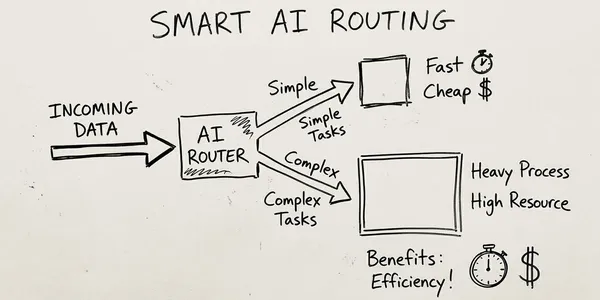
The second asks developers to think like programmers again, in terms of switch statements, if/else branches and routing decisions. Laabs described Jev as "a smart if statement or a smart switch statement … an intelligence-infused logic gate." For people who build with coding agents, she suggests sketching a flowchart of the application's behavior and asking at each branch whether the condition could be defined mathematically. If a branch is more of a gut feeling, "That's probably a spot where Jev could work."
Ask every question in one call
One technique Laabs highlights is speculative prompting, which TypeSafe calls speculative fan-out. Instead of calling an API only when an answer is needed, developers send every question they might need in a single request, including ones that matter only if another answer comes back a certain way. In a support ticket example, a developer would ask whether it is a billing ticket and whether it is a refund request at the same time.
This works, according to the source, because Jev answers all questions in parallel and independently against the same state. An extra question adds a few cheap input tokens and almost no latency, while a second call means resending the whole state and waiting for another round trip. In TypeSafe's parallel questions cookbook, batching a 13-question briefing into one call was 12.2 times cheaper and 10 times faster than asking one question at a time, and the answers did not change.
Coding agents do not do this by default, Laabs said. After a first pass, she tells the agent to bundle calls that send the same state to the TypeSafe API. She expects the problem to fade as decision models enter training data, but "right now we really need to hold the agent's hands."
Turning the habit into a review rule
CodeRabbit, which published the account, suggests encoding that habit as a code review rule using path instructions. Its example flags code that sends the same state to the TypeSafe API in separate calls, checks that low-confidence Jev answers have a fallback path, and flags untrusted text that reaches the Jev state for a decision that authorizes an action.
The last rule reflects a warning from TypeSafe's known-limitations page for Jev 1.13, which says injected instructions or text written to argue for its own classification "can move the answer." For developers, the takeaway from the source is that a cheap decision is still a decision, and the inputs feeding it need checking.
CodeRabbit: The Merge: What if your ‘if-statements’ could think?