UChicago and Caltech conference highlights AI’s expanding role in science
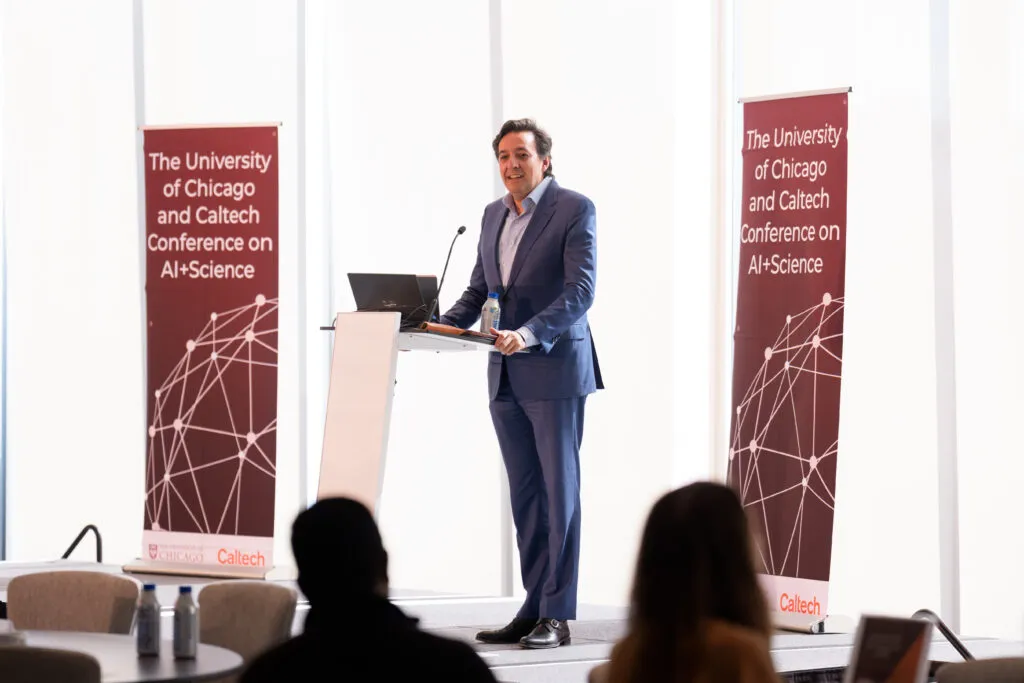
A three-day University of Chicago and Caltech conference brought researchers and leaders from academia, government, industry and philanthropy together to examine how AI is changing scientific discovery. The event also saw the announcement of a new computing network and a major Schmidt Sciences grant for UChicago.
- UChicago and Caltech hosted a three-day AI+Science conference.
- Schmidt Sciences announced a major grant and the Schmidt Science Computing Network.
- UChicago’s AI4S platform will support research across multiple scientific fields.
- The 2026 Pritzker Prizes recognized work in materials design and antibiotic discovery.
- Next year’s conference is planned for Pasadena.
New computing support for scientific AI
The University of Chicago, Caltech Conference on AI+Science included researchers from the two host institutions, Harvard, MIT, Stanford and other organizations. During the gathering, UChicago President Paul Alivisatos and Stuart Feldman, president of Schmidt Sciences, announced the Schmidt Science Computing Network and a major grant from Schmidt Sciences to establish UChicago’s AI for Science, or AI4S, platform.
According to UChicago, the initiative will significantly expand computing capacity for scientific AI research. Its areas of focus include climate and weather forecasting, ecology and biological systems, astronomy, quantum research, chemistry, AI-enabled instrumentation, and work at the intersection of AI, human reasoning and creativity.
“Access to compute is a key to universities making breakthroughs in AI and science,” Alivisatos said. Feldman said the network would pair advanced computing with expert support and durable software, helping researchers work at new scales.
Why universities remain central to AI-enabled science
In opening remarks, Rebecca Willett, the Worah Family Professor of Statistics and Computer Science and faculty director of AI at the Data Science Institute, said AI is reshaping almost every field of science and engineering. She urged researchers to direct these tools toward established scientific questions while also discovering questions that researchers have not yet considered.
Willett pointed to DeepMind’s AlphaFold method for protein structure estimation as an example of progress built on public data, academic ideas and university-trained researchers. UChicago’s Jinbo Xu and his group at the Toyota Technological Institute at Chicago pioneered deep-learning methods for protein contact prediction that AlphaFold’s developers later cited. John Jumper, who received his Ph.D. in theoretical chemistry at UChicago, later joined DeepMind.
The conference’s discussion of academia’s role included testable hypotheses, foundational research, open datasets and benchmarks, methods for identifying where AI tools can fail, startup creation and training the next generation of scientific AI researchers. Alivisatos said students, trainees and postdocs should learn to think “with AI, without AI, and about AI.”
Shared challenges across scientific fields
Speakers described problems that recur across disciplines. In many cases, the difficult step is defining the question, whether researchers are studying functional groups in complex microbiomes, modeling human vision or extracting mechanistic insight from data-driven weather models.
Other talks treated measurement as a design problem. AI and new instruments are changing what scientists can observe, from images of the hidden universe and large-scale cosmic surveys to digital twins of biological systems. Where data are scarce, speakers argued that physical models can help fill the gap.
Darío Gil, the Department of Energy’s Under Secretary for Science, said AI-enabled research had increased the number of known protein structures from roughly 200,000 to 200,000,000 in only a few years. “That is not an incremental improvement,” Gil said. “That is a change in what science can see.” He linked the example to the DOE’s Genesis Mission, organized around science and technology challenges, platforms such as computing and autonomous laboratories, and investment in scientists working across AI and the physical and life sciences.
Research prizes and the next conference
The conference also announced the 2026 Pritzker Prizes for AI in Science Research Excellence. Kristin Persson of the University of California, Berkeley, received a prize for work in data-driven materials design. A team prize recognized Regina Barzilay and James J. Collins of MIT for the Antibiotics-AI Project, which applies deep learning to antibiotic discovery and drug design.
The event’s organizers said the gathering reflected a shared interest in partnerships across government, philanthropy and industry. Caltech professor Anima Anandkumar concluded by looking ahead to next year’s convening in Pasadena, describing it as “a fitting next chapter” for the partnership.
UChicago Data Science Institute: UChicago-Caltech Conference Examines the Expanding Frontiers of Scientific AI