Ultralytics releases Construction-PPE dataset for detecting missing safety gear
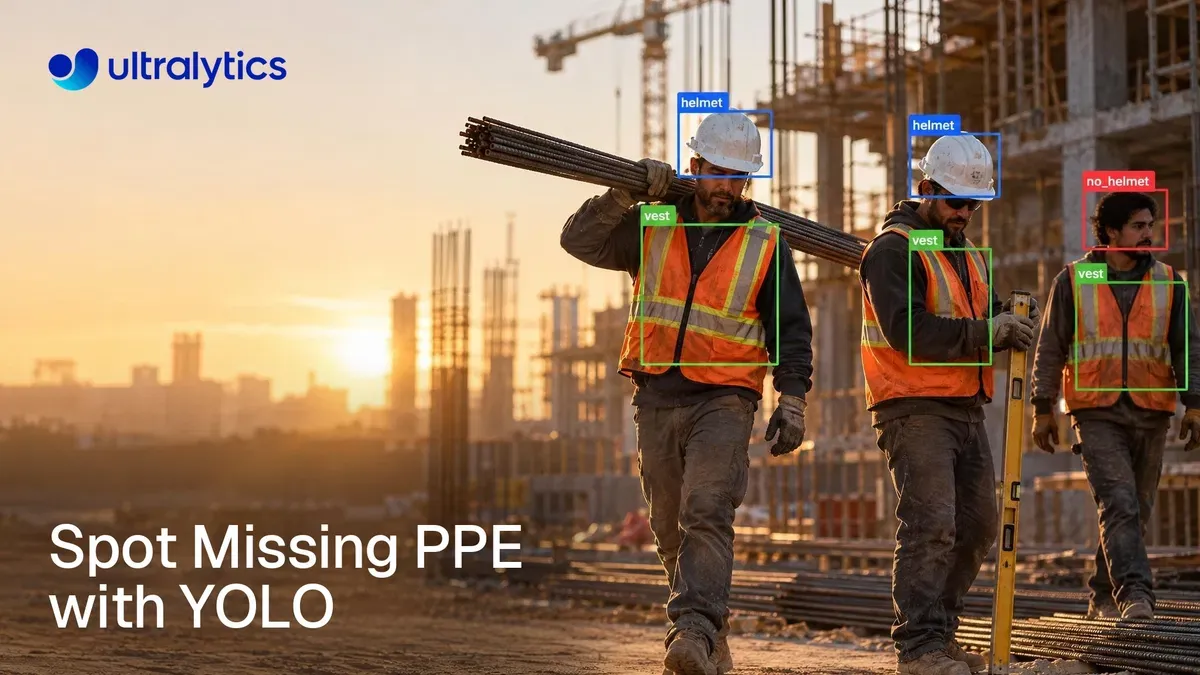
Ultralytics has released Construction-PPE, an open dataset of 1,000 images and 14,863 reviewed bounding boxes that teaches object detectors to spot both protective equipment and its visible absence. The dataset shipped on November 3, 2026, in Ultralytics 8.4.200, and the company has published a guide on training YOLO26 models with it.
- Ultralytics released the Construction-PPE dataset on November 3, 2026, in Ultralytics 8.4.200.
- It has 1,000 images, 12 classes and 14,863 reviewed bounding boxes, under CC BY 4.0.
- Missing-equipment boxes mark only visible body parts, so occluded or out-of-frame heads or hands get no violation label.
- The split is a fixed 800/200 train/validation with no test split, and some images are generated.
- Ultralytics recommends per-class validation and testing on footage from the user's own cameras.
What the dataset contains
Construction-PPE is an original object detection dataset for construction and industrial sites, created and open-sourced in November 2026 by the Ultralytics team. According to the company, the images cover construction sites, workshops, warehouses, loading areas and maintenance work, with varied viewpoints, lighting, worker arrangements and forklift activity.
- Size: 1,000 images and 14,863 bounding boxes across 12 classes
- Split: a fixed 800/200 train/validation split, with no separate test split
- Format: bounding boxes in Ultralytics YOLO format, ready for training without conversion
- Images: human-collected and generated images in landscape, portrait and square compositions
- Annotation: expert human annotation combined with AI auto-annotation, reviewed by the Ultralytics team
- License: Creative Commons Attribution 4.0 International, which permits commercial use with attribution
Ultralytics points out that generated images are not photographs of real events. For that reason, it says, the final test of any model trained on the data belongs on footage from the user's own cameras.
Twelve classes, with a missing partner for each piece of equipment
The classes fall into three groups: five equipment classes, five missing-equipment classes, and two classes for people and vehicles. The equipment classes are helmet, gloves, vest, boots and goggles. Their counterparts are no_helmet, no_gloves, no_vest, no_boots and no_goggle. The remaining two are Person and forklift.
Ultralytics says this pairing gives the model direct examples of what absence looks like. A bare head or an unvested torso becomes its own detection, so application code does not have to infer a violation from a box that is missing.
Label only what the camera can see
The central design choice is how the missing-equipment classes are defined. Ultralytics argues that if annotators boxed every head without a visible helmet, including heads hidden behind beams or cut off by the frame edge, the model would learn that occlusion itself means a violation. In the company's words, a head hidden behind a steel beam is not a missing helmet.
One rule applies to all five missing classes: the box marks the visible body region where the equipment should be, and an occluded or out-of-frame body part does not by itself establish missing equipment. In practice, no_helmet goes on a visible head with no helmet, no_gloves on a visible bare hand, no_vest on a visible torso without high-visibility clothing, no_boots on a visible foot without protective work footwear, and no_goggle on a visible eye region without protective eyewear. Equipment classes box the item itself, so a vest and the person wearing it are separate boxes.
Ultralytics notes that teams extending the dataset with their own camera images should label them by the same rule. Otherwise, it says, the model receives two conflicting answers to the same question.
Training and validating a YOLO26 model
The guide shows training with the Ultralytics Python package, which downloads and extracts the dataset archive on first use. The example starts from the COCO-pretrained yolo26n.pt model and trains for 100 epochs at an image size of 640. A one-line CLI command does the same. Ultralytics calls YOLO26n a sensible first run for checking the pipeline, but advises comparing a larger size such as YOLO26s or YOLO26m, because gloves, goggles and boots are small objects at site-camera distances.
Users who prefer no code can clone the dataset on Ultralytics Platform, start cloud training with a YOLO26 model and choose epochs, image size and GPU in the browser. According to the guide, the Platform tracks loss curves, precision, recall and mAP per epoch and lets users compare runs. A Colab notebook is also available for training on a free browser GPU.
On evaluation, the guide warns that a single mAP number can hide weak spots. A model might find people, helmets and vests reliably while missing most no_gloves or no_goggle cases. It recommends checking per-class metrics, reading the missing-equipment rows first and opening the confusion matrix saved during validation. If helmet and no_helmet are confused, or a missing class is rarely detected, the guide suggests inspecting the missed images and counting how many instances of that class the training split contains.
Vehicles, people and what it means for site safety teams
Because the dataset includes a forklift class alongside Person and no_vest, one YOLO26 model can return forklift, person and unvested-torso boxes for a loading bay in a single pass. Ultralytics stresses that turning those boxes into a safety event is application logic: matching each no_vest box to the right person, deciding what counts as near the forklift, and setting how long a condition must persist. Real-world distances, it adds, need camera calibration.
For teams building PPE monitoring, the release offers a commercially usable starting point with a clear labeling convention. The limits are stated in the source: the 200 validation images come from the same collection as the training set, there is no test split, and some images are generated. Ultralytics advises collecting an independent set from the cameras a system will actually run on and validating on that before deployment.
Ultralytics: Missing PPE detection: train Ultralytics YOLO on Construction-PPE