Vercel adds Virtual Models to AI Gateway to swap AI models without redeploys
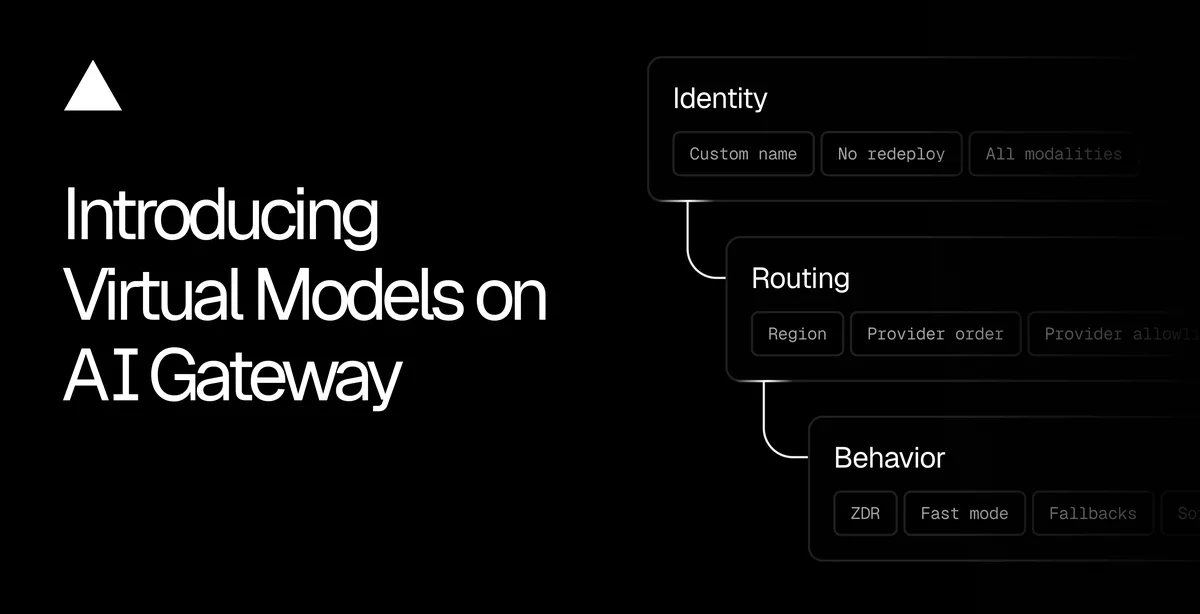
Vercel has introduced Virtual Models on AI Gateway, a feature that lets teams swap the model behind a task from a central place instead of editing code. According to Vercel, apps and agents pick up the new configuration automatically, without code changes or redeploys.
- Vercel launched Virtual Models on AI Gateway, letting a single ID such as vmc/coding-agent stand for a model and its settings.
- Changing the model or settings in AI Gateway needs no code changes or redeploys; Vercel says apps pick it up within a few minutes.
- Settings on a virtual model override request settings, including fallbacks, provider order and Zero Data Retention.
- Tags on a virtual model replace request tags, and a Virtual Models page shows requests, spend and success rate per task.
- Virtual Models work with every model type on AI Gateway and can be created from the dashboard or the Vercel CLI.
One ID for a task, configuration kept in AI Gateway
Vercel describes a virtual model as an abstraction of the model string and configurations that apps and developers use. A team creates an ID for a task, such as vmc/coding-agent, and then sets the model and the settings it should use. The ID is passed as the model string wherever the task is called, and the configuration applies everywhere that ID is used.
The company points to the pace of model releases as the reason. In the last 90 days, 125 new models from more than 10 labs became available on AI Gateway, which Vercel says adds up to about 10 a week. AI Gateway already made switching a one-line change, but that line still lives in application code, so a switch usually means a redeploy. Virtual Models move that choice out of the code.
In Vercel's example, a team creates the virtual model with the Vercel CLI, pointing it at anthropic/claude-opus-5.5 with a config that sets speed to fast and turns on Zero Data Retention. Later, the same virtual model can be edited to point at openai/gpt-6.1-sol. Vercel says every app and agent that calls the ID picks up the change within a few minutes.
A purpose-built model for each task
Vercel argues that different tasks have different needs. Support ticket triage can run hundreds of times an hour and needs to be cheap. Legal contract review may run only a few times a day but requires a high level of reasoning. Each can now have its own virtual model that evolves over time.
Settings such as fallbacks, Zero Data Retention and tags stay with the virtual model when the underlying model changes. Provider options work differently: they apply per provider, so an Anthropic-specific setting stops applying when the virtual model is pointed at an OpenAI model. Vercel advises reviewing provider options whenever a team switches providers.
For production traffic, the company suggests creating a second virtual model, for example vmc/coding-agent-candidate, pointing it at the new model and running evals against it. If quality drops after the switch, the original can be pointed back at the previous model.
Coding agents are a named use case. Vercel says tools such as Claude Code and Codex can be connected with vercel ai-gateway setup, after which the virtual model is selected in each agent's model picker or configuration. According to the changelog, this also allows teams to set reasoning effort, fast mode, prompt caching and other options even when the agent does not expose them.
Central governance and spend tracking
Anyone on a team can call a virtual model, while team roles control who can change it. Vercel says this lets platform and security teams govern and test models and settings centrally, while still giving other teams access to new models as they are released.
Settings on a virtual model take precedence over the same settings in a request. Callers cannot override the provider order, fallbacks or service tier that were chosen. If a virtual model requires Zero Data Retention or providers that do not train on request data, those requirements are enforced even when a request explicitly sets zeroDataRetention or disallowPromptTraining to false.
Tags on a virtual model replace any tags sent with the request, so spend is attributed to the task regardless of how each app tags its calls. A Virtual Models page shows requests, spend and success rate for each task.
Availability and what it means for teams
Virtual models can be created from the team dashboard or with the Vercel CLI. In the dashboard, a user opens the Virtual Models page, clicks Create Virtual Model, enters a slug, chooses the underlying model, configures settings and saves. To use one, a developer replaces the provider model ID in AI SDK or compatible API requests with vmc/<slug>.
According to Vercel, Virtual Models work with every model type on AI Gateway, including image, video, speech, embedding and realtime models, as well as with the AI SDK and the OpenAI- and Anthropic-compatible APIs.
AI Gateway provides a unified API for calling models, tracking usage and cost, and configuring retries and failover. Vercel says it reflects provider pricing with no markup and charges no platform fee on inference, including on Bring Your Own Key requests.
For teams running several agents and apps, the practical effect described by Vercel is that model choice, failover and data-retention rules can be managed in one place and changed without shipping new code.
Vercel: Introducing Virtual Models on AI Gateway
Vercel: Virtual models now available on AI Gateway