Vercel launches Security Review in public beta to scan every GitHub push
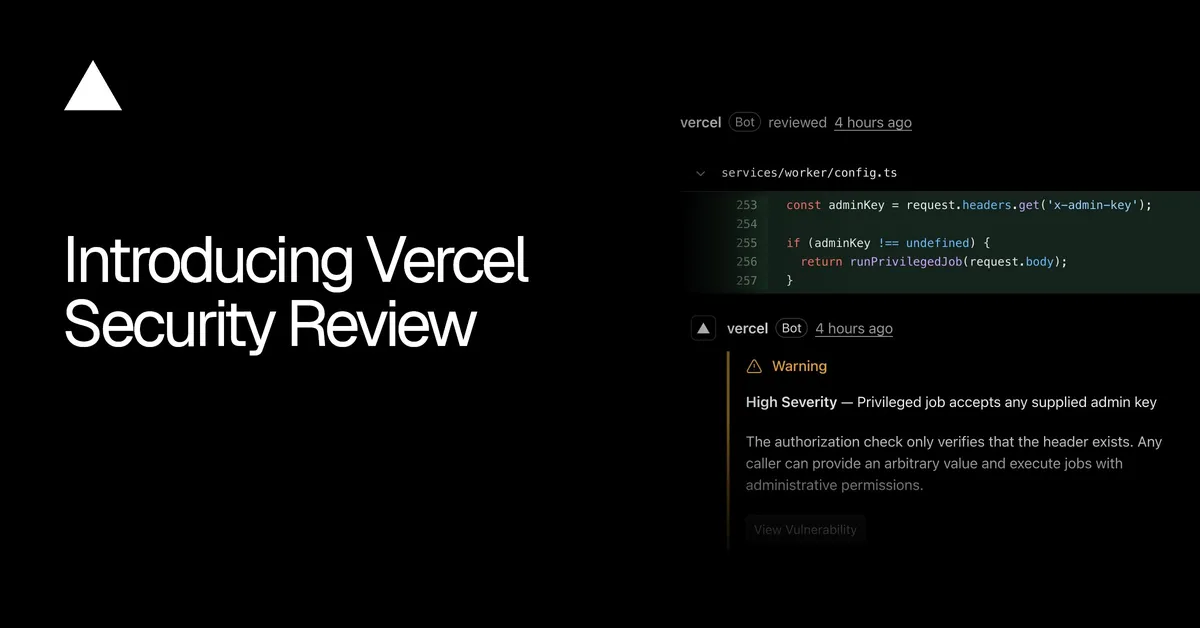
Vercel has launched Security Review in public beta, a new capability in Vercel Agent that scans for vulnerabilities on every push to a team's connected GitHub repositories. Findings appear as pull request comments, in the Security dashboard and via the CLI, and with permission the agent can validate and push fixes.
- Vercel Security Review is in public beta for Pro and Enterprise teams and scans every push to connected GitHub repositories.
- Reviews cover only the diff, which Vercel says lets them finish in seconds and run on every preview and production deployment.
- Teams can write security policies in plain language and apply them per project or team-wide.
- Findings appear in the Security dashboard, on pull requests and via CLI, and Vercel Agent can validate and push fixes with permission.
- Security reviews are free until November 10, 2026, then billed at the Vercel Agent rate plus $0.25 per million tokens.
How Security Review works
Security Review sits in Vercel Agent alongside Code Review and Investigation. According to Vercel, reviews are triggered by GitHub push events, including direct pushes to a production branch. In monorepos, a review is scoped to the project's root directory.
When a push lands, the tool scans the changed code for issues such as missing authorization checks or exposed secrets. Findings go to the Security dashboard. On private and internal repositories, Security Review also adds a GitHub check to the commit and comments on the pull request.
Each review compares the push against a base and covers only what changed. For deployments, the base is the branch's previous deployment. Because it scans only the diff, Vercel says the review finishes in seconds and can run on every preview and production deployment.
The agent reads the diff along with the surrounding code, traces how the changed code can be reached, checks for existing protections and rechecks each finding before reporting it. Vercel says this process lets it catch logic flaws such as missing authorization checks, which pattern-matching scanners miss.
Policies, tracking and fixes
Teams can write security policies in plain language and apply them to specific projects or across the whole team. One example from Vercel: a policy can require any endpoint that returns customer data to check that the requester owns it. Policies can also be managed with the Vercel CLI using vercel security policy.
New findings are checked against those already reported, so the same issue is not flagged twice. Each finding is tied to the deployment where it first appeared. If a vulnerable change from a pull request is merged into the production branch, the finding is flagged in production as well. When a later review no longer detects the issue, it is marked as no longer detected in the dashboard and the GitHub comment is closed.
Every finding explains the vulnerability and how to fix it, with links to the commit and deployment where it first appeared. Each new finding also generates an audit log event, which Enterprise teams can send to their SIEM through Audit Log Drains.
In the dashboard, clicking Fix with Vercel Agent makes the agent confirm the vulnerability still exists, then make the smallest change that fixes it and update the tests. Vercel gives the example of an invoice download endpoint that does not check which organization an invoice belongs to, letting any signed-in user download another organization's invoice by changing its ID. The proposed fix scopes the lookup to the user's organization.
Teams that prefer their own coding agent can pull findings with vercel security vulnerabilities, or copy finding details as Markdown or JSON.
Why Vercel is building it and what comes next
Vercel argues that frontier AI models are making vulnerabilities far easier to find and exploit. It points to researchers who last month turned two decade-old flaws in PHP core into working remote code execution exploits with relatively little effort. At the same time, agents are writing more of the code teams ship, and each handles security review in its own way, or in many cases not at all.
Security Review currently starts with code pushed to GitHub. Vercel says it plans to bring it to deployments from the Vercel CLI and v0, and to repositories that do not deploy on Vercel. It is also working on suggested fixes that can be applied directly from the pull request.
Availability and pricing
Security Review is available in public beta for Pro and Enterprise teams. To start, enable it in Vercel Agent Settings, then choose to run it on all projects or only selected ones.
It is billed at the Vercel Agent rate, with model tokens at the provider's rate and no markup, plus $0.25 per million tokens. Security reviews are free until November 10, 2026. Fixes made with Vercel Agent are billed at the same rate.
Vercel: Introducing Vercel Security Review